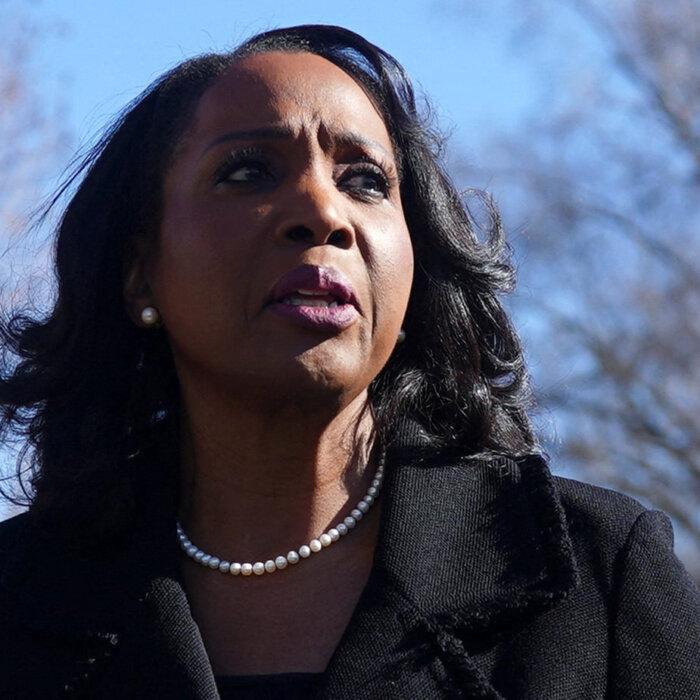
The Supreme Court has blocked President Donald Trump’s removal of Federal Reserve Board member Lisa Cook, marking a tentative loss for the administration as litigation unfolds in lower courts.
In an opinion on June 29, the court rejected Trump’s arguments that he could avoid judicial review of the firing.
The ruling was made months after oral arguments on Jan. 21, when the justices seemed reluctant to allow Cook’s removal. A federal judge reinstated Cook last year on the basis that Trump didn’t give her a notice and hearing before removing her.
In a 5–4 decision, the court said that “Cook was entitled to notice and some opportunity to respond before her termination.”
Trump maintained that he followed the terms of the Federal Reserve Act, which allows presidents to remove members “for cause.”
Chief Justice John Roberts wrote the majority opinion, stating that the president had misinterpreted his power.
“The Government raises three alternative arguments: that a removal for cause under the statute is not judicially reviewable; that even if the removal is reviewable, cause is a low bar satisfied by any concerns about a Governor’s conduct, ability, fitness, or competence; and that even if the Government did not show cause to remove Cook, she is nevertheless not entitled to remain in office while litigation over the removal is pending,” he said.
“We disagree on all three points.”
He added that accepting Trump’s arguments would turn the “for cause” protection into “at-will employment,” which was “out of step with the statute Congress enacted and our Nation’s tradition of central banking protected from political interference.”
Justices Clarence Thomas, Samuel Alito, and Amy Coney Barrett filed dissenting opinions. Alito’s was joined by Justice Neil Gorsuch.
Trump indicated he would continue to fight the issue.
“The Cook Lawsuit, having to do with her suitability in sitting on the Board of the Federal Reserve, was sent back by the Supreme Court on a strictly procedural basis, we will take appropriate action immediately to make sure that someone who has committed wrongdoing will not be making vital decisions concerning the Welfare of the United States of America!” he said on TruthSocial.
Cook has denied wrongdoing.
Cook praised the decision in a statement provided to The Epoch Times.
“Today’s ruling affirms a principle that has underpinned sound economic stewardship for generations: that the Federal Reserve must make all its policy decisions guided by evidence and independent judgment, free from political interference,” she said.
She added that she was “grateful for this decision, not for my own sake, but for the sake of the American people, whose economic well-being depends on a central bank that answers to its mission, not political intimidation.”
The effect of the court’s decision was to reject Trump’s attempt to fire Cook as litigation in a lower court proceeded.
A federal judge held that Cook’s due process rights were likely violated because she had a property interest in her position. The ruling was based on the Fifth Amendment, which states that “no person shall … be deprived of life, liberty, or property, without due process of law; nor shall private property be taken for public use, without just compensation.”
In Thomas’s dissent, he disagreed that Cook’s position was her property.
“Cook’s office was not her ‘property’ because, in this country, government officials do not own the public offices in which they serve,” he said. “Apparent mortgage fraud was a ‘cause’ to remove Cook.”
Alito, joined by Gorsuch, criticized the way the court handled the case, which was brought on its emergency docket.
“The Court departed from its normal practice and ‘deferred’ ruling on this application, bringing proceedings in the lower courts to a 9-month standstill,” he said.
When the court considers cases on the emergency docket, it weighs various factors to determine whether to halt the effect of a lower court opinion.
One of those is how much “irreparable harm” might be done to the litigants as the case proceeds through the court system. Barrett focused on this aspect in her opinion, stating, “We have repeatedly found that the President suffers irreparable harm when he is barred from firing a subordinate.”
Andrew Moran contributed to this report.
Correction: A previous version of this article misstated the vote count in the Supreme Court’s decision. The Epoch Times regrets the error.