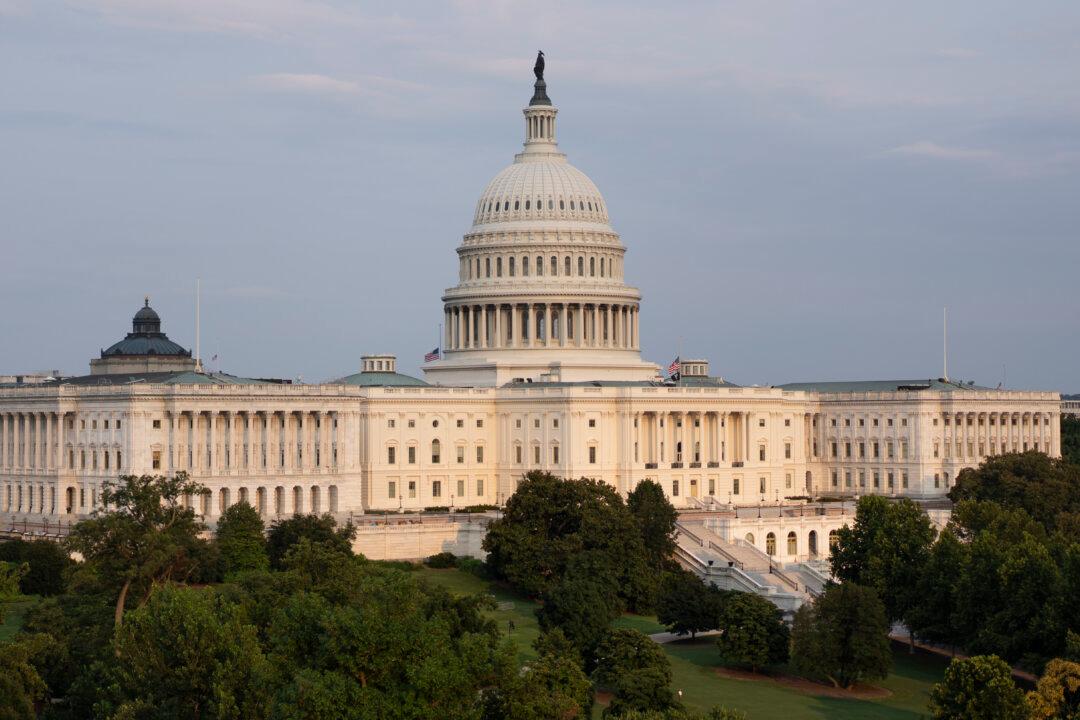
WASHINGTON—The Senate on June 23 passed a resolution seeking to prevent U.S. forces from engaging in further hostilities with Iran unless they are first authorized by Congress.
Senators voted 50–48 in favor of a Democrat-led concurrent resolution to constrain President Donald Trump’s ability to make war against Iran. The resolution was previously passed in a vote in the House of Representatives on June 3.
Its passage marks the first time both chambers of Congress have adopted a war powers resolution since the War Powers Act was enacted in 1973.
It offers a symbolic rebuke of the military campaign Trump launched against Iran on Feb. 28, but lacks clear legal enforceability without the president’s signature.
The 1973 law does not require the resolution to go to the president’s desk for a signature. A 1983 Supreme Court decision held that the measure must be sent for a president’s signature or veto to have legal effect.
The Trump administration has maintained that the War Powers Act is unconstitutional and therefore not binding.


The June 23 war powers vote also comes days after the Trump administration enacted a memorandum of understanding with Iran, which included an immediate ceasefire and continuing negotiations for a longer-lasting diplomatic resolution to the current standoff.
Trump took aim at the Senate’s passage in a Truth Social post, saying that the move was “poorly timed and meaningless.”
“These Senators have just made my job more difficult, but I will get it done, one way or the other, because I always get it done,” the president wrote.
Democrats had led several previous attempts to pass a war powers resolution concerning the Iran conflict but had not managed to gather enough votes for it to pass in the Republican-controlled Senate.
“We’re once again going to put Republicans on record on whether they want his disaster, Trump’s disastrous war, to continue by forcing a vote,” Senate Minority Leader Chuck Schumer (D-N.Y.) said at a news conference ahead of the vote on the afternoon of June 23.
Sens. Rand Paul (R-Ky.), Susan Collins (R-Maine), Bill Cassidy (R-La.), and Lisa Murkowski (R-Alaska) voted in favor of the Democrat-led war powers resolution.
Sen. John Fetterman (D-Pa.) voted to join with the majority of Republicans who voted against the resolution.
Sens. Mitch McConnell (R-Ky.) and Dave McCormick (R-Pa.) did not vote.
Trump is set to meet with Senate Republicans on June 24, when he may address concerns from within his party about the recent memorandum of understanding with Tehran.
Last week, Senate Armed Services Committee Chairman Roger Wicker (R-Miss.) told Reuters that he is concerned that the framework Trump entered into “negotiates away” U.S. military successes against Iran and unduly constrains Israeli military operations in Lebanon.
In a June 17 post on X, Cassidy also criticized the memorandum as not doing enough to curb Iran’s nuclear program while reducing military and economic pressure against Tehran.
“Before the war, the strait was open, Iran was being crushed by sanctions, and 13 service members were still alive,” Cassidy wrote. “Now, 13 Americans are dead, families have paid billions at the pump, sanctions will be lifted, and the bombing has stopped. This is the worst foreign policy blunder in decades.”
Trump has defended his handling of the Iran conflict and his decision to enter into the memorandum of understanding, which sets an initial 60-day window for continued negotiations.
“We didn’t meet out of desperation, Iran did,” Trump wrote in a June 19 post on Truth Social. “They are FINISHED! We’ll play out the 60 days. They get no money, not ten cents!”
Trump has repeatedly threatened that military action could resume if Iran violates the current framework for negotiations. Large numbers of U.S. forces also remain in the Middle East, postured to potentially resume operations.
Sen. Roger Marshall (R-Kan.) voiced support for the deal in an interview with KCMO Radio, saying that Trump chose “a path to lasting peace—not another forever war.”