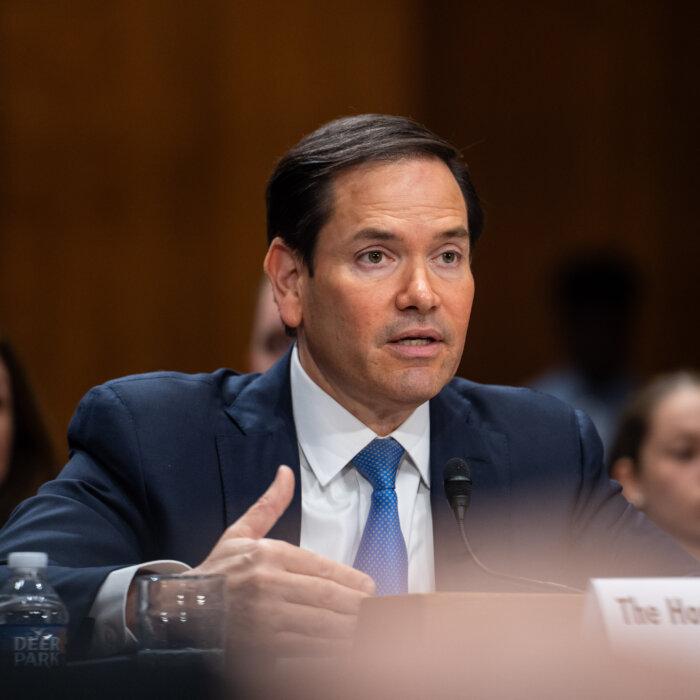
Secretary of State Marco Rubio announced on May 28 new visa restrictions against foreign nationals involved in censoring the speech of U.S. citizens.
“Today, I am announcing a new visa restriction policy that will apply to foreign officials and persons who are complicit in censoring Americans. Free speech is essential to the American way of life—a birthright over which foreign governments have no authority.”
Rubio said foreign nationals involved in suppressing the rights of Americans shouldn’t be allowed to visit the United States.
“Whether in Latin America, Europe, or elsewhere, the days of passive treatment for those who work to undermine the rights of Americans are over,” he said.
The Epoch Times reached out to the State Department for more details about Rubio’s reasons for adopting this new policy position. The department did not immediately respond to the request for comment.

Trump Media & Technology Group, which operates Truth Social, and the video-sharing platform Rumble have recently challenged an order issued by Brazilian Supreme Court Justice Alexandre de Moraes directing the U.S. media companies to remove accounts belonging to a prominent supporter of former Brazilian President Jair Bolsonaro.
In February, a U.S. federal judge ruled that Rumble and Trump Media could ignore the order of the Brazilian court.
Elon Musk, an adviser to the White House and the owner of social media platform X, has also clashed with Moraes over the Brazilian judge’s demands to block certain accounts on the platform.
At a U.S. House Foreign Affairs Committee hearing on May 21, Rubio told lawmakers he was reviewing potential sanctions against Moraes.
During the hearing, Rubio said, “We need to be strong defenders of free speech everywhere in the world and anywhere in the world where it’s being threatened, including, sadly, parts of Europe, where we’re seeing truth and we’re seeing free speech now being endangered.”
Several U.S. tech companies, including Apple, Google, Microsoft, Meta, and X, have faced scrutiny within the European Union under the bloc’s Digital Services Act.
The Digital Services Act requires large tech platforms to account for their content moderation decisions, including the steps they take to remove content deemed to be hateful or deceptive.
The Trump administration has considered other approaches to counter the European Union’s efforts to regulate U.S. tech companies, including imposing tariffs.
This decision to restrict visas for foreign nationals involved in censoring Americans comes a day after the State Department confirmed it is also set to apply a more rigorous screening process for other visa applicants, including those seeking student visas.