Prosecutors in Charlie Kirk’s murder case began their argument on July 6 that enough evidence exists for defendant Tyler Robinson to stand trial for the conservative influencer’s murder last year during an event at a Utah university.
Prosecutors called police witnesses to lay the foundation for the evidentiary hearing, which is expected to last through Friday.
The hearing stands to offer the first detailed look so far at the prosecution’s evidence against 23-year-old Robinson, who is charged with aggravated murder.
State District Judge Tony Graf Jr. will determine if the case should proceed after the hearing.
Robinson, who has not entered a plea, faces a possible death sentence if convicted of murdering Kirk, founder of Turning Point USA.
Officer Chris Bagley, who was working at the Utah Valley University Police Department on the day of the shooting, said he attempted to secure the crime scene around the area after seeing Kirk fall to the side after a shot rang out.
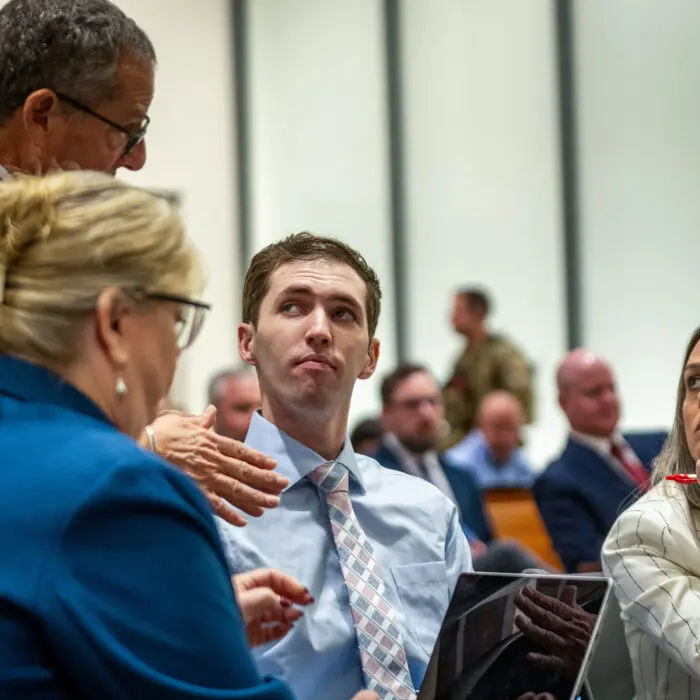
“A lot of people were screaming, standing up, and starting to run in all different directions away from the center of the tent,” Bagley testified.
The officer said he attempted to move the crowd back away from where Kirk was shot.
At one point, he found a handgun holster in the grassy area. But he believed the shot he heard belonged to a rifle, so he went to investigate the Losee Center, which was within sight of Kirk’s location.
Bagley described climbing atop the building to secure the scene after the shooting, noticing what looked like a disturbed area and where he saw a red and black screwdriver.
He testified that an evidence photo taken on top of the Losee Center on campus depicted a “sniper pad” on the building, with markings of elbow, knee, and foot indentations in the graveled roof and “where, like, somebody laid a gun down.”
Video footage showed a man police claim was Robinson running diagonally from the southern side of the building to a shorter drop on the building’s northern side, where he went from the roof to the ground.
Bagley also testified that he found a shoe imprint in the ground below the building and scratch marks on the side of the building.
Robinson allegedly hid the weapon and ammunition used in the attack in a small wooded area just northeast of the Losee Center.
Forensic processing allegedly found Robinson’s DNA on the rifle, ammunition, and towel.
The defense is expected to call DNA experts to testify.
The preliminary hearing is different than most in that prosecutors are also allowed to introduce “reliable hearsay,” which consists of statements from witnesses about what someone else said.
Last month, Graf denied a defense request to remove the death penalty as a possible punishment.
However, the judge also found prosecutors in contempt after they publicly stated they could prove Robinson’s guilt beyond a reasonable doubt before the case reaches trial.
Robinson turned himself in to the Washington County Sheriff’s Office after Kirk’s assassination.
Kirk’s widow Erika, who attended the hearing with the victim’s family, made a statement on X that the family was “deeply grateful for the support, prayers, and kindness” they have received during the “darkest days of their lives.”
“Every court proceeding serves as a painful reminder of his death and the loss that has irrevocably impacted our lives and the lives of his children,” she wrote.
“Out of respect for the judicial process, we will not be commenting further at this time. We ask for continued privacy as we navigate this process and immense grief.”
Possible Motive
Messages on the cartridges in a rifle found by police in a wooded area after Kirk’s shooting provided insight into a possible shooter motive.
According to court documents, the phrase on one cartridge referenced online furry and roleplay culture.
Another read “Hey fascist! Catch!” and featured arrow symbols that may have referred to a sequence of controller moves that unleash a bomb in the video game “Helldivers 2.”
Robinson’s mother told investigators at the time that over the past year before the slaying, Robinson’s political beliefs had been leaning to the left, “becoming more pro-gay and trans-rights oriented,” according to the documents.