This copy is for your personal, non-commercial use only. Distribution and use of this material are governed by our Subscriber Agreement and by copyright law. For non-personal use or to order multiple copies, please contact The Epoch Times Reprints.
Federal Appeals Court Sides With Trump Admin in Mass Firing of CFPB Staff
The appeals court lifted an injunction that had blocked sweeping cuts at the consumer watchdog, giving the White House wide latitude to remake the agency.
The Trump administration scored a major legal win on Friday as a federal appeals court lifted an order that had kept the government from cutting staff at the Consumer Financial Protection Bureau (CFPB), clearing the way for sweeping changes at the financial watchdog.
In a 2–1 decision, the U.S. Court of Appeals for the District of Columbia Circuit on Aug. 15 vacated the preliminary injunction issued by U.S. District Judge Amy Berman Jackson, who in April found the administration was “engaged in an unlawful effort to dismantle and eliminate” the CFPB. The majority held that the employment claims brought by the plaintiffs—the National Treasury Employees Union (NTEU) that represents CFPB staff—must be handled through federal labor channels and that the remaining allegations did not involve final agency action reviewable under the Administrative Procedure Act.
With the decision, the administration regained broad latitude to reshape—or shrink—the bureau, which Congress created after the 2008 financial crisis.
The ruling capped six months of fast-moving litigation that began shortly after President Donald Trump named Russell Vought, head of the Office of Management and Budget, as acting director of the CFPB in early February.
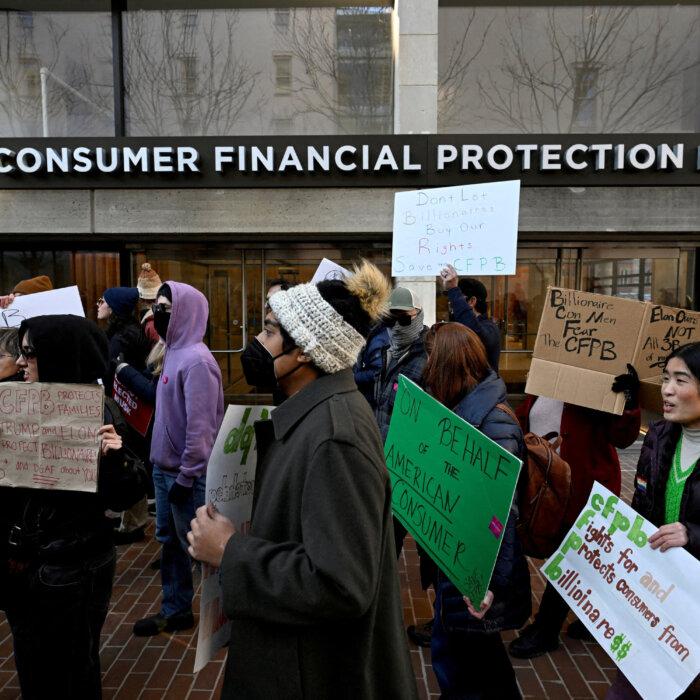
Within days, unions and consumer groups accused Trump of seeking to “totally eliminate” the CFPB and alleged that Vought was “acting quickly” to carry out his direction by ordering a halt to the watchdog’s enforcement and supervisory work, refusing to draw on the bureau’s statutory funding from the Federal Reserve, and closing its Washington headquarters.
“We will not stand by and let this administration destroy the agency that protects seniors, veterans, active-duty military and all American consumers,” NTEU National President Doreen Greenwald said in a statement at the time. “The employees of the CFPB are nonpartisan professionals who swore an oath to uphold the Constitution. ... Locking them out of their jobs or firing them is a gift to predatory lenders and unscrupulous actors who prey on consumers.”
The plaintiffs argued that Vought’s directives violated the Dodd–Frank Act’s mandates for the CFPB and encroached on Congress’s authority to create, fund, and direct the mission of federal agencies. They sought emergency relief to stop what they called a “shutdown” of the bureau, citing impacts such as canceled contracts, the suspension of the consumer complaint system, and the firing of dozens of probationary employees.
Vought and other officials called the actions a lawful, temporary pause to reassess the CFPB’s priorities under new leadership. They said the administration could set enforcement agendas, streamline operations, and focus on duties “required by law,” portraying the changes as part of a drive for a more “streamlined and efficient” government, not an attempt to abolish the bureau.
On March 28, after two days of evidentiary hearings, Judge Jackson sided with the plaintiffs, writing that the record showed the administration was moving to “eliminate the agency before the Court has the opportunity to decide whether the law permits them to do it.” She ordered the reinstatement of terminated employees, barred further reductions in force, lifted the stop-work order, and required the CFPB’s Office of Consumer Response to keep operating its toll-free hotline and complaint database.
The Justice Department appealed, and on April 11, the D.C. Circuit partially stayed Jackson’s injunction. The stay allowed terminations and work stoppages to proceed if the CFPB determined, after a “particularized assessment,” that affected employees or functions were unnecessary to its statutory duties. Days later, the bureau issued reduction-in-force notices to more than 80 percent of its staff, prompting fresh disputes over whether the administration was complying with the court’s order.
In Friday’s decision, Judges Gregory Katsas and Neomi Rao concluded that the NTEU’s employment-related claims fall under the Civil Service Reform Act, which channels federal personnel disputes through the Merit Systems Protection Board and the Federal Labor Relations Authority. That framework, they said, precludes district court jurisdiction over those claims. The majority also found that the plaintiffs’ “shutdown” theory bundled together a series of management decisions but did not point to a discrete, final agency action reviewable under the Administrative Procedure Act.
In a dissent, Judge Cornelia Pillard argued that the administration’s steps went well beyond ordinary priority-setting at the start of a presidency.
“The President’s chosen CFPB leadership may ... run the Bureau as it determines best serves the public interest,” she wrote. “But it is emphatically not within the discretion of the President or his appointees to decide that the country would benefit most if there were no Bureau at all.”
The CFPB, created by Congress in 2010 as part of the Dodd–Frank Wall Street Reform and Consumer Protection Act, has sweeping powers to enforce federal consumer finance laws, supervise large banks and nonbank lenders, and respond to consumer complaints. Supporters credit it with returning billions of dollars to consumers, while critics say it wields too much regulatory power with too little accountability.
The Epoch Times has reached out to NTEU for comment on the ruling, which removes a significant legal barrier for the Trump administration to reshape the bureau in line with its policy goals.
Tom Ozimek is a senior reporter for The Epoch Times. He has a broad background in journalism, deposit insurance, marketing and communications, and adult education.