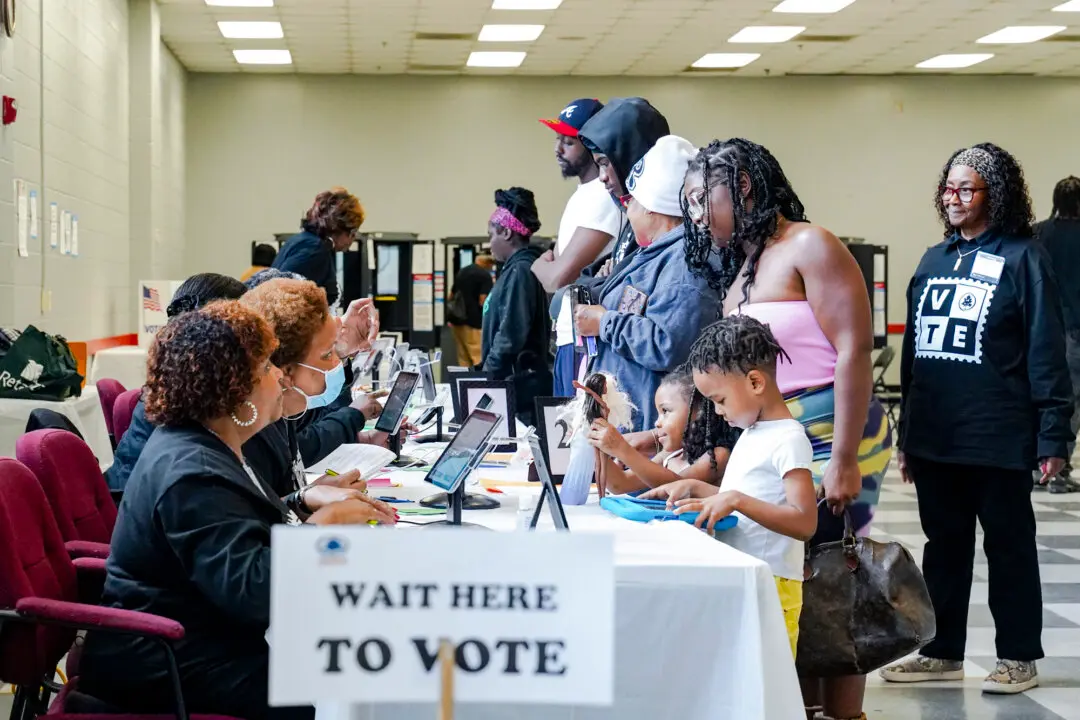
Republican Party committees hold more cash than their Democratic counterparts at every level of the 2026 campaign, while Democratic candidates have raised more than Republican candidates in races for both chambers, according to the most recent reports filed with the Federal Election Commission.
The reports were filed on July 20 and cover activity through June 30. They are the committees’ most current disclosures, with the next monthly filings due on Aug. 20.
The Republican National Committee (RNC) reported $128.5 million in cash on hand and no debt—a figure the RNC said was a record for the committee. The Democratic National Committee (DNC) reported $16.3 million in cash and $18.5 million in debt—the only one of the six national party committees to report any debt.
Each party also runs a separate committee for Senate races and another for House races. All four ended June with no debt. For the Senate, the National Republican Senatorial Committee reported $55.9 million in cash to the Democratic Senatorial Campaign Committee’s $41 million. For the House, the National Republican Congressional Committee reported $92.7 million to the Democratic Congressional Campaign Committee’s $79 million.
What Leading Candidates Raised
The party committees hold only one part of the money in a campaign. Candidates raise funds in their own accounts, and by that measure, Democrats lead.

Across every 2026 Senate campaign, Democratic candidates have reported raising about $579 million to Republican candidates’ $336 million, according to Federal Election Commission data. Among House candidates, Democrats have reported about $1 billion to Republicans’ $805 million.
Those totals cover everyone who ran this cycle, including candidates who lost primaries or dropped out, and they count every dollar raised since the cycle began rather than what remains in the bank.
The same pattern holds in some of the most contested individual contests this fall. In three of the most competitive Senate races, the Democrats had more money on hand at the end of June than their Republican opponents.
In Georgia, Sen. Jon Ossoff (D-Ga.) reported $42.6 million to $2.1 million for Rep. Mike Collins (R-Ga.) in their Senate race.
In North Carolina, former Gov. Roy Cooper, a Democrat, reported $20.7 million to $3.5 million for Republican Michael Whatley, a former RNC chairman.
In Texas, Democratic state Rep. James Talarico reported $21.5 million to $1.8 million for Republican Ken Paxton, the state’s current attorney general.
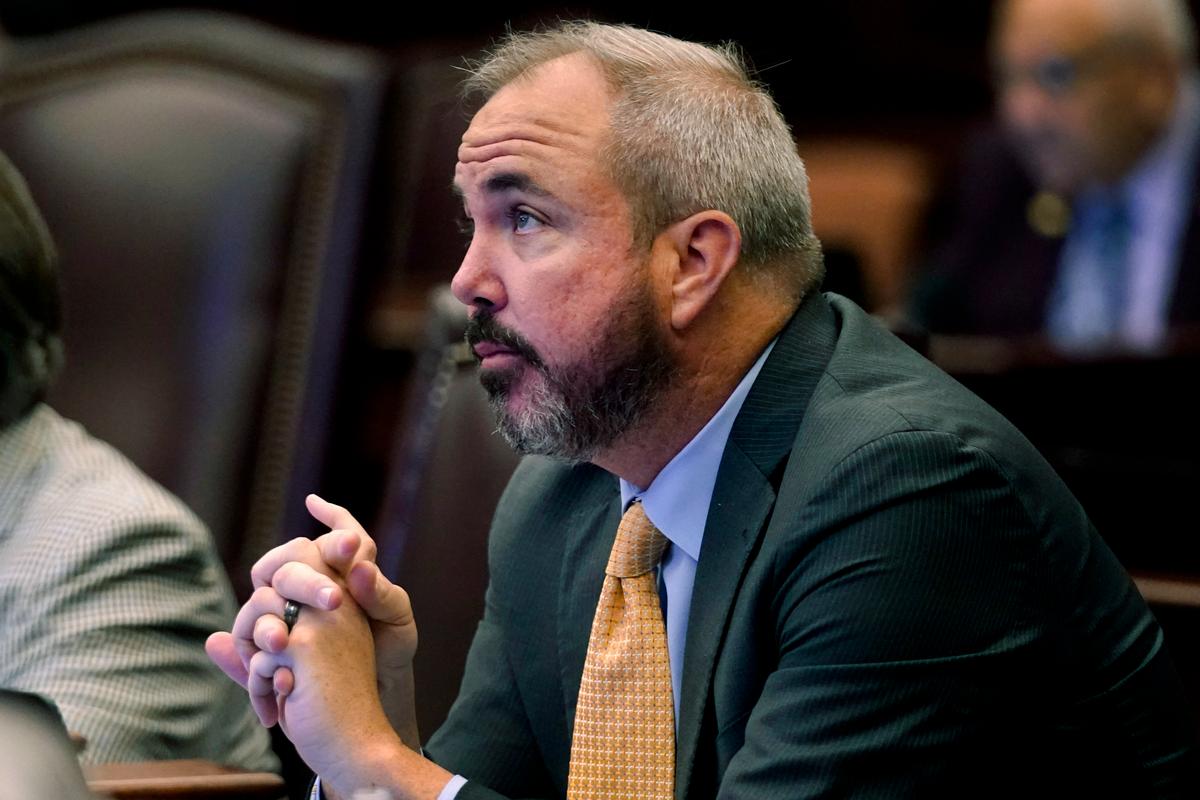
“Our goal is to defy history in November,” Gruters said of midterms. “We have the resources to do that. The [Democratic] Party literally is borderline bankrupt. They have $18 million in debt.
“We have the most cash on hand ever. And when you look at the coordinated campaign limit law that was just struck down by the Supreme Court, it magnifies that by two- or threefold. We’re well positioned to help all of our candidates and any of our candidates that need [it]. ... We’re going to be there for them.”
The DNC’s Debt
The DNC’s own cash position improved over June. It raised $10.6 million and spent $9.1 million, ending the month with $16.3 million, up from $14.9 million on June 1.
The committee also reported no new loans and no loan repayments, either in June or at any point in 2026. The gap between what the DNC holds and what it owes narrowed during the month, but the change came from adding cash rather than paying down what it owes.
DNC Chairman Ken Martin addressed the committee’s cash position in a Substack newsletter, arguing that focusing on cash on hand is the wrong way to look at the committee’s position. He wrote that cash on hand is a snapshot in time and that the committee made a deliberate decision to convert money into organizing capacity rather than hold it.
“But a party is not a savings account,” he wrote. “Its purpose is to build power.”

Martin wrote that the DNC reported more than $207 million in total receipts through June 2026, compared with $109 million during the comparable 18-month stretch of the 2017–2018 cycle. His figure covers an 18-month span beginning in January 2025; the June filing, which reports only calendar year 2026, shows $61.6 million in receipts through June 30.
“The current DNC has raised the most money of any DNC without the White House in the 198-year history of the Democratic Party,” Martin said in the post.
“That means the current DNC has reported total receipts of nearly $100 million more—roughly 90 percent more—than the most relevant historical comparison.”
He said the money is going to monthly support for all state parties, county-level party building, partisan voter registration, voter file and organizing technology, voter protection, and staff training.
He also argued that the DNC should not be measured against the congressional campaign committees, writing that those committees focus on winning specific races and preserve resources for late-cycle advertising, while the DNC’s role is to build the infrastructure that the whole party uses.