DNC Chair Ken Martin closed his party’s summer meeting in Austin, Texas, on Aug. 15 by calling the Democratic Party a “big tent” and telling members to stop applying litmus tests to one another. The speakers who followed him over the next hour demonstrated how much room that tent is being asked to cover.
Former DNC Chair Terry McAuliffe told members to stop using factional labels at all. Meanwhile, Rep. Ro Khanna (D-Calif.) claimed to be part of the “economic patriotism wing” of the party and laid out a policy agenda. Rep. Lloyd Doggett (D-Texas), who sits on the leadership of the Congressional Progressive Caucus, warned that progressive candidates must be careful not to hand Republicans ammunition.
Martin, closing a three-day meeting that also adopted the party’s 2028 presidential nominating calendar, framed the argument around the size of the party’s coalition.
“We don’t strengthen our party through stricter and stricter litmus tests,” Martin said. “You do not build a majority by constantly looking for reasons to throw people out of it.”
He traced the point to President Franklin D. Roosevelt’s New Deal coalition, which he said brought together big-city residents, small-town Americans, rural Southerners, northern labor unions, and working-class families. That coalition also included “people who have been pushed to the margins, including religious, racial, and ethnic minorities,” Martin said, and the party “welcomed all of them into this big-tent party of ours.”
McAuliffe, who chaired the DNC from 2001 to 2005 and later served as governor of Virginia, made the same case more bluntly and aimed it at Democrats who criticize other Democrats publicly.

“Knock it off or get off the playing field,” he said, directing the remark at party members who go on television and social media to “trash” fellow Democrats.
He also said he wanted members to stop using factional labels altogether, listing “DSA,” “moderate,” “progressive,” and “liberal” among the terms he objected to. McAuliffe pointed to his time as governor and asked whether policies he enacted during that time made him a centrist or a socialist.
He answered his own question, stating, “It makes me a damn good governor and a proud Democrat.”
Another Direction
Khanna, who spoke later, went the other direction. He thanked Martin for his leadership and asked the room to applaud him, then said he had not come to celebrate the party.
“A lot of people now say that our party needs to be bold again. I agree,” Khanna said. “But calling for boldness without an agenda is just branding.”
He said he was tired of “platitudes” and of what he described as consultant-crafted, focus-group language about affordability and renewing the American dream that arrives without specific policies attached—a sentiment that gained applause from the audience.
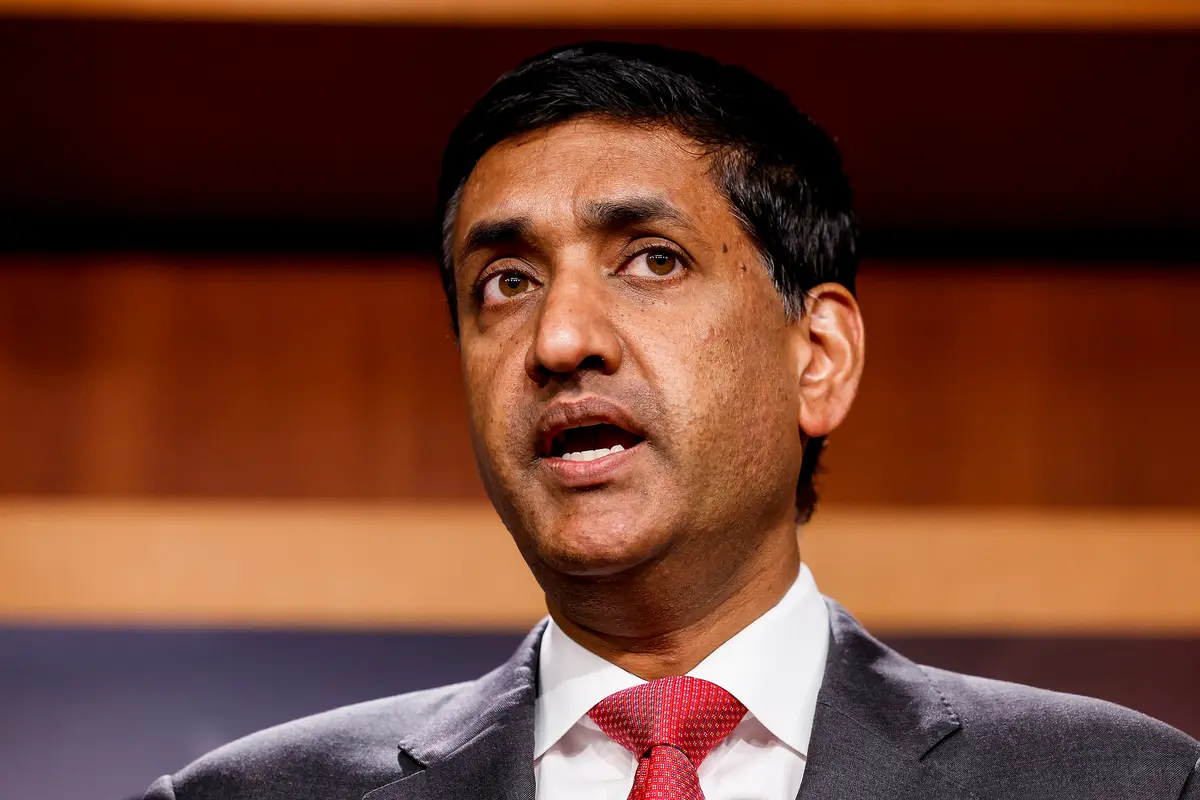
He then listed his own ideas: Medicare for All, free universal child care, a national industrial development bank to rebuild manufacturing towns, 1,000 new trade schools, and a program he called “home by 35” that would let Americans who have worked seven years buy a house with no down payment and low-interest loans.
To pay for it, Khanna proposed a 5 percent tax on the roughly 989 U.S. billionaires, which he said would raise $4 trillion. He also called for taxing artificial intelligence systems and robots at a higher rate than human workers, and endorsed a ban on super PAC spending in Democratic primaries.
Where McAuliffe asked members to drop the wing labels, Khanna claimed one. “I come from the economic patriotism wing of the Democratic Party, the New Deal wing of the Democratic Party,” he said.
Khanna’s sharpest line was directed at the party’s recent leadership.
“We understand—and I mean this with no offense—we understand that those who have lost two elections to Trump are no experts on electability and have no standing to tell a new generation of Democrats that their ideas for justice are too radical,” he said.
Khanna did not name anyone in particular. However, party leadership such as Jaime Harrison, who chaired the DNC through the party’s 2024 presidential loss and chairwoman Donna Brazile who chaired the party during the party’s 2016 presidential loss were both in attendance as members of the DNC.
Harrison had spoken earlier in the meeting, with his remarks mostly on the party moving South Carolina—his home state—to the front of the presidential primary calendar for 2028.
Khanna has been widely rumored to be considering a run for president in 2028.
Testing the ‘Big Tent’
Doggett, who introduced Khanna as a friend doing “an outstanding job of spreading our progressive message across the country,” used his own slot to test the tent from inside the left.
Doggett said he sits on the executive boards of the Congressional Progressive Caucus and its political action committee, and that he is “concerned that our progressive candidates not supply more ammunition to our adversaries.”
He described himself as a capitalist who is worried about the excesses of capitalism and a Zionist who is critical of the Israeli government. He also criticized what he called “corporatecrats” in the party who he said protect “big pharma and tax cheats in corporate America.”
Then he told the room a story about the limits of that critique. Doggett quoted the late Texas populist former Texas Department of Agriculture Commissioner Jim Hightower’s line that the only thing in the middle of the road is “a yellow stripe and a few dead armadillos,” and noted that the remark was popular in Austin.
“Jim lost his next statewide election to a fellow named Rick Perry,” Doggett said.
Doggett, who has represented four different Texas congressional districts after repeated redistricting, said his own answer is to keep the same positions and change how he explains them.
“While my progressive values have never changed, the way I present them and express those values and the priorities I set is not always the same in another place as it might be here in Austin,” he said, adding that the party should spread “our big Democratic tent to include Democrats of all political persuasions, including some we might not always like.”
Doggett, 79, also said the party must avoid alienating and demonizing older Americans while still welcoming in younger generations.
DNC Vice Chair Malcolm Kenyatta told the room that the arguing is the selling point. He said that when reporters and viewers outside the DNC watch a party debate for and against issues, “they love to say, ‘Look how divided Democrats are.’”
“A part of why they get so confused is that Democrats are not a part of a cult,” Kenyatta said. “We have big, hearty debates about our country and about the future that we believe in.”
A Democrat who was not in Austin was asked about the same fight the next morning. Maryland Gov. Wes Moore, appearing on CNN on Aug. 16, was asked by host Jake Tapper about Democratic incumbents losing primaries this year to progressives and democratic socialists.
Moore did not take either side of the Austin argument. He said the test is whether policies address what voters are dealing with now, and that “any Democratic policy that’s not focusing on what people are feeling right now and the status quo protection has got to go.”
Moore, who is currently running for reelection as governor, is also widely considered to be a 2028 Democratic presidential contender.