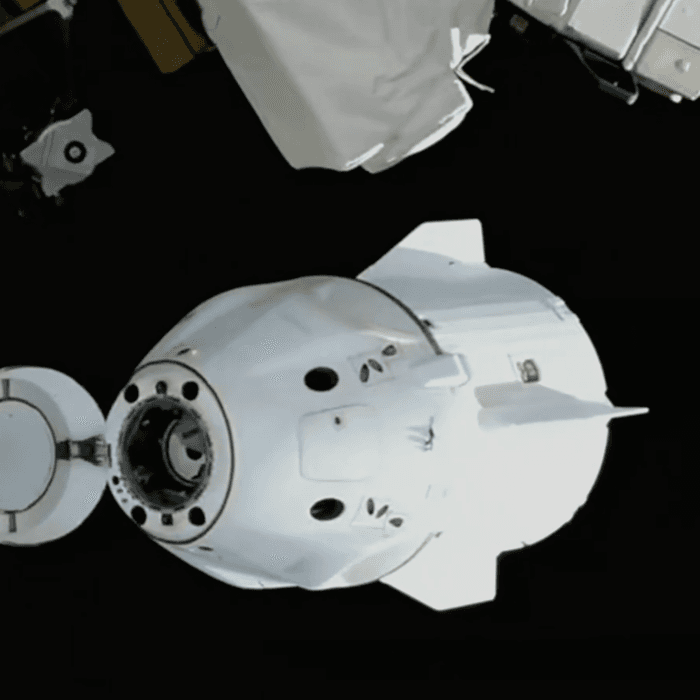
SpaceX’s Crew Dragon capsule Endeavor splashed down off the California coast in the early hours of Jan. 15 as NASA and its international partners in space closed out a shortened but successful multi-month mission in space.
Inside the capsule, NASA astronauts Zena Cardman and Mike Fincke, JAXA (Japan Aerospace Exploration Agency) astronaut Kimiya Yui, and Roscosmos cosmonaut Oleg Platonov had returned home from the International Space Station after nearly 170 days in space. Parachutes were deployed and dropped the charred spacecraft in the Pacific Ocean just after 3:40 a.m. ET.
At a press conference just before 6 a.m., NASA Administrator Jared Isaacman said all four crew members were undergoing routine post-splashdown medical evaluations aboard a recovery ship. He was joined by Joel Montalbano, deputy associate administrator for Space Operations Mission Directorate, who added that all four would all be flown by helicopter to a hospital in San Diego. They are expected to stay overnight and return to Houston, Texas, on Friday.
Crew-11 returned home approximately four weeks early due to a serious medical concern befalling one of the crew members. The two officials said the affected crew member was doing fine, and while medical activities that could only be done on Earth were planned, the entire crew was expected to be released from the hospital together.
The crew member’s identity and exact condition remain undisclosed due to medical privacy considerations, but Isaacman emphasized his agency’s desire to be transparent and share any available information.
“To the extent that we are in a position to share more information publicly and have the necessary consent, we would do so,” he said.
“This is why we’re there to learn and things that could have implications on the health and wellness of crew members is vitally important to all those that undertake these types of missions in terms of preparation for subsequent missions, whether it’s on the International Space Station or on Artemis two, we’re always learning here.”
Isaacman said that the medical condition was not a result of any ongoing space station operations, and that the situation and its outcomes would not have changed if there had been a dedicated medical officer onboard. However, he appeared open to the idea of having a dedicated physician on future missions that do not offer Low Earth Orbit opportunities like real-time communication with Mission Control or an hours-long trip back to Earth, like those to Mars.
Despite being cut short, Crew-11’s mission, which was part of the space station’s Expedition 74 mission, was deemed a success, completing more than 140 science experiments during the 167-day mission.
Isaacman also praised the rapid responsiveness of NASA and its partners to bring the crew home early.
“Space Flight will always carry some degree of uncertainty,” he said. ”That is the nature of exploration. Fundamentally, it’s why we’re in space to learn. It’s why NASA prepares for the unexpected, so we are ready to respond decisively and safely. The successful return of Crew-11 is a direct result of that preparation.”
Crew-11 was supposed to remain on the station until Feb. 20, by which time, NASA’s SpaceX Crew-12 would have arrived and gone through a standard handover process to continue ongoing work.
That crew, NASA astronauts Jessica Meir and Jack Hathaway, European Space Agency (ESA) astronaut Sophie Adenot, and cosmonaut Andrey Fedyaev, is scheduled to launch for the space station no earlier than Feb. 15 from Space Launch Complex 40 at Florida’s Cape Canaveral Space Force Station.
Any attempts to move up the launch date could cause it to overlap with the first launch window or the Artemis II mission, which runs Feb. 6, 7, 8, 10, and 11.
However, Isaacman welcomed the challenge of handling multiple missions as something NASA should be able to execute.
“We have the means as an agency, and should be expected of our agency to be able to bring our astronauts home at any time, as required under circumstances like this, which is exactly what we did today with Crew-11, while making preparations to pull forward our next mission, like Crew-12, while also progressing on our Artemis II campaign for what is going to be probably one of the most important human spaceflight missions in the last half century,” he said.
“I don’t see any reason why we wouldn’t continue along those parallel paths,” Isaacman added. ”And if it comes down to a point in time where we have to find where we have to deconflict between two human space flight missions, that is a very good problem to have at NASA.”