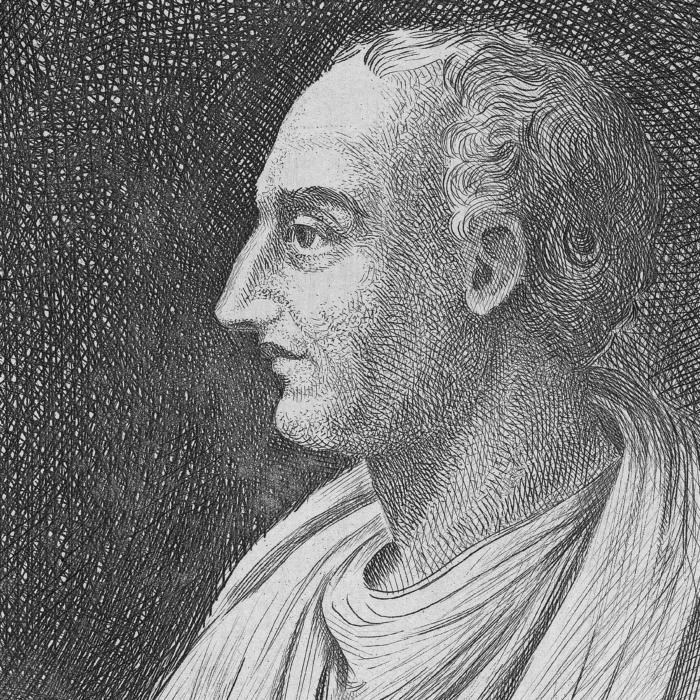
“If the American Founding had a poet laureate,” I wrote, “he would be it.”
This installment outlines Virgil’s influence on the constitution-makers in more detail.
 Unlike Plato, Aristotle, Polybius, and Cicero, Virgil had little to say on the comparative benefits of political institutions. One can’t claim of any particular clause in the Constitution, “Virgil helped formulate this one.”
I suppose you could argue that (1) Virgil’s love for agriculture, as reflected in his poem “the Georgics,” contributed to the idealization of farming among many Founders and, therefore, (2) promoted a desire to protect agricultural land and farming implements from federal tax collectors, which (3) facilitated the adoption of the Constitution’s apportionment clauses (Article I, Section 2, Clause 3 and Article I, Section 9, Clause 4). But for the most part, the poet’s influence on the American Constitution-makers was of an entirely different kind. His great epic the “Aeneid” was inspirational: As noted in the last essay, the central character appealed to American nation-builders, and there were parallels between the plot and the Founders’ own lives.
A Personal Experience
After beginning the study of Latin at the age of 32, I noticed that I was experiencing my environment differently. Latin is embedded in our world in myriad ways, both noticed and unnoticed. Thus, familiarity with the language enabled me to see the world in a further dimension. I was like the man who had lived his entire life with sight only in his left eye but who then undergoes an operation enabling vision in the right. I now saw things more deeply and three-dimensionally than ever before.The American Founders were, for the most part, realists. They perceived the world as it was, not as they wished it to be. Moreover, they could anticipate possible future results from present decisions. They were adept at communicating their thoughts in English.
Virgil and George Mason
George Mason of Virginia participated actively in the writing of the Constitution. But he was unhappy with the convention’s draft and opposed ratification.“Our peasants will be like those mentioned by Virgil, reduced to ruin and misery, driven from their farms, and obliged to leave their country: Nos patriam fugimus—et dulcia linquimus arva.”
The Latin verse comes from Virgil’s first Eclogue. It means “We flee from our homeland; we abandon our own sweet country.” It’s the lament of Roman farmers evicted from their ancestral land in the dispossessions caused by civil wars. Mason’s recital communicates melancholy to anyone who knows “the Eclogues.”
Virgil in the Ratification Record
Mason was only one opponent of the Constitution (“Antifederalist”) who resorted to Virgil to portray the dire consequences of ratification. A Maryland Antifederalist writing as “A Farmer” (probably John Francis Mercer) warned that the Constitution could bring heavy federal taxation. He employed a line from the third Eclogue about a greedy shepherd who milks his sheep twice every hour, thereby robbing baby lambs of nutrition.Another Antifederalist warned about the Constitution with a now-common metaphor from “the Eclogues”: “A snake lies in the grass.” Still another, borrowing from the “Aeneid,” quoted lines from the story of how the Trojans dragged the fateful wooden horse into their city:
Instamus tamen immemores caecique furore
et monstrum infelix sacrata sistimus arce.
“Yet we push forward, unmindful, blinded by madness,
and erect the ill-omened monstrosity within our sacred citadel.”
A New York Antifederalist employed a line from the “Aeneid” to warn his countrymen: Heu fuge crudeles terras, fuge litus avarum—“Listen! Flee the cruel lands, flee the savage shore.” An exasperated New Hampshire essayist signing his name “Phileleuthos” (Greek for “lover of freedom”) challenged an advocate of the Constitution with a question, also borrowed from the “Aeneid”: Quid miseros totiens in aperta pericula cives proicis?—“Why do you repeatedly push your wretched fellow citizens into obvious danger?”
The pro-Constitution (“Federalist”) side resorted to Virgil as well. One writer borrowed from the “Aeneid” to highlight the sad state of the Union under the Articles of Confederation: Sunt lacrimae rerum—“There are tears for things.” Another varied a quotation from the same source to lament the hardship that state paper money loaded on responsible savers: Hic labor, hoc opus est—“This is the toil, this is the task.”
Maryland’s Charles Carroll of Carrollton quoted lines from the “Aeneid” to predict that, just as the universal spirit animates the world, under the Constitution, the federal government would reanimate the union:
Spiritus intus alit: totamque infusa per artus
Mens agitat molem, et magno se corpore miscet.
“The spirit nourishes, the limbs infused,
the mind sways the mass and mixes with the great body.”
(Notice Virgil’s use of alliteration in the second line of the Latin original, and how difficult it is to reproduce the effect in English translation.)
But while the issue was still undecided, impatient Federalists could only state their case and endure. Several recited the Aenead’s verse, Forsan et haec olim meminisse iuvabit—“Perhaps one day it will be pleasant (or helpful) to remember even this.”
Ultimately, of course, the Federalists proved persuasive. As state after state ratified the document, pro-Constitution newspaper editors rejoiced with lines from the fourth (“Messianic”) Eclogue:
Incipient magni procedere menses
“The great months [i.e., ages] will now go forth.”
Redeunt Saturnia regna.
“The Golden Age returns!”