
Iran’s national soccer team is scheduled to play its first match in the 2026 FIFA World Cup on June 15.
This Iranian team will play as its home country seeks to finalize a deal to end the multi-month armed conflict with the cup’s primary host nation: the United States.
Though the 2026 World Cup is being jointly hosted by the United States, Mexico, and Canada, the Iranian team will start the competition on U.S. soil. They’ll play their first match against New Zealand at the Los Angeles Stadium in California.
During the initial group stage of the World Cup, 12 groups of four teams will each play three matches in a round-robin format for a chance to advance to the later stages of competition. The top two group competitors from each of the 12 groups and the eight best-performing third-place group finishers will advance to the next stage.
All three of Iran’s opening group stage matches are set to take place at U.S. venues.
Iran’s soccer team had initially planned to establish its World Cup base camp at Tucson, Arizona. After U.S. and Israeli forces launched military strikes across Iran on Feb. 28, the Iranian team elected to set its base camp at Tijuana, Mexico, to limit its time on U.S. soil.
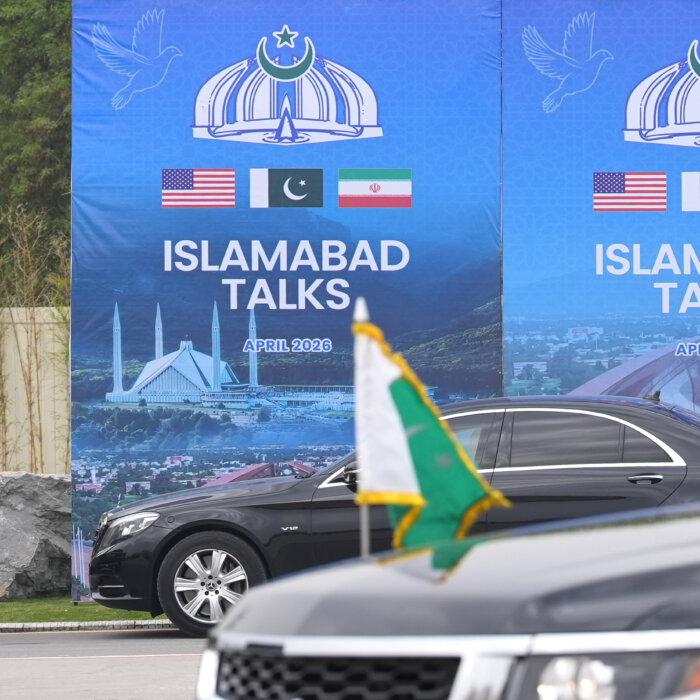
The Feb. 28 strikes on Iran set off 38 consecutive days of fighting, before Washington and Tehran entered into a ceasefire agreement on April 7. That ceasefire had proven tenuous, with repeated armed exchanges in the past two months.
On June 14, President Donald Trump announced that the two nations had reached a tentative agreement to end the conflict, and a signing ceremony is scheduled for June 19 in Switzerland.
Trump previously ordered two consecutive days of heavy U.S. strikes on Iran this week. He had planned for a third day of strikes on June 11—the same day the World Cup kicked off—but backed off amid the signs of progress on a peace agreement with Iran.
Iran’s soccer team has claimed it faced travel disruptions, including difficulties obtaining visas for some of its support staff to enter the United States.
At a June 2 House hearing, Secretary of State Marco Rubio acknowledged some visa restrictions impacting the Iranian delegation, but indicated the constraints weren’t stopping players and core team staff.
“What we’re not going to allow is for them to embed in their delegation a bunch of people that we know have nothing to do with athletics and have ties to the [Islamic Revolutionary Guard Corps] or things of that nature,” Rubio said.
Iran’s national soccer federation and members of its team have still said that U.S. entry policies pose troubling disruptions.
“We have also a lot of people, logistic people, who have to look after us outside the pitch,” Iranian team forward Alireza Jahanbakhsh said in an interview with ESPN this week.
Jahanbakhsh said visa denials “can affect our preparation, in a way.”
The U.S. Department of Homeland Security told The Epoch Times that the current visa policies will allow Iranian players to enter the United States the day before their games.
The Iranian team also appears unlikely to be bringing much of its own cheering section to the upcoming games.
Each participating nation is allocated 8 percent of the available tickets for their respective matches. However, earlier this week, Iran’s national soccer federation announced their ticket allocation had been canceled.
Iranian players may also have to be wary of how their actions on the world stage are interpreted.
The 2026 Women’s Asian Cup soccer tournament began on March 1, just one day after U.S. and Israeli forces began bombing Iran. After the Iranian women’s team failed to sing their national anthem ahead of one of the games, an Iranian state media presenter referred to the team members as “wartime traitors,” fueling concerns they’d face reprisals upon returning to their home country.
Trump called on the Asian Cup’s host nation, Australia, to extend asylum status to the Iranian women’s soccer team, writing on Truth Social that the players “will most likely be killed” if they returned to their homeland. Seven members of that Iranian delegation initiated asylum claims, but five ultimately dropped their asylum status and returned home amid some claims their family members had been threatened.
The World Cup is underway as the conflict between the United States and Iran, which has kneecapped global oil shipping, may be coming to an end.
On Sunday, Iranian state television quoted an Iranian national security official saying the war “will end immediately and permanently beginning tonight” on all fronts, while the U.S. blockade “will be terminated immediately and in full.”
A key area of disagreement between the two sides—the status of the Hezbollah terror group in Lebanon as it launches attacks on Israel—remains shaky, and Trump has urged all sides to work to keep the peace.
Pakistani Prime Minister Shehbaz Sharif—a key intermediary in the peace negotiations—said in his announcement of the deal that both the United States and Iran “have declared the immediate and permanent termination of military operations on all fronts, including in Lebanon.”
The deal gives 60 days to find a way forward on the Persian state’s highly enriched uranium and its atomic program, which has been a key area of disagreement between the two in the current conflict and the decades leading up to it.
Trump said that global shipping could resume freely and safely through the critical Strait of Hormuz once the deal is signed.