This Thursday, French President Nicolas Sarkozy and British Prime Minister David Cameron were the first foreign head of state to visit “post-Gadhafi” Libya. The visit can probably be understood as a thank you from former Libyan rebels for the help provided by both the French and British governments acting under the NATO banner to oust the Gadhafi’s regime.
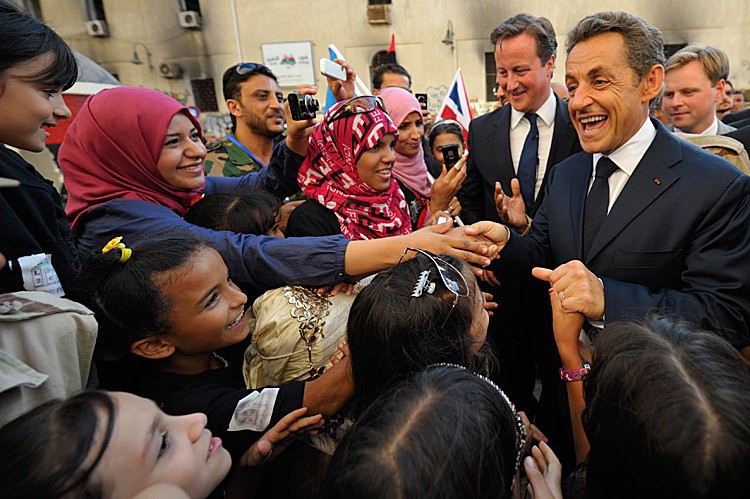
The European leaders were cheered by crowds as they walked through Tahrir (‘freedom’) Square in Benghazi, then both joined a press conference in Tripoli with the head of the Transitional National Council (TNC), Mustafa Abdel Jalil.
Other than the calls for a united Libya made by Sarkozy, and Cameron’s call on Gadhafi to surrender, the visit to Libya is unique in showing a certain eagerness by both leaders to root themselves in a country where almost everything needs to be built anew.
On Sarkozy’s side, many in France consider the choice of this Thursday to visit Libya as a clear attempt to sabotage Socialist Party communications in the lead up to French presidential elections next year: Sept. 15 was the first TV debate for French socialists presidential candidates. In June, Sarkozy likewise had tried to upstage the socialists by holding a large event the same day Socialist First Secretary Martine Aubry announced her candidacy.
Sarkozy is also looking to anchor himself as a friend to the Arab revolutions, something made harder since he had renewed ties to both Gadhafi and Syria’s Bashar al-Assad during his presidency.
In 2008, Sarkozy was harshly criticized for offering a warm welcome to both leaders in France—a strong embarrassment after the wake of Arab revolutions. France is also criticized for having at one time offered Tunisia’s former President Zine al-Abidine Ben Ali its “help and expertise” in the management of social unrest.
A main message of Sarkozy’s visit was that France’s involvement in Libya is about defending a just cause.
A high priority for Sarkozy is to build a correct geopolitical position in the region after years of unwise diplomacy.
The challenges are high and geopolitical considerations appear heavy in the background, with Europe trying to limit the expansion of Turkey’s aura in the region since the country seems to be stepping back from its ambitions to join the European community. Turkey’s Prime Minister Erdogan is soon expected in Tripoli with the distinct advantage of representing a Muslim country having recently shown a strong position against Israel and enjoys historical legitimacy in the region.
Sarkozy was also given some assurance that France would be taken care of in terms of Libyan oil. Several weeks ago, TNC leaders said France would be first served for Libyan oil and Sarkozy’s Tripoli’s trip reconfirmed this. “As Muslim believers, we are thankful to their [France’s] efforts, and they will have priority,” said Moustapha Abdel Jahil, TNC leader as quoted by Le Monde newspaper.