This copy is for your personal, non-commercial use only. Distribution and use of this material are governed by our Subscriber Agreement and by copyright law. For non-personal use or to order multiple copies, please contact The Epoch Times Reprints.
An F-16 fighter jet leaves Volkel Air Base on its way to be handed over to Ukraine, in Volkel, Netherlands, on May 26, 2025. Robin van Lonkhuijsen/ANP/AFP via Getty Images
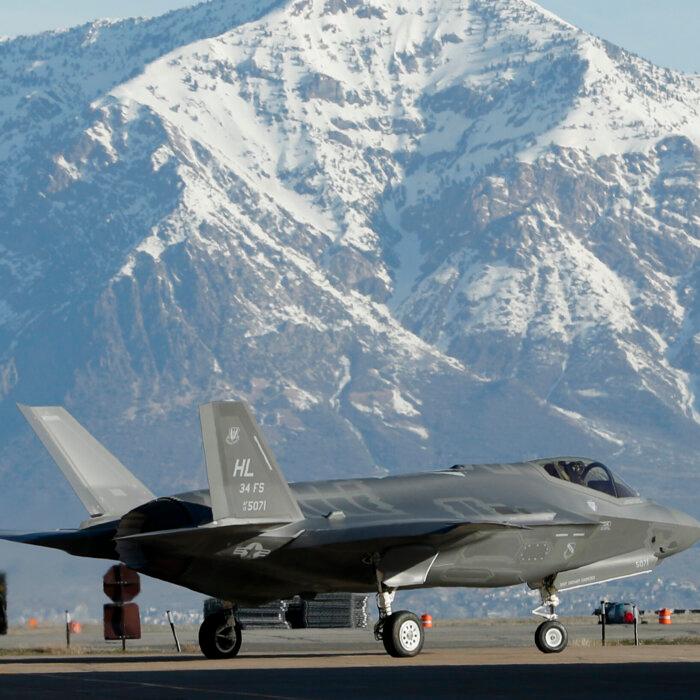
Problems with F-35 unreliability and uncertainty over the aircraft’s ability to become the Air Force’s, Navy’s, and Marine’s everyday workhorse led to the creation and acquisition of a brand-new more advanced F-15, the F-15EX Eagle II. Yet, for nearly half a century, it is the F-16 Fighting Falcon that has been the foundational fighter for the U.S. Air Force (USAF).
Born in the 1970s as a lightweight, agile, air superiority fighter, the F-16 was evolved into a versatile multi-role platform that remains a force to be reckoned with today. Despite the rise of fifth-generation stealth fighters such as the F-35 and F-22, the F-16’s superior sortie generation rate, affordability, and continuous modernizations have allowed it to remain a highly effective multi-role fighter. Now there is a proposal to take a subset of F-35 technology and other cutting-edge tech and create a brand-new advanced Block 80 F-16.
That this proposal is being taken seriously is a testament to the F-16’s solid design that, although often overshadowed in the media by newer fighters, continues to deliver much greater bang for the buck on today’s modern battlefield than its flashier, more urbane siblings.
The F-16’s story begins with its design as a dogfighter par excellence, intended to outmaneuver adversaries in within-visual-range (WVR) combat. As noted in my December 2024 analysis, the F-16 was initially crafted to surpass large F-15-sized fighters in close-quarters aerial duels, leveraging its agility and lower cost. And it did so. However, the Air Force, believing that the future of aerial combat was going to be won by a fighter with big, powerful radars designed to engage opponents at beyond visual range (BVR), decided to adopt the F-15 as its dedicated air superiority fighter. This decision didn’t sideline the F-16; instead, the F-16 was transformed into a multi-role juggernaut, capable of air-to-air combat, ground attack, and reconnaissance. Today, more than 2,800 F-16s remain in service across 25 nations, with new orders still rolling in—a testament to its enduring effectiveness.
The proposal being discussed is to merge the latest advanced Block 72 F-16’s being sold overseas with a subset of advanced F-35 capabilities, forming a new advanced Block 80 F-16. The rationale and process for doing so would roughly mirror what was done to evolve the Air Force’s F-15C/F-15 Strike Eagle into the F-15EX Eagle II, featuring some of the capabilities found in the F-35 and F-22. This sounds great, but only if the price is right and the Block 80 F-16’s operational cost remains low and its sortie generation rate stays high.
Indeed, sortie generation rate (SGR) is perhaps the most important parameter in determining how much combat power a plane can deliver. Historically, the F-16 has had a much higher SGR than complex, unreliable, super-expensive-to-operate aircraft such as the F-22 and the F-35. SGR measures how many missions an aircraft can sustain over a given period, typically 24 hours, with sustained SGR reflecting longer-term reliability. A high SGR translates to more time in the air, delivering greater combat power. While advanced fighters such as the F-35 boast cutting-edge technology, their complexity often leads to lower SGRs because of increased maintenance demands. The F-16, by contrast, is a workhorse—reliable, easier to maintain, and far cheaper to operate, with a cost per flying hour roughly half that of the F-15 and much, much less than the F-35.
This reliability isn’t just about numbers; it directly enhances combat effectiveness. High SGRs allow pilots to log more “stick time,” critical for maintaining proficiency. Retired USAF pilot Lt. Col. Thomas “Tom-Chuck” Norris, noted that 10 to 15 hours of monthly flight time ensures familiarity, but 30 hours fosters true mastery. F-16 pilots, benefiting from the jet’s lower operating costs and higher availability, can achieve this higher threshold, honing tactics that maximize the aircraft’s strengths. In a hypothetical scenario, a pilot flying an F-16 with 30 hours of monthly training could outmatch a less experienced pilot in a theoretically superior but more maintenance-intensive, more expensive-to-fly-plane—even if on paper the more “advanced” aircraft looks superior.
The Block 80 F-16, as detailed in Military Watch Magazine, would represent the pinnacle of the platform’s evolution. Equipped with advanced avionics, upgraded radar, and enhanced weaponry, it would be a truly advanced Generation 4.5 fighter capable of holding its own against modern threats. The Air Force’s consideration of new Block 80 purchases, as reported by The War Zone, underscores its strategic value. Air Force Chief of Staff Gen. David W. Allvin has acknowledged the jet’s ongoing relevance, noting its ability to perform many missions effectively at a much lower cost than fifth-generation platforms.
While stealth fighters such as the F-35 and F-22 should theoretically dominate BVR scenarios, in the real world pure BVR engagements have been rare, and for a number of reasons often quickly devolve into within-visual-range fights. An advanced Block 80 F-16 will be able to execute both BVR and WVR engagements. And if the Block 80 F-16 maintains a reasonable cost per flying hour, its pilots will get the flying time necessary to train in tactics designed to minimize (not eliminate) the advantage of a stealthy plane being flown by a pilot with less stick time has over them. Indeed, Block 80 F-16s sporting lock-on after-launch missiles being directed by an airborne warning and control system and other systems capable of tracking stealth aircraft could still be very effective against stealthier opponents.
So, in theory, an advanced Block 80 F-16 makes good sense. However, if the incorporation of technology from the notoriously unreliable F-35 decreases F-16 reliability and raises its cost per flying hour, then we end up with a more complex F-16 that may on paper be able to do some things that the current F-16s cannot do, but whose lower sortie generation rate means that in the real world it will be able to deliver less combat power than current, less complex F-16s that are already capable of performing most missions on today’s modern battlefield.
But if reliability and low cost per flying hour can be maintained, then a Block 80 F-16 could be just what the doctor ordered.
Views expressed in this article are opinions of the author and do not necessarily reflect the views of The Epoch Times.
Mike Fredenburg writes on military technology and defense matters with an emphasis on defense reform. He holds a bachelor’s degree in mechanical engineering and master’s degree in production operations management.