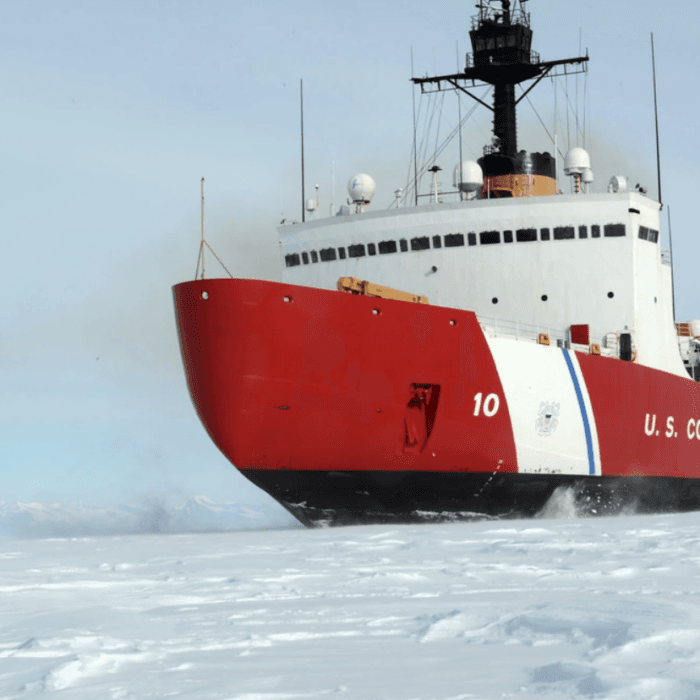
Steel cutting and structural construction on the first of 11 planned U.S. Coast Guard medium icebreakers began last week.
Beginning construction on the first ship of the 9000-ton, 328-foot-long Arctic Security Cutter (ASC) class represents a turnaround for a program that was incepted in 2010 but has yet to deliver a single icebreaker despite $1.8 billion being spent on the program since 2013.
The program was supposed to deliver three of the much larger, more capable 22,000-ton Polar Security (PSC) icebreakers by the end of 2026, but because of development that led to redesigns and ballooning costs, the first of the PSCs will be delivered by 2030 at the earliest.
But back to the good news on our ASC-class medium icebreakers. Originally, the idea was to deliver 3 PSCs and 3 ASCs for a cost of less than $6 billion, but because of PSC program problems, the $6 billion will just cover the costs of the three PSCs, and the first will not be delivered for at least another four years.

He succeeded on both fronts by involving the Finns, who were responsible for the base design that the ASCs are based on and have experience building nearly identical ships.
A deal was negotiated in which Finland partners with U.S. shipbuilders to produce four ASCs, with the remaining seven being built in U.S. shipyards—four by Bollinger Shipyard and three by Davies Defense.
It’s a win-win deal, as Finland, being the designer of the icebreakers on which the two ASC variants are based, has experience that will enable it to deliver two icebreakers by the end of 2028.
Further, in order to gain expertise and experience, U.S. shipbuilders will be embedding their engineers, construction leads, and project managers in the Finnish shipyards where the ASCs are being built.
This will yield big benefits in terms of speeding construction and reducing mistakes once Bollinger and Davies begin building the ships in their own shipyards starting in 2027.
The 11-ship contract for $6.1 billion brings down the price per ACS to $560 million per ship. Considering that the Polar Security Cutter is coming in at about three times this and considering the Navy was paying roughly the same for its flimsily constructed 3,500-ton littoral combat ships, this is quite a bargain.
Another big plus for the 11-ship deal is that it includes $1 billion to greatly expand Davies Defense’s ability to handle building, repairing, and overhauling complex warships of 12,000 tons or less.
So once Davies is done building the icebreakers, it will be ready to handle the backlog of new ship construction, repair, and overhaul for complex warships like the Arleigh Burke destroyer.
This capacity is sorely needed, and one could argue that because the shipyard expansion and upgrade will benefit the Navy and Coast Guard for decades to come, only part of it should be considered when looking at the ACS’s average cost. For example, if only half of that $1 billion shipyard expansion is counted towards the icebreaker program, the average cost per ACS drops to about $500 million per ship.
It must be noted that the original requirement was to have four or five of the larger PSCs and four or five of the smaller ASCs for a total of nine new icebreakers, but given the problems with the PSC program, ending up with 14 new icebreakers will provide more overall presence than the original mix.
Still, only having three large icebreakers versus the four or five that were originally thought to be needed means that the ACS heavy mix will be weak in handling heavy ice conditions.
This suggests that acquiring one or two more PSCs could make sense.
While the PSC program has been troubled, it looks like the main design issues have been resolved and that the experience gained in building the three PSCs could lower the cost to $1.6 billion per ship.
This price point will only be available if the Coast Guard gets a contract in place for the fourth PSC before the third PSC is done, as it depends on leveraging the expertise of workers who built the first three PSCs.
This is an option that should be considered.
The partnership with Finland makes a lot of sense, as it ended up lowering the cost while also transferring valuable shipbuilding skills to U.S. shipbuilders.
Given the shortage of skilled labor and shipbuilding capacity, the United States needs to pursue such partnerships in parallel to getting really serious about adding acres more of shipbuilding capacity to address the fact that the United States does not have enough shipyard space to concurrently maintain the current fleet while building new ships.