My father has a saying that has followed me through every season of my life. Whatever you spend your time and money on is what you are committed to. You can call yourself an activist, an artist, a visionary, or a truth-teller.
But if your days and your dollars are spent clocking a nine-to-five and scrolling and ordering from Amazon, then that is your real commitment. Not your potential. Not your identity. Your calendar and your bank statement tell the truth.
I keep thinking about that same principle with water. The way we use water reflects what we consider important. What we throttle, restrict, permit, and punish is what we have decided is not important. Water policy is a moral document, whether we admit it or not. It reveals what we value, who we protect, and who we are willing to sacrifice.
California: When Water Becomes Political, Orchards Become Firewood
I lived in California long enough to watch the story play out in real time. It is impossible to explain California water without understanding that it is not just a drought story. It is a law story, a bureaucracy story, a courtroom story, and a priority story.During the past decade, you could drive up and down Interstate 5 through the Central Valley and see the anger spelled out in plain language on billboards. “Congress Created Dust Bowl.” “No Water = No Jobs.” Those signs were not political theater; they were put up by farmers and valley residents trying to break through the silence.
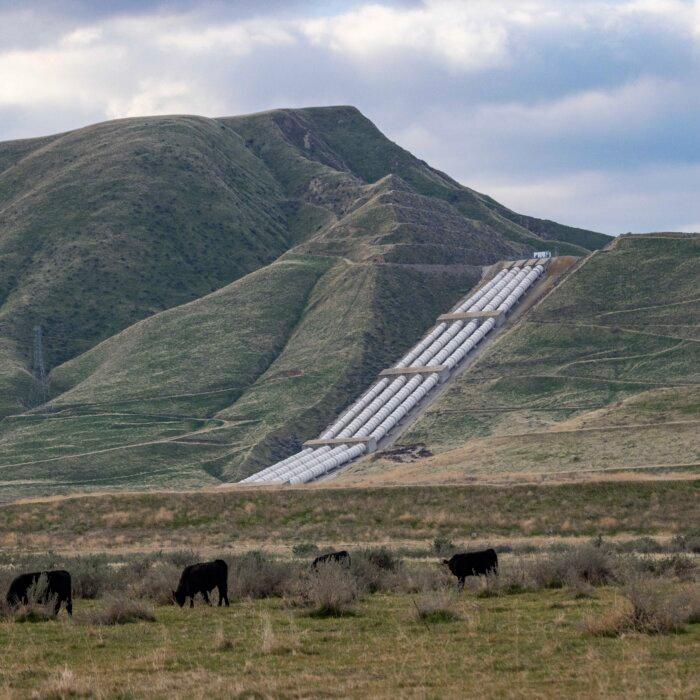
California voters actually understood the need for infrastructure. In 2016, the people of California allocated a massive amount of money specifically to build new water storage. Bonds were passed, and projects were approved on paper. The will of the people was clear.
But years later, very little of that storage has actually been built. Instead, we have watched historic rain events come and go with nowhere to put the water. Reservoirs spilled, rivers flooded, and billions of gallons rushed out to sea because the promised infrastructure never materialized.
At the same time, California tightened groundwater rules and limited surface water deliveries. But it failed to do the one thing that would have helped everyone: capture water when it actually falls from the sky. So even when rain returns, farmers are still left without security, orchards are still ripped out, and communities are still divided.
Idaho: Potatoes in the Ground, Wells Tagged Red
My father lives in Idaho. People imagine Idaho as endless water and endless room, but Idaho is proving that even water states are one court decision away from crisis.Recently, Idaho farmers had potatoes already planted and were fully invested in a season when curtailment orders were issued. They were told they could not pump from their wells. Fields that had already been committed to production suddenly had no legal water.
To anyone who has never farmed, this sounds like a policy debate. To a farmer, it is existential. It means you can do everything right and still lose everything. It means you can never confidently tell your banker, your workers, or your family what next season will look like.
Oregon: The Rain That Became a Crime
Then there is Oregon, the story people repeat because it feels so stark. One man in Oregon went to jail, paid a fine, and had the county remove his water catchment. The state said he was stealing—stealing the water that rained down onto his own property.We are not talking about a giant private lake. We are talking about three reservoirs he built to collect rain and snowmelt for wildlife, for his garden, and for fire protection. He caught the water. He still put the water back on his ground. He simply spread it out a little differently.
The state argued that he had interfered with regulated waterways and needed permits. He argued that it was his rain on his land. Regardless of which side you take, the image remains powerful. A citizen jailed over water that fell from the sky. The case exposes the philosophical fault line we are heading toward everywhere.
How much control does a person truly have over water on his or her own land?
Texas: The Free State Learns What Scarcity Feels Like
Now, I live in Texas. People move here for freedom, for land, and for the feeling that you can still build something real. But Texas is not one water system. It is a patchwork. In some areas, Texas follows the right of capture. In other areas, it is tightly regulated by local groundwater districts and river authorities. Two Texans can live an hour apart and face completely different rules.Texas is in a deep-drought rhythm right now. My irrigation well is dry. The live water creek that runs through my land has not been live since May 2022. Springs that used to drizzle out of limestone are dry as a bone. I pray for rain. I joke with God that I could live on two inches per week, maybe on Thursday, so it does not ruin a busy restaurant on Friday. It is a joke, but also not a joke. I would take the normal 38 inches per year that is typical for this region any day of the week.
Here is what has shifted the conversation in Texas. Data centers are popping up everywhere. They are being sold as progress and inevitability, yet they have a very real physical thirst. Facilities built to power artificial intelligence and digital storage consume enormous volumes of water for cooling, volumes that would be unheard of if proposed for farming.
It is interesting that we call it cloud storage, because it is certainly sucking up water the way that clouds do. The problem is that it is not releasing that water back down onto our fields the way that real clouds do. We are building machines that convert water into heat so we can move and store more data, while farmers are being told to meter every drop and cut back consumption. This is not an anti-technology argument. It is a priority argument. We are showing what we worship.
If we prioritize data over food, what will we eat?
Every society depends on farmers the way that everybody depends on blood, quietly and constantly, without applause. Yet water keeps getting funneled into cities, food keeps appearing in grocery stores, and nobody panics. Modern life has trained us to think of food as a product rather than a relationship, a shelf rather than a season.
So we keep importing more food, outsourcing more production, and telling ourselves that global trade equals security. But the moment supply chains crack, the illusion disappears. You cannot eat data. You cannot drink cloud storage.
The next battle is coming, and it is over water. You can feel it in California’s billboards, see it in Idaho’s red-tagged wells, and hear it in Texas county meetings where communities are being asked to approve water-hungry development while local aquifers shrink.
What if we focused on refilling the cup?
Most water arguments are framed as a question of how many straws are in the cup. The deeper question is this: Why are we not refilling the cup?
In Central Texas, we have living proof that land management can change water outcomes. Places such as the Bamberger Ranch Preserve have shown that thinning cedar, restoring native grasses, and rebuilding healthy soil can bring springs back to life and dramatically increase infiltration. That part of the water conversation rarely gets airtime.
If we had the courage to require that every straw also do work to put water back down, we would change everything. What if growth came with obligations? What if industrial users had to fund recharge projects? What if we incentivized farmers not just to use water efficiently, but to build soils that infiltrate, hold, and cycle water?
A Society’s Water Budget Reveals Its Values
My father’s saying applies perfectly here. What we spend our water on is what we are committed to. If we keep building a world where cities expand, data centers multiply, and sprawl spreads, while farming is throttled, permitted, curtailed, and treated like an inconvenience, then we are writing our future in plain language.That future reads like dependence, vulnerability, and hunger disguised as modern comfort. If we want to protect ourselves, we start by telling the truth about priorities. We stop treating farmers like the problem and start treating them like the infrastructure.
Food is not optional. Water is not abstract. Soil is not dirt. And a country that cannot guarantee water for its farmers is a country choosing, knowingly or not, to live on borrowed time.