One of my favorite parts of hosting the Brownstone Institute supper club at Sovereignty Ranch is choosing the speakers.
Brownstone isn’t about filling auditoriums. Most of the people who join us have spoken to audiences much larger than ours. The point is something different.
Once a month, people who care deeply about the future gather around a dinner table to share a meal and have the kinds of conversations that seem increasingly rare. In a world where so much of our interaction happens through screens, there is something powerful about sitting face to face with people willing to wrestle with difficult ideas.
The July 24 gathering was even more intimate than usual. Between the recent Hill Country floods and the middle of summer, attendance was lighter than normal. I couldn’t help wishing more people had been there.
Our speaker was Terri Hall.


Most Texans know Hall as the founder of Texans Uniting for Reform and Freedom (TURF), in which she has spent more than two decades fighting toll roads, defending property rights, and following transportation legislation that most of us never even realize exists.
More recently, she cofounded We the People – Liberty in Action, a Kerr County grassroots organization dedicated to helping citizens stay engaged in local government and defend constitutional liberties.
I know Hall as something else first.
An extraordinary mother.
Hall raised and homeschooled 10 children while carrying on that work. She wasn’t simply studying legislation or fighting policy battles. She was fighting for the future her children would inherit. It shows.
Many of her children are now adults, and anyone who knows the family can see the kind of people they have become. They are thoughtful, productive, generous people who contribute to their community, a reflection of a mother who invested herself not only in raising her children but in protecting the freedoms they would someday enjoy.
I first met Hall because she invited me to teach one of her younger children’s 4-H groups. I brought herbs from the ranch and organic honey, and together we showed the kids how to make sweet tea from plants growing right here in Central Texas. We connected almost immediately.
What brought us together wasn’t transportation or agriculture. It was a shared belief that the future our children inherit depends on the choices we make today.
Throughout the evening, one thing kept striking me.
Several times, Hall mentioned Democrats working alongside her against their own governor on transportation issues.
That sentence stayed with me.
There are issues in which conservatives and progressives naturally begin with different values. That is part of living in a free country.
But the freedom to move shouldn’t be one of them.
Transportation rarely receives the attention given to abortion, gun rights, taxes, or immigration. It isn’t the issue that dominates campaign speeches or headlines. Yet if we lose the ability to move freely, many of our other freedoms become much harder to exercise.
And transportation isn’t really just transportation anymore.
It is privacy.
It is artificial intelligence.
It is property rights.
It is surveillance.
It is data collection.
It is digital identity.
It is infrastructure.
It is who ultimately controls the machines we believe we own.
Even if every patent currently being developed never becomes standard equipment on every vehicle, the sheer number of patents involving connected cars, biometric monitoring, driver surveillance, voice recording, behavior analysis, and systems designed to determine whether someone should be allowed to drive tells us something important.
The totality of those patents points in one direction. They reveal where the technology is headed.
Hall also emphasized how interconnected these systems have become.
Artificial intelligence gives us the ability to process unimaginable amounts of information. Connected vehicles generate that information. Cameras collect it. Data centers store it. Software analyzes it.
The question isn’t whether each individual technology has benefits. Many undoubtedly do. The question is what happens when they all become one interconnected system.
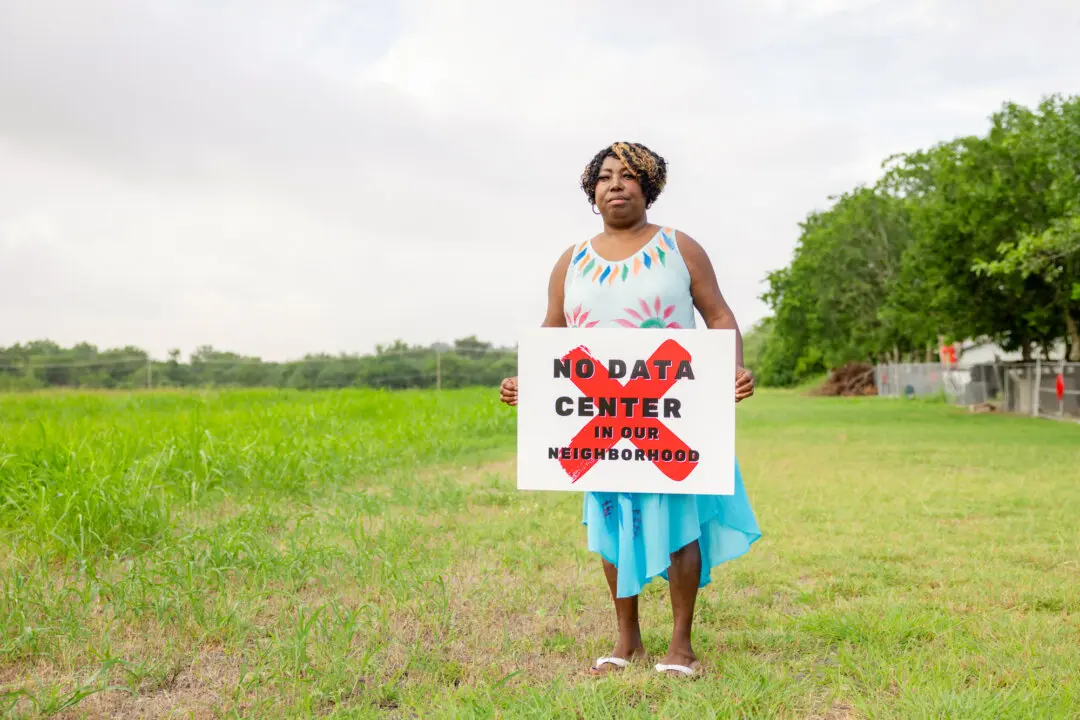
That is one reason I have become increasingly concerned about the explosion of data centers across rural America.
The conversation is usually about electricity demand, water use, or preserving rural landscapes. Those are important discussions. But there is another question we should be asking.
What are we helping build?
If artificial intelligence depends on massive computing infrastructure and those systems increasingly rely on data collected from every aspect of our lives, then these debates are not separate. They are connected.
Freedom of movement is connected to privacy.
Privacy is connected to artificial intelligence.
Artificial intelligence is connected to data centers.
Data centers are connected to energy policy.
Piece by piece, the infrastructure for an increasingly monitored society is being assembled.
I understand restricted movement in a personal way.
When my husband and I first got married, he was living in the United States without legal status. For years, we planned our lives around Border Patrol checkpoints. We turned down food truck festivals and catering jobs because getting there safely mattered more than the income.
I understand why those checkpoints existed, and I understand that those circumstances were the result of decisions my husband had made before we met. This isn’t an argument against border security.
It is simply to say that once you have experienced having your movement restricted, you never again take the freedom to move for granted.
Today, our lives depend on vehicles in an entirely different way.
On any given day, I might drive a pickup, an SUV, a tractor, a side-by-side, or a quad. My husband operates even more equipment than I do. We haul feed, move livestock, pick up diesel, and transport animals to the processor.
On a farm, mobility isn’t a convenience.
It is as necessary as water, fencing, or electricity.
That is one reason I have little interest in turning more authority over to artificial intelligence. I don’t want an AI deciding whether my tractor starts. I don’t want my vehicle to determine whether I am fit to drive. I don’t want ownership to slowly become a subscription in which someone else retains ultimate control over the machine sitting in my driveway.
Every connected system creates new vulnerabilities. As our vehicles become more connected, we should be asking not only what new conveniences they offer but what new risks they create and what freedoms they quietly ask us to surrender.
Freedom of movement should become one of the rare issues capable of uniting Americans.
Conservatives often speak about preserving liberty, protecting private property, strengthening families, and limiting government power. Progressives often speak about equity, access, and equal opportunity. The freedom to move freely through your own country advances every one of those values.
When toll roads become so expensive that they effectively separate people by income, when surveillance becomes the price of mobility, or when ownership of a vehicle no longer means meaningful control over it, everyone loses.
That is why freedom of movement deserves a place near the top of both political platforms.
Yet somehow, it rarely appears near the top of either one.
That should make all of us curious.
If protecting our ability to move freely reinforces so many of the values that both parties claim to champion, why do we repeatedly end up with legislative majorities willing to support expanding toll roads, increasing vehicle surveillance, and technologies that shift control away from the owner?
How do those ideas advance conservative principles of liberty and private property?
How do they advance progressive principles of equity and equal opportunity?
Equity surely includes the ability to move freely without pricing ordinary families off public roads or making privacy something only the wealthy can afford.
When an issue so naturally advances the values that both parties claim to champion, yet rarely appears on either platform and repeatedly moves in the opposite direction, it raises an uncomfortable question.
What forces are shaping transportation policy that seem to transcend party politics?
Hall described spending months helping stop legislation only to watch portions of it quietly reappear as amendments attached to unrelated bills in the final hours of a legislative session. Listening to her, I realized this isn’t simply about transportation.
It’s about whether ordinary citizens still have meaningful influence over the systems that increasingly shape our lives.
As people lingered after dinner on July 24, I found myself thinking about something that had very little to do with toll roads.
Here was a woman who raised 10 children, homeschooled them, invested in her community, and spent more than 20 years reading legislation that most of us never knew existed because she believed that the future was worth fighting for.
Whether you agree with every conclusion she reaches or not, that kind of long-term commitment deserves respect.
Freedom rarely disappears all at once.
More often, it is surrendered one small compromise at a time.
Perhaps it is time that the freedom to move became one of the freedoms we were finally willing to defend together.