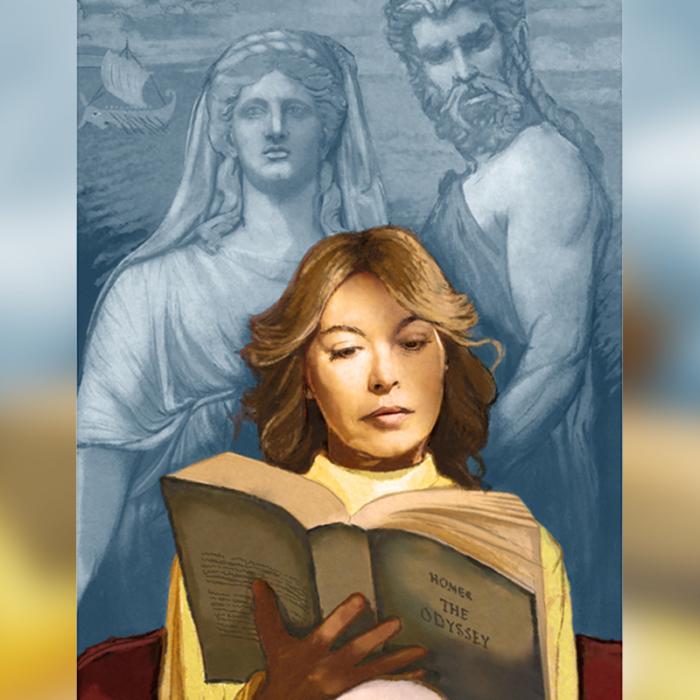
This is not a review of the movie “The Odyssey.” I’ve not seen it. But every review notes how the director Christopher Nolan relied on a translation of Homer’s epic poem by Emily Wilson, a British-American classicist, professor of classical studies at the University of Pennsylvania. Appearing in 2017, her translation of Homer’s “Odyssey” was the first by a woman into English verse.
You might ask: why does the gender of the translator matter? She says it does. She is “a woman and a gender-aware feminist,” and it is from that perspective that she has corrected “unexamined biases.” At the same time, she does not want people forever to point to her womanness because no prior translator has been routinely characterized as a man.
She is going to be mad either way. So too in her translation, in which Odysseus is stripped of his valor and instead is presented as a mass murderer, a colonial invader, a pirate, thief, adulterer, a liar, and so on, themes that are reportedly reflected in the movie version (though not enough for the translator’s taste).
And yet isn’t the goal of translation merely to render the author’s intentions in a different language and in a way that preserves the spirit of the original? That’s what the hoi polloi believe.
In the academy these days, the new orthodoxy is that words like “intention” and “spirit of the original” mask unconscious bias toward a patriarchal, racist, and colonialist outlook. The only real escape is for a person of some marginalized demographic to re-render the meaning itself according to lived experience.

Yes, you can start rolling your eyes because all these incantations are really getting old and tired. It’s been the emerged and entrenched orthodoxy in the higher realms of academia now for many decades.
The school of thought here is called deconstructionism or poststructuralism. It’s the theoretical invitation to tear up the pea patch, which is much more fun than carefully curating a vegetable garden. Deconstructionism began by ruining literary criticism. It advanced toward the real goal of bowdlerizing the texts themselves, which I can only assume is what is happening here. It ends by corrupting everything it touches, including films made from the ruined texts.
Let’s march through the steps of logic, such as it is, of deconstructionism.
Stop looking for cap-T truth or cap-M meaning, says this view. Language functions as a system of inchoate signs (signifiers) that point to concepts (signifieds), but these are not anchored in a stable authorial mind. Once a text is written, it enters a “chain of différance” where meaning is endlessly postponed through relations to other signs rather than tied to an original intent. The text “lives” independently, open to contexts the author could not control. Result: Interpretation cannot be grounded in biography or declared purpose.
Already, you are thinking: I need to un-enroll from this class! Probably you should. Or you can do what most students do, which is memorize the jargon, hate on the classics, trash all traditional understandings of everything, affect a lefty vibe, deploy some disconnected large words in random orders, and sail through this course with an A.
In the classroom, I’ve seen these feats performed on texts written in English for English audiences, such that a single word in a 1,000-page work operates as an invitation to debunk and reverse the plain intentions of the author and come out on the other side amidst a blizzard of babbling lunacy. It’s a pained process littered with neologisms and armloads of academic references and tripe.
I cannot even imagine what applying this method would do for rendering an ancient text in modern vernacular. There are enough troubles with attempting such a thing, which is why there are hundreds of translations of “The Odyssey” written over hundreds of years. But when you overlay a difficult task with a cockamamie theory rooted in nihilistic ideology, you end up in places no one can recognize. And yet here we are, with a movie that reflects that very enterprise.
I guess I have to see it at some point but I dread it. Whether the movie is good or bad, I know from the underlying theory of the source text that I won’t be seeing “The Odyssey” as rational people have understood it for thousands of years.