We often talk about the lost arts of cooking and growing food. We lament the fact that modern people don’t know how to bake bread from scratch or coax tomatoes from a small patch of soil. But there is another kind of loss happening quietly, almost invisibly, and it may be even more consequential for our future.
We have forgotten the old ways of caring for ourselves.
Just a century ago, it was common for households to maintain a working knowledge of herbs and home remedies. Families knew how to respond to everyday ailments with what they grew, gathered, or stored. Pantries held elderberry syrup and garlic honey. Cupboards stored poultices and salves. People foraged mullein, yarrow, bee balm, and wild mint as casually as we now scan the shelves at a pharmacy. These weren’t trends or niche skills; they were part of ordinary life.
On our farm, we continue that legacy because it is part of our culture and memory. We grow comfrey and make comfrey salve, the same kind of preparation families relied on for generations. My ex-husband’s father sends beeswax from his apiary in upstate New York, and we turn it into salves and chapstick for the whole family. We hang herbs such as bee balm, mullein, spilanthes, and echinacea—plants our grandparents used and talked about—because they remind us of where we come from. My father grows wormwood every year and mails it to us in simple envelopes, continuing a tradition his own elders followed and passed down through the family.
Our apothecary grows in baskets, hangs from rafters, steeps in jars, and rests amber-dark on shelves.
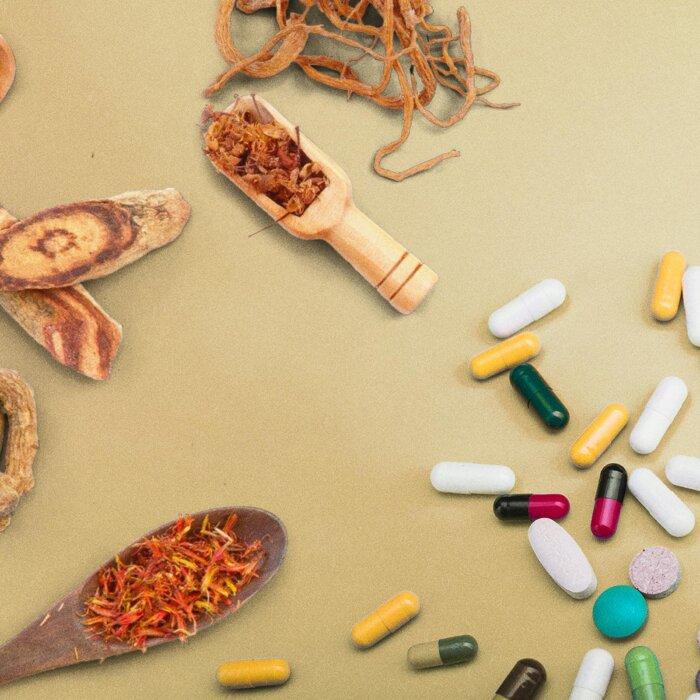

One of the things we make is a simple rosemary and dandelion root tincture steeped in vodka, something often referred to in certain communities as “Amish Advil.” I haven’t reached for an over-the-counter painkiller in more than a decade; not because anyone told me not to, but because this is the rhythm I grew up with and still live by.
As I sit in the back of my restaurant packaging tinctures made from herbs we harvested, I think about how unusual this knowledge has become. My mother and her twin sister taught me how to forage mullein, dry it with garlic, and steep it gently in olive oil to make the ear drops families used long before pharmacies existed. They also taught me that mullein makes a decent emergency toilet paper substitute, a reminder that things in nature often serve more than one purpose.
Mullein has a long history of being used for the lungs. People brewed it, smoked it, crushed it, and soaked it; its uses were part of cultural memory and community practice long before pharmaceuticals.
My aunt also taught me to make salves using comfrey from our garden, which grew so vigorously it nearly took over. She showed me how some generations used comfrey root to support recovery from cuts and bruises and why it was sometimes called “bone stitch.” She also showed me how gardeners used its leaves to enrich soil, because in the old world, the plants that were good for people were often good for the land, too.
This is the kind of knowledge that lives in hands, conversations, and memories, not in labels or instructions. Meanwhile, culturally, we have gone in a very different direction. Instead of learning the plants around us, we drive to a chain store and buy whatever package seems to match our symptoms. Most people don’t know what’s in those packages or how they work with the body. The default trust has shifted away from ancestral knowledge and toward aisles of identical boxes.
None of this diminishes the value of modern medicine. Emergency medicine, skilled surgeons, and lifesaving interventions are gifts I’m deeply grateful for. But somewhere along the way, balance vanished. Instead of blending old wisdom with new tools, we simply replaced everything that came before. Instead of cultivating connection with our own bodies, we outsourced understanding.
And now we have entire generations of people who couldn’t identify a healing herb if it grew beside their front porch.
As I bottle tinctures I harvested and steeped myself, I wonder how much longer this lineage will survive. I learned from my grandmother, my mother, and my aunt. I hope to pass it to my daughters. But I also know many families in which this knowledge has already faded.
A society that cannot feed itself becomes dependent.
A society that cannot care for itself becomes fragile.
Herbal traditions were never meant to compete with emergency medicine. They were simply part of everyday life, part of how people understood their own bodies and landscapes. The plants God placed on this Earth have played a role in human culture for thousands of years.
That wisdom deserves to remain part of our homes and our conversations—not because it replaces anything modern, but because it adds depth, memory, and resilience to our lives.
Healing, like growing food, was never meant to be outsourced.
It was meant to be practiced, remembered, and passed down.