China poses a continuing nuclear threat to the United States through a relentless effort to modernize and expand its nuclear arsenal and delivery capabilities.
The People’s Liberation Army (PLA) is executing the fastest and largest peacetime nuclear buildup in history, moving from a “minimum deterrence” force of roughly 200 warheads a decade ago toward a force that multiple U.S. officials now project could approach numerical parity with the United States and Russia within four to five years.
This is a direct military threat: more silos, more delivery platforms, new low-yield and tactical designs, and—per credible but contested reporting—a resumed covert testing program.
Historical Trajectory, Production Trends
From the 1970s through roughly 2012, the Chinese Communist Party’s declared “minimum deterrence” doctrine held its stockpile essentially flat at about 200 warheads, carried by a small, mostly liquid-fueled, silo-light force. The Pentagon’s 2020 baseline assessment still placed the arsenal in the low 200s, but that report’s projection of a doubling over the following decade has since been blown through entirely.By 2024, the stockpile had risen to the “low 600s,” per the Pentagon, a figure corroborated independently by the Federation of American Scientists: China’s stockpile had held steady at about 200 since the 1970s but now stood at more than 600 nuclear warheads.
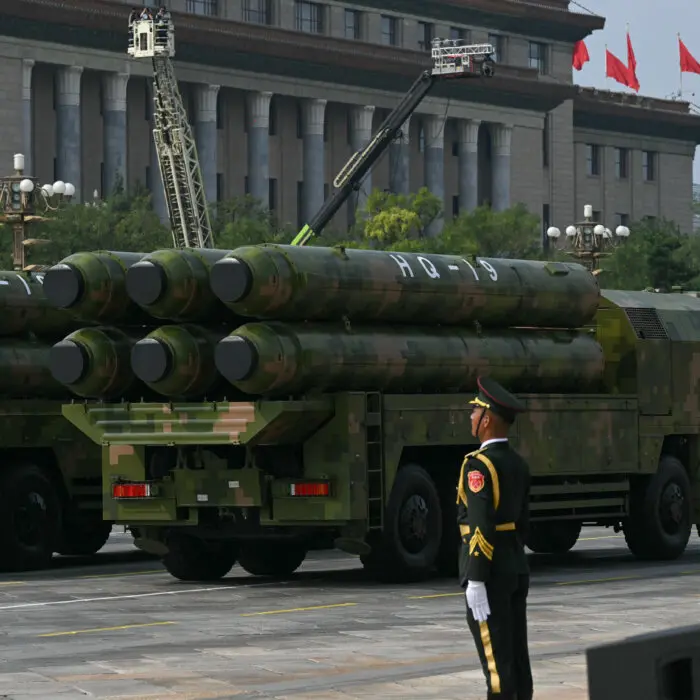
That same period saw the three new intercontinental ballistic missile (ICBM) silo fields—Yumen, Hami, and Ordos—reach substantial completion. The Pentagon’s most recent report holds to that low-600s figure through 2024 but adds an important qualifier: China’s stockpile of nuclear warheads remained in the low 600s through 2024, reflecting a slower rate of production than in previous years, yet the PLA remains on track to have more than 1,000 warheads by 2030.
- The PLA has likely loaded more than 100 solid-propellant ICBM missile silos at its three silo fields with DF-31-class ICBMs, very likely intended to support launch-under-attack postures.
- China now fields more ICBM launchers than the United States, per senior U.S. Strategic Command testimony.
- The 2025 Defense Intelligence Agency Golden Dome threat assessment projected a large increase in 2035 in nuclear-capable boosted hypersonic missiles (from 600 to 4,000), land-attack cruise missiles (from 1,000 to 5,000), and nuclear fractional orbital bombardment systems (from 60 to 2035).
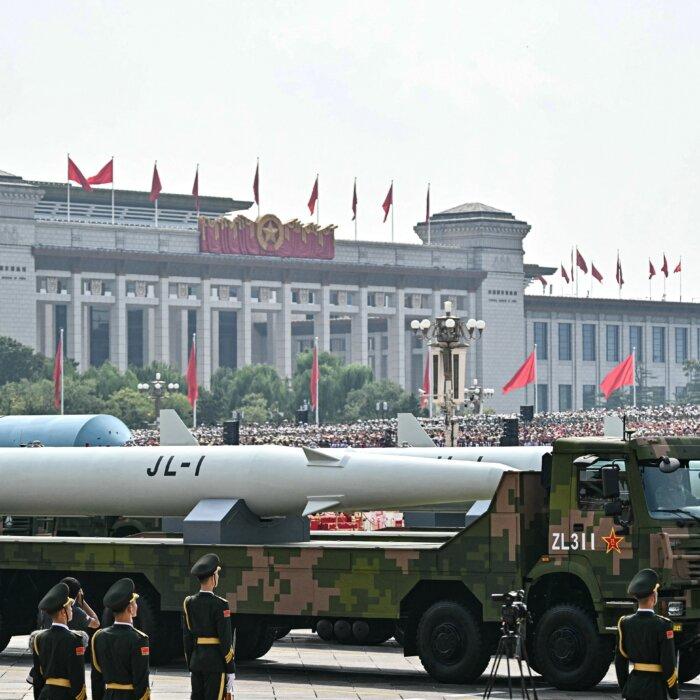
- China’s triad is now complete with the air leg: The Jinglei-1 nuclear-capable air-launched ballistic missile, carried by the H-6N strategic bomber, completes the PLA’s nuclear triad and, per a state-linked military magazine, boosts confidence in China’s second-strike survivability.
- Satellite imagery reported in a Reuters investigation, cited by independent open-source analysis, documented more than 80 previously undisclosed launch pads, hardened bunkers, and command nodes in the Xinjiang region desert near the Hami silo fields—two large octagonal command complexes built over six years, linked by rail and airfield to the silos, with camouflaged launch sites and air defense-protected positions and observed armored-vehicle exercises as recently as this spring. This infrastructure was not previously disclosed by Beijing and goes well beyond simple silo construction into a hardened, dispersed launch-and-command architecture.
Troubling Signals on CCP Intent
This is where concerns among U.S. national security experts get dicey. Several data points suggest that Beijing may be moving beyond minimum deterrence toward coercive leverage rather than pure retaliatory assurance.Covert Testing
In February 2026, Undersecretary of State Thomas DiNanno told the U.N. Conference on Disarmament that the U.S. government is aware that China has conducted nuclear explosive tests, including one yield-producing test on June 22, 2020, concealed through decoupling techniques meant to defeat seismic monitoring.Posture
The DF-61, MIRVed DF-31BJ silo loadings, and pursuit of sub-10-kiloton low-yield weapons collectively suggest warfighting and damage-limitation options beyond what pure minimum deterrence requires. Silo-loading timelines track suspiciously with Beijing’s own stated 2027 Taiwan contingency planning horizon.Precedent
China tested an enhanced-radiation warhead in the 1980s and has a documented, albeit thinner, history of interest in nuclear artillery, consistent with a preference for graduated, usable options rather than city-busting yields alone.Concluding Thoughts
No single point, whether the continuing expansion of the Chinese nuclear arsenal or the troubling signals identified above, proves coercive intent. However, the combination—hardened, dispersed infrastructure, MIRVed silos timed to 2027, low-yield development, contested-but-credible testing, and parade-stage signaling—is consistent with an arsenal built for leverage and warfighting flexibility, not for assured retaliation alone.The bottom line is that Beijing’s nuclear buildup is ultimately an attempt to force Washington to drop the perceived strategic assault on China by the Trump administration and accept a “mutual vulnerability” relationship in which neither country would have the capability or will to threaten nuclear war without risking its own destruction.
The buildup also provides China with additional leverage to coerce Taiwan and rival claimants in territorial disputes, to counter third-party intervention along China’s periphery, and to project power globally.
Most importantly, Chinese MIRVing, low-yield/tactical designs, hardened dispersed launch infrastructure, and testing-derived design improvements collectively exceed what a “mutual vulnerability” or pure minimum-deterrence posture requires, suggesting that an actual warfighting and coercive-signaling capability is also being built, not merely a survivable retaliatory floor. And that is indeed very troubling to the Pentagon.