The Nobel Memorial Prize in Economic Sciences this year goes to Joel Mokyr of Northwestern University, Philippe Aghion of Collège de France, and Peter Howitt of Brown University. It has been given for their scholarship showing the link between technological innovation and economic growth.
It’s typical with the Nobel Prize in economics that the first response is always something such as “We knew that already.” But think about it. When any new innovation comes along, and this dates as far back as the printing press—the scribes flew into fury—the first concern is always about the people who will be put out of work. This is certainly true in artificial intelligence.
There is always more worry than joy. That is true of flight, commercialized steel, electricity, internal combustion, the database, and nearly every innovation that you can name back to the crossbow.
These economists recognize that innovation certainly does create job losses. But more-efficient ways of doing things also open up new job opportunities. Most importantly, technology creates wealth, which can then be fed into more capital investment and further economic opportunities for all. This is the burden of their work, along with the general lesson that societies should welcome innovation.


Here is what Schumpeter wrote:
“In dealing with capitalism we are dealing with an evolutionary process. ... [It] is by nature a form or method of economic change and not only never is but never can be stationary. And this evolutionary character of the capitalist process is not merely due to the fact that economic life goes on in a social and natural environment which changes and by its change alters the data of economic action. ... The fundamental impulse that sets and keeps the capitalist engine in motion comes from the new consumers’ goods, the new methods of production or transportation, the new markets, the new forms of industrial organization that capitalist enterprise creates.”
Further, he wrote, it’s the “process of industrial mutation—if I may use that biological term—that incessantly revolutionizes the economic structure from within, incessantly destroying the old one, incessantly creating a new one. This process of Creative Destruction is the essential fact about capitalism. It is what capitalism consists in and what every capitalist concern has got to live in.”
Why was this interesting? Back in Adam Smith’s time, the main focus became solving the question of where new wealth comes from. Since the ancient world, it was widely believed that one could only become wealthy by taking from someone else. This involved conquest or cleverness or trickery or something, but it was widely believed that there was no process endemic to economic structures that generated new wealth.
Reality all around them confirmed that. But as the plagues ended and prosperity began to dawn in the late Middle Ages, the problem presented itself in new forms. It was clear that society had become richer. How and why?
Adam Smith’s enduring answer did not take recourse to innovation. His observation was that the division of labor—ever more widening circles of human cooperation—permitted more specialization and economization on the use of time and talent. The division of labor has a mysteriously interesting math about it. It shows that even the most talented person in the world benefitted from trading with people with less talent in every area. This is because such cooperation relies not on absolute advantage but comparative advantage. Thus was born the science of economics.
Schumpeter was of a generation that was convinced of Walras’s theory and carried around with him a “general equilibrium” framework. But he was also among the first to notice a big problem with the model. It did not account for change. Real life was not functioning the way that the models said they would. Instead, we live in a world of ceaseless change.
Schumpeter’s answer was that entrepreneurship permitted society to break out of the Walrasian box of perfect market clearing, thus introducing every form of disruption. This change was necessary for good and ill, job gains for some and job losses for others. This insight allowed him to preserve his Walrasian model while accounting for real-life change.
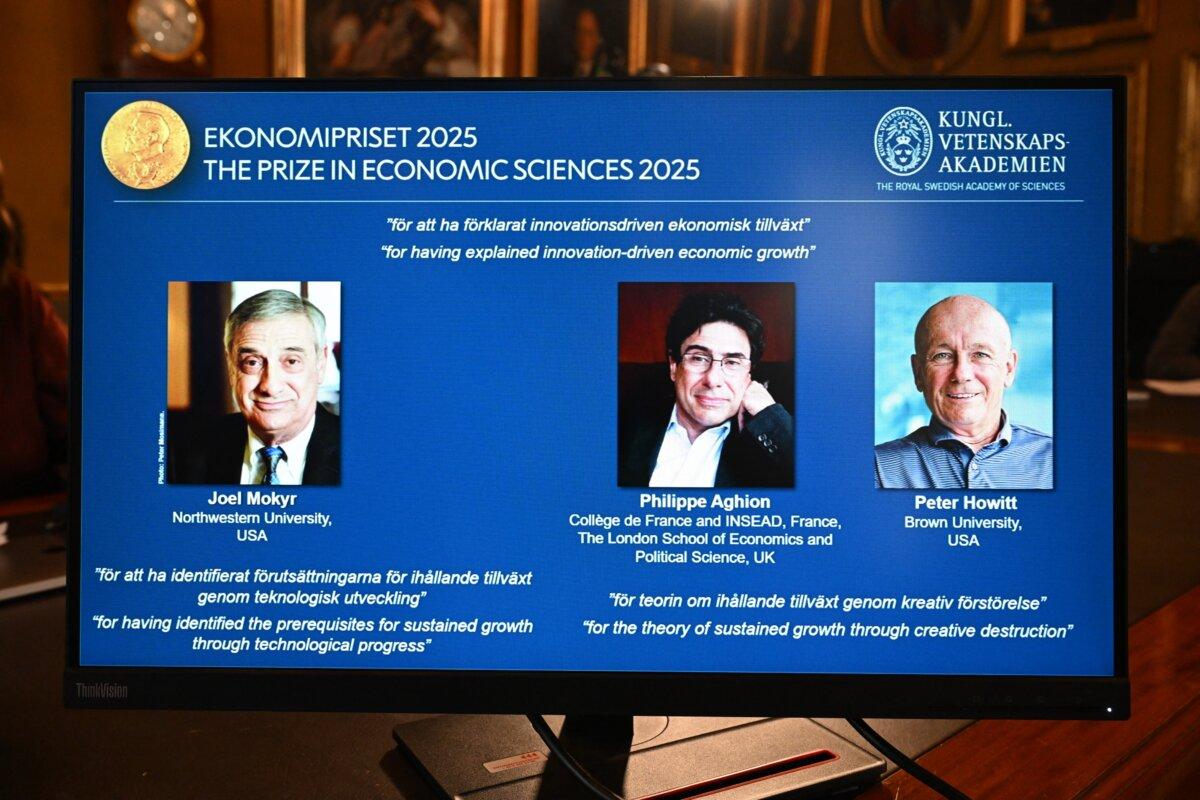
A much more interesting feature of Joel Mokyr’s writing in particular concerns his reflections on cultural entrepreneurship, which he distinguishes from judgments of businessmen and bankers over the use of resources. Cultural entrepreneurs are people who pitch new ways of thinking and living, new paths for organizing politics and new religion, and new philosophies for going about our lives.
Such people operate for good and ill. St. Augustine was a cultural entrepreneur, and Jesus of Nazareth before him, and Martin Luther after him. But so were G.W.F. Hegel, Karl Marx, and Anthony Fauci. These are people who battle it out in the world of ideas, confronting the failings of the old ways while pitching to the people and leaders a new way of doing things. Sometimes their efforts lead to glorious results, and sometimes to disaster.
An example of today’s best among them is Robert F. Kennedy Jr., who labored ceaselessly in the world of litigation and law and then saw the need to stand up and speak out against the overmedicalization of children. He is now at commanding heights as head of Health and Human Services and works daily to make changes and evangelize for his cause.
Resource and cultural entrepreneurship can be combined as they are in the institution of The Epoch Times, founded to fulfill aspects of the mission of Falun Gong, and which now engages the culture in print and digital publishing that rivals legacy media outlets for influence.
In some ways, intellectuals, podcasters, and social-media influencers are engaged in this, too, daily urging a new way of looking at politics, life, technology, religion, and more. This world is just as exciting and influential as that world of the lab and the financial markets.
It’s too rare that we can say without hesitation that a Nobel in anything is wholly deserved, but this one to these economists certainly is. There is much to learn from this body of thought.