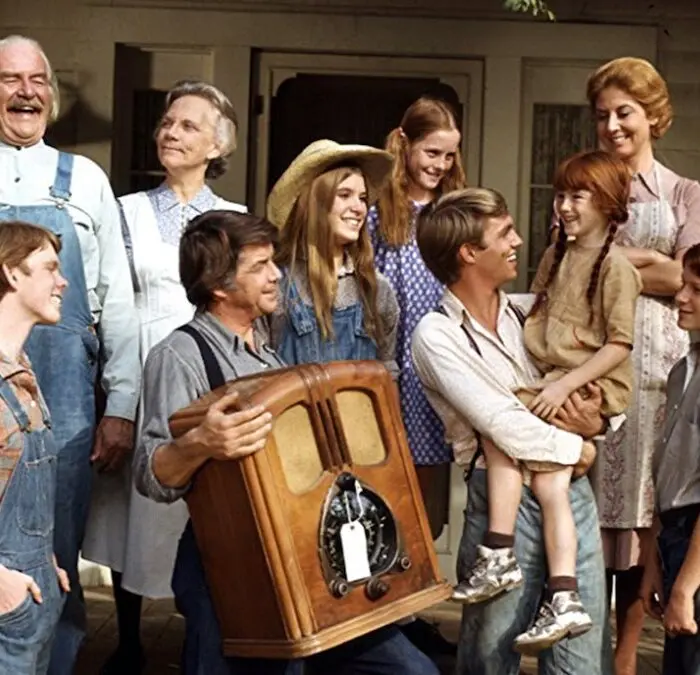
“The Waltons,” a phenomenal television show from the 1970s about a Virginia family during the Great Depression, has emerged as my all-time favorite series. It’s always reliable, interesting, revealing, and uplifting. It seems actually remarkable that it exists at all, much less holds up so well after half a century.
I vaguely remember it as a kid but watching now I’m astonished at its historical accuracy. It is teaching me features of American culture of the past about which I knew nothing.
Consider, for example, the episode in Season 3, in which John Boy, the oldest child, decides to participate in a dance marathon. His mother Olivia is scandalized and forbids it. But by now he is in college and chooses this particular event to test his adult autonomy, even if it means neglecting household chores and help for a full week plus, there is a girl involved with whom he wants to partner, thus clouding his judgement.
So he goes for it. It is held in a nearby town in a dance hall. A company has arrived with a promoter and a crew. Many young people sign up for the challenge in hopes of winning $200, a great deal of money in 1934. The plan is for the challenge to last a week. The couple that goes the longest wins the prize.
It lasts all day, dance for one hour and fifty minutes, take a 10-minute break, and start again. You sleep but only in the building. Wake. Dance all day. Sleep. Start again. Feet swell. You start to go crazy. You wonder why you took this on. One partner wants to give up but they are bound together in this madness, so no one wants to drop out.
There is this thing called an elimination round. You dance faster and faster going in a circle and whichever couple falls back is taken out. Others collapsed in exhaustion and sleep deprivation. Nurses are on hand but still some people have to be rushed to the hospital.
There are spectators who pay and gamblers who make bets. There are concessions. The crowd has a great time watching the spectacle of it all.
In “The Waltons” version, John Boy’s parents arrive just as he has realized the error of his ways. He drops out even though his partner begs him to stay because she is desperately poor and needs the money. He says no and walks away, apologizes to his mother, and then sleeps the entire rest of the day. The episode ends.
It’s the craziest thing I’ve seen in a long time. It was kind of a “Hunger Games” in its exploitation and cruelty. And yet I know that this series strives for historical accuracy.
As it turns out, the dance marathon of the early 1930s was very real. They popped up all over the country in hard times. The promoters took a fun activity like dancing and pitched a very cruel scam. It worked and they made the big bucks. It was not necessarily fair either. The promoters would hire one or two couples who know the racket well, pace themselves, and take the prize money every time. No one knows who they are. Everyone else wastes a week of time and is pillaged.
Horrible. Yes, people participate voluntarily. No one is forced. It works because it draws on greed, lust for competitive action, the love of spectacle, and the lure of the dramatic. You could say that no fraud is involved but it is still a scam. The dance marathon was widely banned in towns and cities all over the country by the mid-1930s.
As it turns out, there was a famous novel that came out in 1935. It is “They Shoot Horses, Don’t They?” by Horace McCoy. McCoy had worked as a bouncer at such events and used that experience for the story of contestants trapped in a bleak, desperate competition. The book later inspired the well-known 1969 film adaptation directed by Sydney Pollack (starring Jane Fonda and others).
The producers of “The Waltons,” then, likely got the idea from the film but it is a realistic picture of the times.
Whatever the impulses that exist within the human spirit that gave rise to the dance marathon are surely still with us, so I began to wonder about the modern equivalent. There are the obvious cases of shows I’ve never seen, these “reality TV” series about survivors and tests of the human spirit and so on. They invite mass voyeurism and exploit all the participants who are desperate for fame. I would never watch such a show. The very idea disgusts me personally but they are very popular.
Let’s move beyond popular entertainment and look at culture more broadly. The dance marathon was popular and profitable, however briefly, because people are drawn to a challenge. It provides a sense of mission, even meaning. If it leads to pain and suffering, all the better. That which is worth getting is also worth the difficulties in getting it.
This is all the more true because a large swath of American workers, and people the world over, have much easier lives than our ancestors. Instead of clearing forests and struggling against the elements, people sit, click buttons, eat, drink, and consume entertainment. This life does not speak to the primal need to believe one’s life has productive and transformative meaning.
This is where things like politics come into play. It allows one to join a team and struggle against an enemy. It is brutal, winner-take-all, and the stakes are high. It attracts money, leads to power over others, and allows participation in the crafting of the social and cultural order. It seems to matter and so people do it, even though the journey is long and arduous with an elusive payout.
The pandemic period provided something similar. It had a set of implausible rules, like a new game. Six feet apart. Stay home for long periods. There is a payout that arrives in your bank. There is a set of beliefs, a list of heroes, and villains to oppose like the unmasked and unvaccinated. It caused enormous suffering but that is a feature not a bug from the point of view of the otherwise bored. It gave many people a sense of meaning.
The medieval flagellants attracted followers for the same reason. Sack cloth. Long marches from town to town. Deprivation of sleep and food. Shaming others while valorizing oneself and one’s cause. The hatred of others who are not doing penance. It had all the same psychological makings.
The dance marathon was a particularly insidious enterprise because dancing seems fun. Why not extend it for days and even weeks? The promoters are the ones who converted a nice institution from fun to demonic, a commercial racket that shredded bodies and souls at a time of social and economic desperation. It’s a tremendous example of how the unscrupulous can take advantage of an otherwise innocent and playful cultural habit.
It’s good to know this history if only to trigger one’s awareness. Be alert and beware! John Boy’s mother was correct all along. He did not belong in that dance hall and neither does any person who strives to live a good and respectable life. He should have been reading and doing chores, as we all should.