The latest jobs numbers make for good headlines. However, there is trouble beneath the surface. The increases are concentrated in health care and social assistance, while younger professionals seem nearly locked out of jobs that they expected.
Consider the following scenario.
You are in your late 20s, talented, and trying to get a foothold in a career. You earned a nice degree in economics from a decent university. You have a good job, have bought a car, have credit-card debt and student-loan debt, and are saving for a down payment on the house that your new wife loves. She is expecting a child.
Suddenly, you are laid off in a corporate restructuring. Nothing unusual. Thousands of others in your industry have dealt with this recent bout of layoffs.
You hit the job market. Send out dozens and then hundreds of resumes. No answer. Months go by. Every day is like the previous day, working at the kitchen table during times when you were once at an office. You try to keep your spirits up. Inside, you are starting to panic.


Whatever happened to the corporate recruiters who are paid to seek out people like yourself? A few years ago, they were everywhere. You could choose among them. In terms of job seekers, it was a seller’s market, and you had the goods. Times have changed.
Watching your financial flow dry up and lacking any capital, sitting on debt with interest, you start wondering about the future. Then you notice a new service that has become available. It’s called reverse recruiters. It’s reverse because instead of seeking you out, you have to seek them out. It’s like carrying a manuscript for which you are seeking an agent.
This reverse recruiter will clean up your resume, fix up your social profile, find suitable positions for you, send in resumes, line up interviews, use all contacts in an industry, and so on. No promises, but they will do their best. The charge is $500 to $3,000 per month. You are financially in a bad way and are now being asked to pay more money just to get your foot in the door.
Another model is this: You agree to pay the recruiter 10 percent to 20 percent of your first-month or sometimes first-year salary. True, this is a thing. It’s like a tax, and the recruiter takes you on as a speculation. No money needs to exchange hands until the winnings become available, like a lawyer who will file suit for you on condition of taking half the settlement fees.
Such is the new order of things. When you are at your lowest, the market is driving you lower, to the point that you cannot sleep at night. You have to stay in good stead with Mom and Dad because they might have to open up the spare bedroom soon. You are suddenly aware that but for their benefaction, you and your wife would have nowhere to go.
It’s a strange reality into which we’ve moved, especially for people who have spent many years in school and feel entitled to enter into the professional ranks of lifetime jobs working on keyboards. They are being hit very hard in this job market, which is purging whole sectors of management and “thought workers” while favoring plumbers, builders, welders, and cooks.
The Bureau of Labor Statistics keeps track of hiring and firing. In some ways, these numbers are more revealing than the broader unemployment numbers, which seem more or less fine. Not so with hires. The job market looks really rough out there. New hires in business and professional services are going in the wrong direction fast.
The sticky market has profoundly affected the very groups that have done well over 15 years, an entire generation that learned one easy path to success: Get a degree. Clean up your resume. Perform well in the interview. Land the six-figure job with benefits. Don’t do much other than flatter your direct report. The end.
Those days have been ending now for a few years. Large companies are taking a machete to whole lines of management, including bloated staffs.
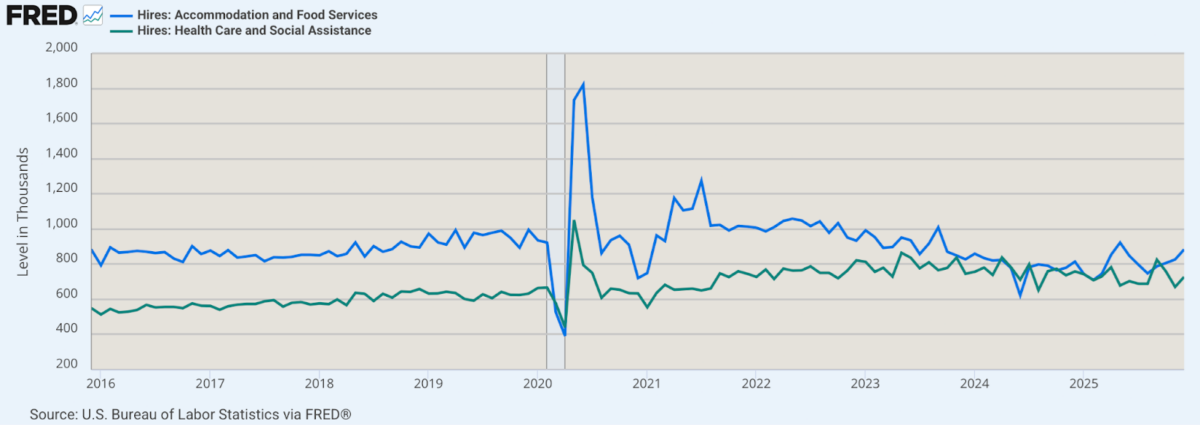
Meanwhile, there are two sectors in which hiring is occurring at an even pace and without much disruption. They are accommodation and food services and medical care. You can work through the irony of that confluence if you want to. Even given that, these are fields for people who mostly actually do things.
More generally, there is a growing gap between the number of people who want jobs and the number of jobs available. You cannot tell that by looking at online marketplaces for employment. As it turns out, many companies post positions they have no interest in filling. Having open positions is a good look for investors and helps stock valuations.
Unemployment for college graduates is rising and approaching recession levels at 5.6 percent, which is pretty much where it stood in February 2009 during the financial panic.
There are many factors that could help this problem, but the No. 1 issue concerns the high costs of health insurance. It is harming business to take more people under its wings. So far, no reforms have been able to break this connection between health insurance and employment, a link that never should have been there and could easily be offloaded with the right incentives.
The cost of health insurance is also making it extremely difficult to find affordable insurance for independent contractors. Think of the example of that young man at the start of this essay. Companies continue insurance even after termination, but not for an extended period. Even if going without is the rational thing to do—signing up for a crowd-sourced private system is the best—many young workers have a dependency relationship with conventional insurance. They don’t know what to do when it runs out.
Congress could today solve this problem by making new catastrophic plans available, ones that do not force people into ridiculous and expensive “wellness checkups” and “preventative care.” The same reform package could make available health savings accounts for everyone if the individual has no health insurance at all. Right now, that is not possible for the most part. Such simple reforms would enable individuals to market themselves to companies as much less expensive, because they are declining insurance through their employers.
In addition, at some point, reformers have to do something about the high payroll tax that enrolls all workers into systems of social entitlement that they do not want. That means finally giving an opt-out to Social Security and Medicare provision. I am aware that this sounds politically impossible, but as long as that remains, the job market will be vulnerable to the types of tightening we are seeing right now.
Finally, we have the issue of artificial intelligence that is weighing on all professional sectors right now. In legal services, publishing, finances, and customer services, AI is doing a competent enough job already to cause companies to pare back in their hiring. How far this can go is anyone’s guess. AI cannot do everything, but it can do many things once done only by people.
For young professionals who are only marginally employed while sporting impressive credentials or who have just lost a promising job, these are challenging times. No longer is it Easy Street for this labor cohort. They are going to have to get very creative to survive this market.
None dare call this a recession—it’s not clear we can even measure such swings with any accuracy anymore. It hardly matters either way for those whose promise of job security has turned to shock and alarm that things haven’t worked out as planned.