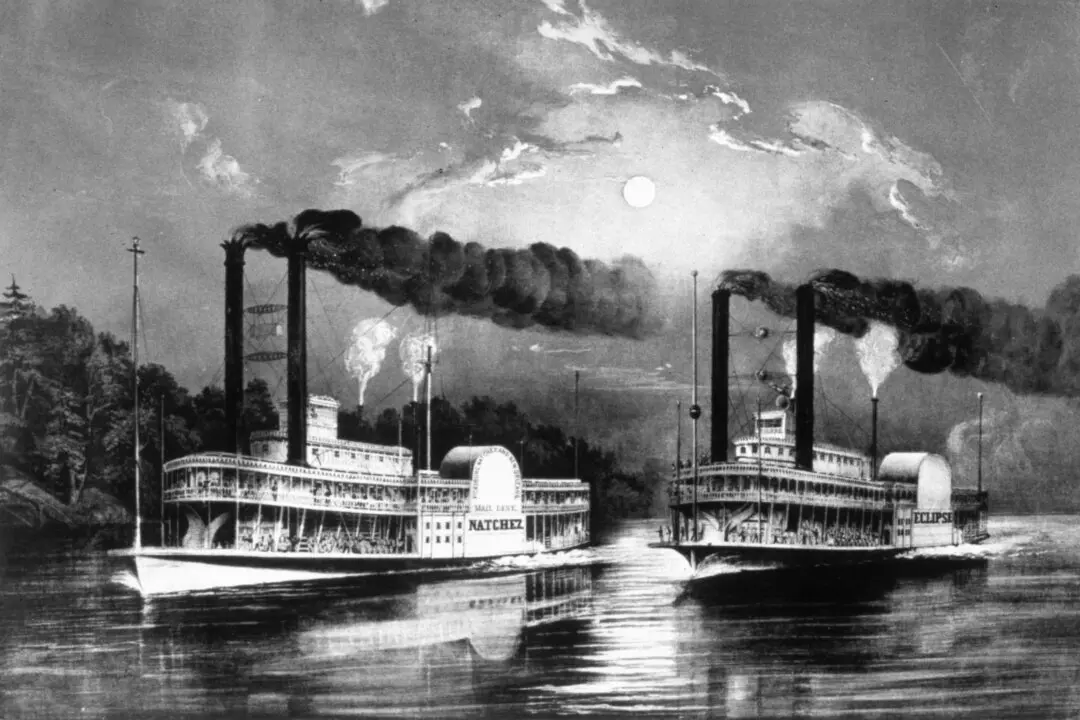
In the 1880s, in a fit of technocratic enthusiasm, the railroad industry hatched an audacious scheme. They would force every town in America to abandon what was called time for all recorded history and instead adopt a new conception. The goal was to make it easier to follow train schedules.
The trouble, as they saw it, was that every town had a slightly different time on the clock. You could ride the train for an hour and be at the destination at a time not different or even earlier from one you left. How can you make sense of this?
It was never a problem in the past but now the modern age necessitated a big change, or so the theory said. There was even a brief and mostly fake hysteria that keeping the status quo would lead to more train crashes. Oh sure.
One solution was to offer a railroad time that would pertain to the industry alone. Clock manufacturers made wall clocks with two faces and both times. Fine.
That worked for a while but then it wasn’t enough. The industry lobbied every city council and every state house to override local time (or what is called solar time) for their engineered form of time. Incredibly, and with enough payouts and bribes, it worked.

The people were not happy. There were protests and resistance. Bars facing mandatory closing times refused to adhere and instead kept time as it always had been kept. Finally the courts intervened. They sided with industry over tradition and biology. By the turn of the century, the victory of the railroads was complete.
By the way, I’m still protesting this change. On New Year’s Eve, I only offer a toast at solar time midnight. To heck with what the central planners say.
In 1917, the United States entered the Great War, and the industrial overlords decided to push their luck again. They invented Daylight Savings Time, designed to grant more daylight to working and opening hours and less in the mornings. But of course this was only called for in half the year due to the tilt of the earth and its rotations.
This is where the real thicket began. For longer than a century, most parts of the United States have switched the clock back and forth between two constructed and engineered conceptions of time. Neither is related to the sundial (God’s time) but standard time comes closest.
The news out of Washington is that the House of Representatives has finally decided to end this insanity and settle on one time alone. Incredibly, they have settled on the wrong choice. They have embraced Daylight Savings Time over Standard Time, a solution which every leading authority on biology and health agrees is the wrong one.
The bill is called the Sunshine Protection Act. The sun does not need the government to protect it. We need protection from Congress.
Once again, the choice of DST signals the triumph of industrial lobbyists over the people and over nature. It’s true that the bill allows states to pass legislation to adopt Standard Time provided they do it before a deadline. That said, the intent of universalizing DST is clear.
Human physiology evolved under the predictable rhythm of the sun. I’m not a scientist but I can read and all literature—anyone can—and it clearly reveals that disrupting that alignment through clock changes carries measurable costs to sleep, metabolism, cardiovascular health, mood, and safety. The worst system is shifting back and forth. The least bad system is what we used to call Railroad Time or what is called Standard Time.
Major medical organizations, including the American Academy of Sleep Medicine (AASM), have reviewed the evidence and concluded that permanent standard time best serves public health.
At the core of this recommendation lies the circadian system. Nearly every cell in the body operates on an internal clock with a natural period slightly longer than 24 hours—typically around 24 hours and 12 minutes in humans. The master clock—called the suprachiasmatic nucleus (SCN) in the hypothalamus—synchronizes these rhythms to the external environment.
Light is the primary time-giver, all research shows. Specialized retinal cells containing melanopsin detect light and send signals directly to the SCN, independent of vision. Morning light exposure advances the circadian phase (makes rhythms run earlier), promoting alertness via cortisol release, suppressing melatonin, and aligning sleep-wake cycles.
Evening light delays the phase, postponing melatonin onset and making it harder to fall asleep at the right time. Standard time keeps sunrise and sunset times more closely matched to solar time, especially in winter. DST, by advancing clocks one hour, effectively delays sunrise on the clock. This creates morning darkness (less advancing light when the body most needs it) and extends evening light (more delaying light). The result is chronic circadian misalignment, often called “social jetlag”—a persistent mismatch between biological time and social schedules (work, school, meals).
This misalignment does not fully resolve even after weeks or months on DST. The body’s internal rhythms remain anchored closer to solar time, leading to ongoing sleep pressure, altered hormone profiles (delayed melatonin, blunted morning cortisol), disrupted metabolism (affecting glucose regulation, hunger hormones like ghrelin/leptin), and impaired immune and cardiovascular function.
The twice-yearly transitions themselves provide clear evidence of harm. The spring “forward” shift deprives people of roughly 40–60 minutes of sleep on average and induces abrupt circadian disruption. Meta-analyses of epidemiological data show a statistically significant increase in heart attacks in the days following the spring change—pooled relative risk around 1.04 (a roughly 4 percent increase). Similar short-term rises occur in stroke incidence, atrial fibrillation hospitalizations, emergency department visits, missed medical appointments, and motor vehicle crashes.
The autumn “fall back” produces far milder or negligible effects in most studies, consistent with its moving clocks closer to solar time. These acute spikes reflect real physiological stress from sleep loss and hormonal shifts during the vulnerable transition window.
Beyond transitions, remaining on DST year-round creates ongoing misalignment, particularly problematic in winter when daylight is already already short. Later sunrises under DST mean darker mornings for commutes and school starts, reducing the critical morning light signal needed for robust circadian entrainment. Evening light extension further delays sleep onset.
A 2025 Stanford Medicine modeling study, published in Proceedings of the National Academy of Sciences, quantified these effects across U.S. counties using light-exposure data and CDC health prevalence statistics. It estimated that permanent standard time would reduce national obesity prevalence by 0.78 percentage points (roughly 2.6 million fewer cases) and stroke prevalence by 0.09 percentage points (about 300,000 fewer cases) compared with the current system. Permanent DST achieved roughly two-thirds of these modeled benefits. Biannual changes performed worst.
The model further emphasizes that prioritizing morning light exposure (as standard time does) minimizes “circadian burden”—the cumulative adjustment the internal clock must make to stay synchronized. Other research links chronic misalignment to higher risks of metabolic syndrome, depression, and poorer cognitive performance, with adolescents and evening night owls disproportionately affected.
Proponents of permanent DST or the status quo sometimes cite historical rationales like energy conservation, agriculture, or evening recreation. Close analyses, however, show these benefits are marginal or nonexistent. Electricity savings from DST are small or offset by increased morning and air-conditioning use; some studies even find net increases in consumption.
Agriculture and industry adapted to solar time long before clocks; the one-hour shift was never a fundamental requirement. Health and safety data—sleep quality, cardiovascular events, accidents—provide a clearer, evidence-based priority.
Permanent standard time does not eliminate evening activities. It simply restores mornings to a more natural alignment with sunlight, benefiting the majority of the population whose chronobiology favors earlier light cues. International precedents and expert consensus align with this view. The European Biological Rhythms Society, European Sleep Research Society, and Society for Research on Biological Rhythms have jointly endorsed permanent standard time.
Russia’s experiment with permanent DST (2011–2014) was reversed amid public complaints about dark mornings and health impacts. The United States has seen repeated legislative pushes, but sleep medicine experts consistently favor standard time.
Adhering to permanent standard time respects biology and nature. DST is an artifice.
Incredibly, the United States has tried this before. President Nixon in 1973 sign a law that would make DST permanent for purposes of saving energy. It went into effect in January of 1974. He left office in August. By October, public outrage forced a rollback of the entire scheme. President Ford signed legislation that would go back to standard time. Then the entire mess started over again in the spring as Daylight Savings Time came back.
Maybe we all just need a sundial.