In 2009, I opened a tiny vegan ice cream shop in Studio City with my best friend, Mimi. It sat on Cahuenga Boulevard where Ventura Boulevard ends near Universal Studios. It was only about 700 square feet, but to me it felt enormous. It was the first business that was truly mine.
We sold vegan ice cream, fresh juices, smoothies, milkshakes, and espresso. Our customers were primarily vegans, people who were lactose intolerant, and members of the local Jewish community who appreciated having a nondairy dessert after meals that included meat. It was a loyal customer base, but it was also a narrow one. Organic ingredients were expensive, margins were thin, and I quickly realized that while the concept worked, building a sustainable business on ice cream alone would be difficult.
That little shop became something much bigger.
Like a tiny snowball rolling downhill, gathering more snow with every turn, it eventually grew into five restaurants across Los Angeles with a valuation north of $30 million. Every restaurant still had ice cream out front, but by then, the ice cream had become only one part of a much larger business.
Looking back, that humble storefront also introduced me to something else that would become all too familiar: bureaucracy. It was my first real lesson in how difficult it could be to build something in the brick-and-mortar world.

Nearly twenty years later, I find myself in a different state with a completely different business model. Instead of trying to fill tables in Los Angeles, I’m trying to bring people consistently to Sovereignty Ranch.
Some weekends we’re packed. Other days, customers trickle through one at a time. That inconsistency makes everything difficult. How many employees do you schedule? How much food do you prep? How do you make payroll when you never know whether 20 people or 200 will walk through the door?
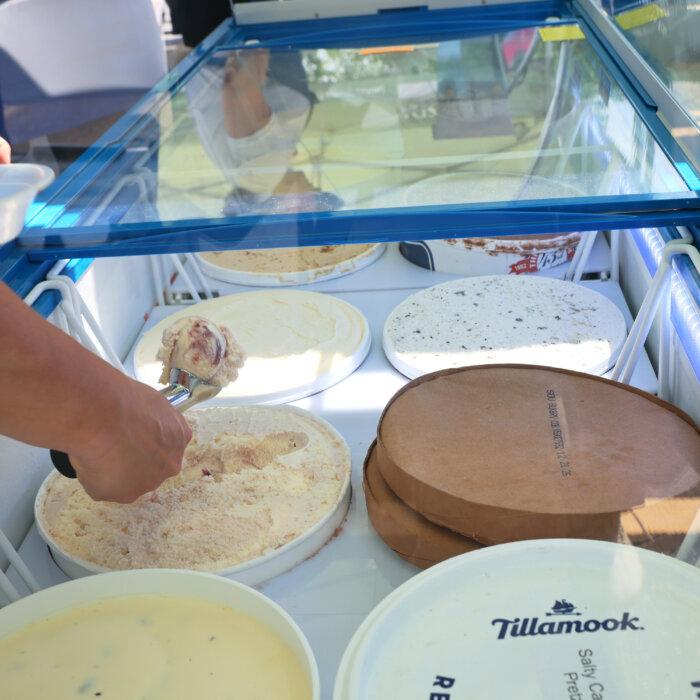
We’ve sold popsicles in the farm store for quite a while, but my husband had resisted pulling out the old Emery Thompson ice cream machine and the gelato case. He wasn’t wrong. Ice cream is another inventory to manage, another piece of equipment to maintain, and another product that has to be made before customers ever arrive. I remembered spending countless nights making batch after batch just to have enough inventory for busy weekends.
Still, I couldn’t shake the feeling that it was time.
After enough convincing, my husband helped me move the equipment with the box truck, install electrical outlets, run water to the machine, and get everything into place. By Friday afternoon, everything was finally ready.
He looked at me and said: “Let’s wait until next week. Weekdays are slow. You can make the ice cream then.”
I looked back and said: “No. Let’s do it today.”
One of my greatest strengths has always been my willingness to simply try. I often wonder how many good ideas never become reality because they’re overanalyzed instead of attempted. There is, of course, a downside to this approach. Sometimes, I leap before I look. Sometimes, I create work for myself that could have waited. But more often than not, I’ve found that progress belongs to the people willing to begin before they feel completely ready.
I’ve never been the smartest person in the room, and I certainly don’t have life all figured out. What I do have is a stubborn belief that most problems can be solved if you’re willing to keep showing up. Throw your hat over the fence, as the saying goes, and then figure out how to climb over after it. That philosophy has built businesses, started farms, carried me through failures, and now, apparently, gotten an old ice cream machine running again.
We had help in the restaurant. My brother could cover the front with another friend while I made ice cream. I decided to make the least expensive flavor first in case the machine had problems after sitting in storage for years. Coconut ice cream came out perfectly. Beautiful. I started to relax.
Then I started the next batch.
The compressor shut off.
Suddenly, I had 5 gallons of chocolate custard base and 5 gallons of vanilla custard base sitting there, ready to freeze, and a machine that refused to cooperate.
I called my dear friend, Jorge. He’s a general contractor now, but he began his career working on commercial refrigeration and ice cream equipment. We FaceTimed for what felt like forever, trying to diagnose the problem. We tested theories, checked connections, and finally admitted we weren’t going to solve it that night. Discouraged, we quit troubleshooting and spent a little time admiring his brand new grandchild instead. The custard went into the refrigerator, and I headed home hoping the answer would come in the morning.
At 5:30 the next morning, I woke up still thinking about that machine. I walked down to the restaurant convinced it had something to do with the high-pressure or low-pressure safety switch. Maybe everything had simply cooled overnight. I flipped the breakers.
Nothing.
So I did something that didn’t exist when I opened that first ice cream shop in 2009.
I asked ChatGPT.
It asked me for a photograph of the Copeland pressure switch. I snapped a picture, uploaded it, and within moments, it walked me through resetting the switch. By 5:45 that morning, the compressor was running again. By 11:00 a.m., the entire gelato case was full.
On the very first day, we offered organic A2 A2 ice cream at the ranch, we sold 51 scoops.
Will ice cream solve the financial challenges of running a ranch?
Of course, not.
People often talk about economies of scale. Produce more of one thing and eventually the numbers work. That may be true if you’re farming thousands of acres or running tens of thousands of cattle. But this isn’t a generational ranch that’s been paid off for a century. My husband and I bought this property with a mortgage.
Cattle alone won’t make that payment. Corn won’t either.
For us, survival depends on economies of scope. The cattle support the restaurant. The restaurant supports the farm store. The farm store supports the events. The events support the lodging. The lodging introduces people to regenerative agriculture. Every part of the ranch strengthens the others.
But if I’m honest, the best days on the ranch aren’t measured by receipts.
They’re measured by families.
The happiest days are when children race from the bounce house to the trampoline, stop to feed the animals, sit down with their parents for pizza, wander through the farm store, and finish the afternoon with an ice cream cone in their hands. Ice cream isn’t just another menu item; it’s part of the experience of childhood.
My dad used to take my brother and me to Ben & Jerry’s. We were allowed to order double scoops, but before we got back into the car, he insisted on getting our ice cream “under control,” which somehow meant eating about a third of each cone himself. Cherry Garcia was always my favorite. I still remember standing there trying to decide which flavor to choose, convinced it was one of life’s biggest decisions.
I recently wrote about how some of my favorite ice cream companies have moved in directions that no longer reflect my own values. One celebrates causes I don’t share. Another refuses to accept cash.
It occurred to me that I probably wasn’t the only parent looking for an ice cream shop that aligned with my values, not only around local food, organic ingredients, and high-quality dairy, but around the idea that businesses can simply welcome everyone. A place that takes cash, serves real food, and gives families a chance to slow down together for a few minutes.
Maybe that’s why this doesn’t feel like going backward at all.
The little vegan ice cream shop that Mimi and I opened in 2009 wasn’t a detour. It taught me skills that my family needed nearly 20 years later. Sometimes, the work we think we’ve left behind is simply waiting for the right season.
People often say life comes full circle, but I don’t think that’s quite right. A circle ends where it began. Life doesn’t.
It spirals upward.
You return to familiar work carrying more wisdom, more scars, more gratitude, and a clearer understanding of why it mattered in the first place. Sometimes, the skills you think you’ve outgrown turn out to be exactly the ones you need. Sometimes, the thing that makes you feel like you’re moving backward is really the next step forward.
And sometimes, that next chapter begins with something as simple as handing a child an organic ice cream cone on a summer afternoon.