This copy is for your personal, non-commercial use only. Distribution and use of this material are governed by our Subscriber Agreement and by copyright law. For non-personal use or to order multiple copies, please contact The Epoch Times Reprints.
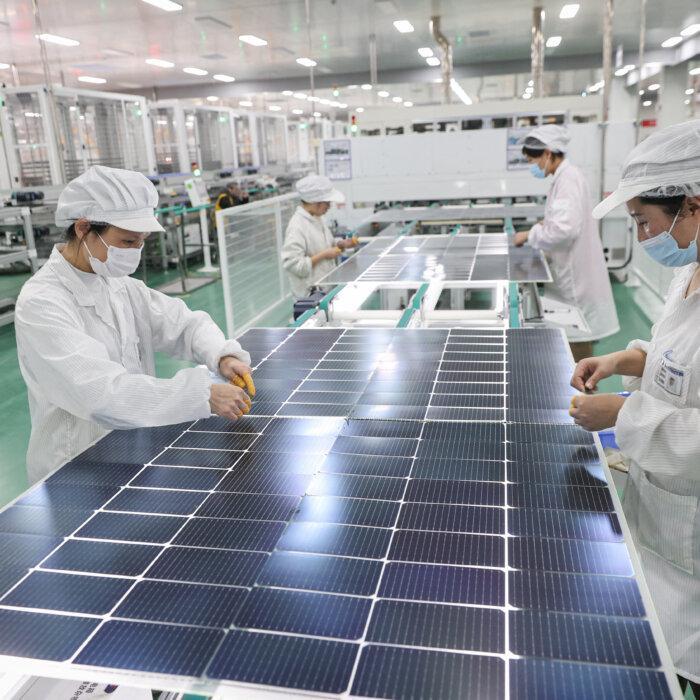
Employing a standard communist tactic, Beijing’s information warfare campaign to blunt and mask the potentially devastating effects of U.S. tariffs kicked into high gear with a flurry of stories citing rosy Chinese growth and production statistics.
For example, the National Bureau of Statistics (NBS) claimed on April 16 that “the gross domestic product (GDP) in the first quarter reached 31,875.8 billion yuan, up by 5.4 percent year on year at constant prices.”
This is odd given that this GDP growth (if actually achieved) would seem to indicate that U.S. tariffs are having zero impact on China’s export economy.
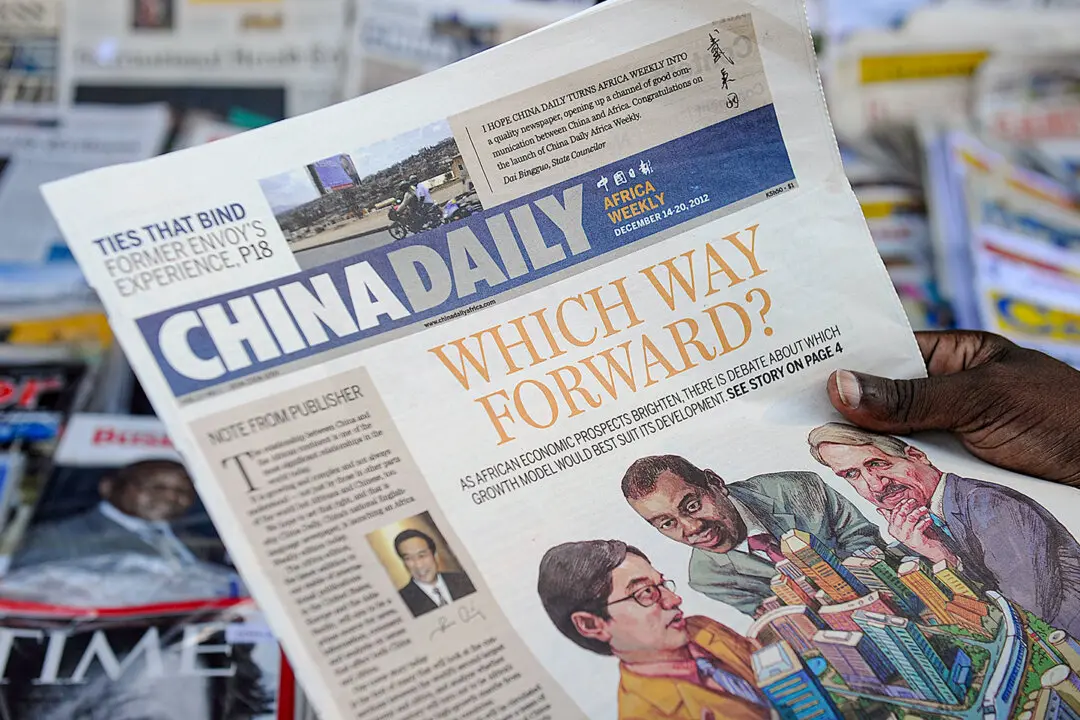
State media China Daily attempted to calm Chinese domestic concerns and downplay the U.S.–China tariff war by claiming on May 27 that “officials and economists said the positive [economic] trends underscore the effectiveness of stimulus policy measures in cushioning the impact of the United States’ tariff hikes and stabilizing market expectations.”
Is there a track record of believability associated with the eye-glazing NBS reports, or do they mask serious problems? Let us examine the topic.
CCP’s Economic Statistics
Foreign observers suspect that official NBS statistics routinely obfuscate systemic problems in the Chinese economy, including property sector contraction and local government debt. These systemic problems are driven by local governments, which are rewarded for meeting the growth and investment targets set by the National Development and Reform Commission (NDRC) and, therefore, have incentives to skew local statistics.
Last year’s numbers are a case in point. As noted in January by the Atlantic Council, while NBS reported that China’s 2024 GDP growth came in almost exactly at the predicted 5 percent, the “Rhodium Group estimates that China’s GDP grew between 2.4 percent and 2.8 percent in 2024, well below NBS figures.” Rhodium noted that the 5 percent GDP growth numbers do not square with “retail sales growth at half the 2023 rate, consumer confidence at rock bottom, consumer price inflation near zero, and declining e-commerce sales.”
Is NBS cooking the books?
Various analysts have questioned NBS reporting for years. For example, the National Bureau of Economic Research published an analysis in 2019 that concluded “[China’s] GDP growth from 2010-2016 is 1.8 percentage points lower” than that reported by the NBS.
In another example, independent research firm MacroPolo noted that seven Chinese provinces had been caught “overstating their GDP by 10 percent or more” from 2016 to 2020.
Sometimes, the local falsification of data is so egregious that even the NBS has to acknowledge the problem publicly. This happened after a corruption probe in Liaoning and Inner Mongolia provinces in 2018 that resulted in the local statistical bureau (the local office of the NBS, for all practical purposes) issuing new revised estimates of local GDP in 2016 and 2017 that were, respectively, 22 percent and 11 percent lower than previous year’s official numbers.
The local government corruption that is apparently endemic in China is relatively easy to understand. The Chinese Communist Party (CCP) has a longstanding Cadre Exchange System (干部交流制度) that rotates officials across provinces, cities, and other administrative units and departments periodically, much like the periodic changes of duty stations for U.S. military personnel throughout their careers.
Local Party secretaries, governors, mayors, and even bureaucrats in statical bureaus are routinely rotated through different roles and locations every three to five years, ostensibly to give them experience needed for promotion, as well as to maintain continuity of the CCP’s centralized control and also avoid the development of regional cliques that might challenge Beijing’s policies.
Since promotions and rotations are tied to economic performance, social stability, and adherence to the Party’s directives, local CCP officials are personally incentivized to cook the books. Having no local loyalties makes it easier, too, as officials rotating out have likely ignored festering long-term local issues in favor of inflating the numbers to achieve their short-term goals.
Contradicting the Rhetoric
Amid the tariff war with the United States, the NBS continues to produce statistics to support the narrative that the CCP has everything under control. For example, China Daily reported on May 27 that China’s industrial enterprises with at least $2.78 million in annual revenue “saw their total profits jump 3 percent year-on-year in April, up from 2.6 percent growth in March.”
The reality of these statistics is well stated by the Atlantic Council: “Macroeconomic data [reported by NBS for 2024] shows good news of growth consistently hitting targets: if that were the case, Beijing’s increasingly aggressive policy actions aimed at propping up the economy would not be necessary.”
There are other noteworthy contradictions to NBS’s numbers.
Nikkei Asia reported on May 24 that “80 percent of Chinese banks have seen their interest margins fall below the industry threshold for profitability,” down 1.52 percent at the end of 2024 and a record low. This is not the sign of a healthy economy.
China’s economy is further threatened by deflationary pressures. As reported by Asia Times on May 5, “producer prices have fallen for 29 consecutive months [and] March’s figures showed the sharpest drop in four months.” With the reduction in U.S. demand, the Chinese have resorted to redirecting unsold exports to their domestic market at steep discounts, which is weakening earnings of export companies and putting pressure on them to cut costs (job layoffs).
Lastly, China Daily reported that the People’s Bank of China, the Chinese central bank, “injected 1 trillion yuan ($139 billion) into the market on [June 6].” This measure was advertised as “stabilizing the economy and spurring growth.” Left unexplained is why this monetary stimulus was needed, given the standard 5 percent GDP growth estimated by the NDRC and NBS.
Concluding Thoughts
Communist China has a history of cooking its economic books, as many local governments routinely inflate their statistics reported to the NBS. Current state-run Chinese media reports claim that the CCP’s economic management has blunted the impact of U.S. reciprocal tariffs, and that the Chinese economy continues to grow at the projected 5 percent annual rate.
This narrative flies in the face of clear indications of economic distress as identified above. Deflationary pressures in China’s domestic market are the direct result of communist mismanagement of the economy and a desperate attempt to redirect exports to domestic consumption. This, in turn, undermines the profitability of Chinese export companies, resulting in drastic cost-cutting measures—a death spiral.
The pressures of reciprocal tariffs will continue to spotlight the CCP’s failures and elucidate the truth about economic statistics.
Views expressed in this article are opinions of the author and do not necessarily reflect the views of The Epoch Times.
Stu Cvrk retired as a captain after serving 30 years in the U.S. Navy in a variety of active and reserve capacities, with considerable operational experience in the Middle East and the Western Pacific. Through education and experience as an oceanographer and systems analyst, Cvrk is a graduate of the U.S. Naval Academy, where he received a classical liberal education that serves as the key foundation for his political commentary.