Old New England was out and about in historic Elizabeth Park on Sunday, walking dogs, playing frisbee, feeding the ducks, and observing the spectacular show of roses crawling up the trellises in all directions in an explosion of color.
It’s a moment when all seems right with the world. The rose garden was beyond belief but the annual, perennial, and herb gardens were also wonderful to behold. The ducks and geese were in their element on the pond, as families enjoyed the sunshine while drinking root-beer floats and eating ice cream.
It doesn’t get much better than this. I was discussing with colleagues and friends how this magical place came to be. There is no admission fee to get in. It is open 24/7 all year. Everything is perfect: the grass is mowed, the flowers tended to with expertise, and the water and fountains are clean and perfect.
You might have noticed that the roses you buy at the store are very pretty but don’t actually smell like anything. This is the nature of commercial roses. It is disappointing. But at Elizabeth Park, particularly in the heritage garden with varieties hundreds of years old, the fragrance is spectacular and enticing in wild ways.
This is a place where you really can stop and smell the roses. There is meaning to this old expression.
Some people are so thrilled to be there that they come in costumes of fictional characters. Others gather for wedding photo shoots. Everyone is on his best behavior, with strangers greeting each other with smiles.
Joy is everywhere. All is right with the world.
It’s an experience you can only get from what we used to call the commons, the places where the community is always welcome. It’s beautiful, safe, and uplifting, embodying so much of what we think of as Old America that one wants to arrive and depart in a horse and carriage.
It’s so old-fashioned that you can even tell the time from the working sundial in one of the gardens. It wasn’t until the mid-1880s that the railroads forced the adoption of a new conception of time that was more convenient to industry, one that divorced time from nature. But this sundial keeps the old ways.
The sundial said it was half past noon. My watch registers what we call the time as distorted by both industry and the insanity of Daylight Savings Time, which saves no daylight but fully distorts our sense of everything twice each year.
My friend asked the question: How is it that this garden, which belongs to everyone in the community, has somehow been protected from the collapse of our times? How come the commons in most parts of the country are a huge mess but this one park is the most perfect thing this side of heaven?
The park has a deep history, becoming part of community life in the 1880s from its initial development on private land. For the neighborhood and the surrounding area, maintaining it in every season has been a matter of community pride. Whether donating time or money to the nonprofit that manages it, involvement in the life of the park has carried a cultural cache in the community.
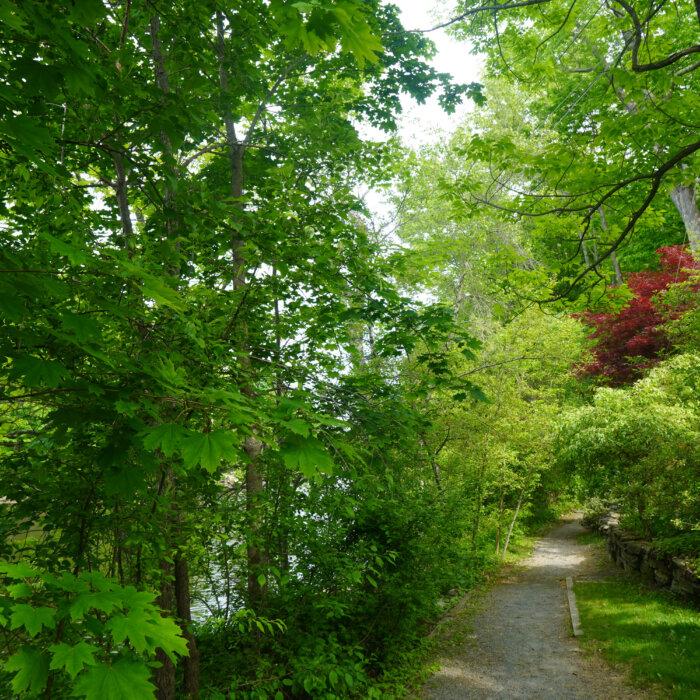
There are very few hortatory signs in the park but one knows for sure what to do and what not to do. For example, I’ve never seen anyone pick the flowers, no matter how tempting it is. Hard play is limited to the open spaces while people stroll carefully through the gardens and stone pathways. It just feels like the right thing to do.
This feeling of respect is everywhere, perhaps inspired by nature herself. You can see the bees feasting on pollen from flowers and watch in awe at the unfolding of this interesting dynamic and thank the geese for digging around in the grass for bugs. I’ve never once heard of ticks in this large space, despite how they seem to be taking over everywhere else.
Above all else, the maintenance of this magical place is due to the volunteers who devote countless hours to working the rose gardens, curating the tulips for the spring, and preparing the ground for the dahlias that come out in early autumn. Each new seasonal wave of color attracts people, as do the Wednesday concerts in the summer months at which everyone shows off the year’s fashions plus their beloved dogs.
This is not the sort of thing that is imparted by a plan. It grows organically from time and generations of devotion. In other words, it comes not from a city council but from love and community feeling. Those are delicate things, cultivated by generations.
It was a special pleasure to see a flag hanging from the greenhouse that recognized the 250th birthday of this nation that is right around the corner on the calendar. One sees too far too little of this by way of public recognition.
This strikes me as strange. I’m old enough to recall the bicentennial in 1976. It was a huge deal. Whole book series were appearing and shows were all over the TV. Major pop artists like Elton John produced bicentennial songs while flags were everywhere.
That is not happening on the same scale this year. Why is that? We know why. It’s because Donald Trump happens to be president and a major swath of this country has decided to boycott patriotism so long as he is in office. This is petty. And pathetic.
Whatever else you think of Trump, his administration has done a magnificent job in fixing up Washington, D.C. for the occasion. Every fountain is working again, some of them for the first time in decades. The place is clear, the statuary brushed up, and the walkways beautiful.
Above all else, Trump performed wonderfully in finally making the reflecting pool beautiful again for the semiquincentennial. Can we not give him credit for this? The speed was amazing and repair and restoration far under initial budget claims.
This reflecting pool has been disgusting for as long as I can remember. Now it is suddenly fantastic again, reflecting the Washington monument as it was designed to do. You really should go see it soon if you can.
I’ve now got a new test for the extent of political bias. If you loathe the president so much that you cannot even give him credit for this action, there is a serious problem.
As much as I adore individual liberty and pretty domestic spaces, a country without safe and beautiful common spaces can never really be a civilized place. How a society cares for the commons is a good standard by which to measure its health and well-being.
Elizabeth Park in Hartford, Connecticut, and now the newly revived Washington, D.C. are doing this the right way now. May these serve as inspirations on the 250th anniversary of our beloved country, our home.
America was founded on the principle of individual liberty. These individuals banded together to create a common culture of magnificence. This dream needs renewal. A clean, safe, and thrilling commons is essential to the good life.