The conventional wisdom that Xi Jinping has a firm grip over the Chinese Communist Party (CCP) and its key institutions is likely true—until it isn’t.
Signs Xi May Be Under Pressure
Despite his apparent dominance, there are clues that Xi may be facing mounting internal resistance. Notably, he has skipped several high-level policy meetings in mid-2025, delegating them to Premier Li Qiang.Observers also note that recent PLA Daily articles have referred more frequently to “collective leadership” and “shared responsibility,” signaling a possible reevaluation of Xi’s one-man authoritarian rule over China.
A Great Divide Between Power and Performance
The fundamental criticism is that the unprecedented power that Xi has gathered for himself hasn’t delivered on the Party’s promise to the people to provide sustainable economic growth. Plus, Xi hasn’t fulfilled his own political promise in terms of leading China to greater economic performance or global influence.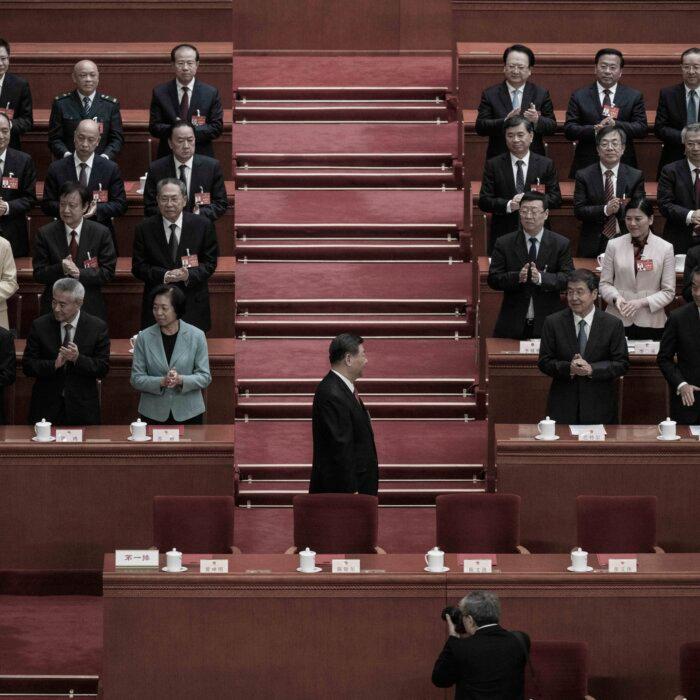

China’s prestige around the world has been irretrievably tarnished, especially with emerging economies, because of the global disappointment of the Belt and Road Initiative and its resulting debt traps, and that has led to charges of neocolonialism, which are certainly not easily deniable.
Furthermore, the Chinese regime’s arrogant disregard for its largest trading partners, characterized by multiple and entrenched adversarial trading practices, has reached a critical point, prompting the world’s leading technology, manufacturing, and retail companies, along with their investment capital, to flee China.
That trend is reversing a 30- to 40-year history of building business and commerce relationships with Beijing, culminating in Xi’s assertions of global dominance via the “Made in China 2025” project, which was nothing less than the attempted technological impoverishment of the rest of the world for the benefit of the CCP.
Widening Rifts Within CCP’s Old Guard
In political terms, these failures have revealed and widened rifts beneath the surface of the CCP that already existed but have since become more visible. Similar to geological fault lines that run deep beneath the surface of the earth, these rifts remain unseen, although not irrelevant to the stability of the current political structure.To carry the metaphor, when the rifts become too wide, the landscape above becomes unstable and unsustainable. At that point, a sudden and earthshaking tectonic event occurs, often violently, that disrupts the status quo and reshapes the landscape above.
Xi is sitting atop a country riven with deep political fault lines and growing economic instability.
Friction Within the Military
But it’s not just the old guard or displaced princelings that are disenchanted with Xi’s performance. Despite rigorous loyalty purges and frequent political reshuffles, Xi has replaced multiple high-ranking officers in 2024 and 2025, including Gen. Li Shangfu and Adm. Dong Jun, because of alleged corruption or disloyalty. Still—or perhaps because of it—the People’s Liberation Army (PLA) remains a potential source of dissent.Middle Class and Entrepreneurial Discontent
China’s persistent economic troubles are also eroding public confidence among the middle and entrepreneurial classes. Youth unemployment remains high in many urban centers, and gross domestic product growth has slowed significantly amid a deep and enduring real estate crisis and export contraction.Succession Vacuum, Structural Risk
Perhaps the most delicate and yet pressing issue for the CCP is Xi’s refusal to name a successor. By removing term limits and centralizing authority, Xi has disrupted a decades-long norm of collective leadership and peaceful succession. Without an apparent heir or institutional mechanism to transition power, China faces the prospect of a leadership crisis in the not-too-distant future.The longer this ambiguity persists, the more vulnerable the CCP becomes to factional struggles in the event of Xi’s sudden incapacitation or political failure. Preventing such a crisis appears to be top of mind for many within the Party, yet so far, Xi has not allayed their fears.
Perhaps doing so is now beyond even his reach, which may be his greatest failure of all.