In its latest bid to engineer total conformity across its vast empire, Beijing has unveiled its new “Law on Promoting Ethnic Unity and Progress,” which officially took effect on July 1.
Behind the Orwellian phrasing of “unity and progress” lies a chilling mechanism designed to forcefully dissolve distinct cultures and replace them with complete ideological alignment with the Party.
From man-made famines to the one-child policy, this latest law is just the latest in a long line of social engineering disasters that the CCP has forced upon its people. For decades, the regime maintained a facade of ethnic autonomy, a relic imported from the Soviet model designed to placate minority regions.
That era is officially dead.
This sweeping new national statute legalizes a total shift toward aggressive, forced assimilation, codifying Chinese leader Xi Jinping’s so-called second-generation ethnic policies to melt down individual identities into a singular state-controlled mold.
The Myth of Social Harmony Is Fading
The core driver behind this law is the preservation of the CCP’s absolute power. Under the banner of “forging the communal consciousness of the Chinese nation,” the regime is using state law to enforce what it previously attempted through raw, extrajudicial coercion. Essentially, the CCP recognizes that its economic miracles are tapering off and that public discontent is growing.
To fortify its borders and lock down its periphery, the Party requires absolute obedience by means of embedding political slogans directly into the legal framework. Beijing has turned state law into an ideological weapon.
The law explicitly mandates that all private and public entities—from schools and corporations to local neighborhoods—prioritize Party loyalty and a centralized identity above all else. The target isn’t harmony; it is the absolute elimination of cultural or local identities and resistance.
The Erasing of the ‘Other’
While the law technically applies to all 56 officially recognized ethnic groups, its sharpest edges are explicitly aimed at peripheral minority populations that have historically resisted the Party’s iron fist. That includes the Tibetans, Uyghurs, and Southern Mongolians. These groups hold distinct linguistic, historical, and religious identities that directly contradict the CCP’s atheistic, state-centric narrative.
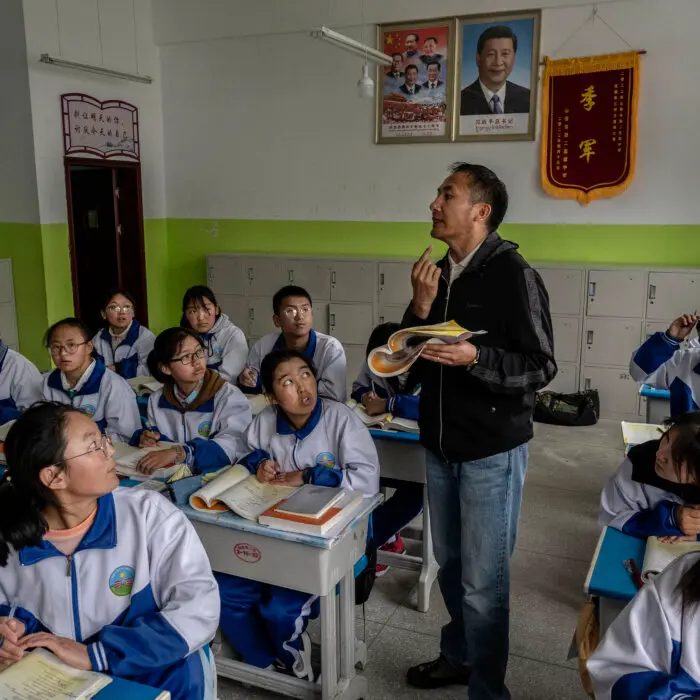
Under Article 15 of the new law, Mandarin Chinese is legally mandated as the standard language to be taught to all children before kindergarten. This effectively obliterates minority languages as primary tools of education, stripping future generations of their native tongues in what human rights advocates have rightly termed a colonial project of cultural genocide.
Furthermore, the law commands CCP authorities and private firms to give prominence to Chinese characters over minority scripts in public spaces.
Why the Han Majority Is Worried
On paper, the Han Chinese have little or nothing to worry about. They make up more than 90 percent of China’s population, leading many outside observers to assume that they face no threat from an “ethnic unity” law.
Yet underneath the surface, deep anxieties are rippling through the Han majority. In a totalitarian state, any expansion of surveillance, reporting, and legal vulnerability eventually blows back on the population at large.
The law institutes a comprehensive surveillance and informant apparatus, explicitly permitting and encouraging citizens to report any conduct that “undermines ethnic unity and progress.”
In practice, this means that everyday Han business owners, content creators, and ordinary citizens are suddenly walking on eggshells. An accidental misstep in marketing, an unauthorized historical discussion online, or a minor business dispute with a minority-owned firm can easily be weaponized as an “anti-unity” crime. Such a charge could lead to severe public security punishments or long prison sentences under the criminal code.
Furthermore, some Han parents are deeply unsettled by the state’s overt intrusion into the household. The law explicitly commands parents to provide “lawful family education” and strictly prohibits them from instilling any ideas deemed detrimental to state-defined unity in their minors. It could turn the dinner table into a political zone, raising the terrifying specter of children being conditioned to report their own parents to the authorities.
Global Subjugation of Industry and Economic Activity
The domestic fallout from this law is coupled with an unprecedented and dangerous expansion of Beijing’s legal overreach beyond its borders. The statute includes a highly controversial clause stating that individuals and organizations outside the borders of the People’s Republic of China can be held legally accountable for inciting separatism or undermining ethnic unity.
This has drawn fierce condemnation from the European Union, Germany, and the UK, who warn that Beijing is legalizing transnational repression and cross-border intimidation.
Economically, the law forces minority and border regions to align their local industries entirely with national security, resource extraction, and food security priorities. Instead of allowing local, organic economic growth, the state is treating these regions as resource colonies to fuel the Han-dominated core.
This heavy-handed economic subjugation destroys local entrepreneurship and ensures that economic dependence remains an effective tool of political blackmail.
Coordinated Religious Persecution
It is impossible to separate this new ethnic unity law from the CCP’s broader, long-running war on faith. The law works hand-in-glove with the regime’s ongoing “Sinicization of religion” campaign, which demands that all spiritual practices submit themselves to communist ideology.
For Muslims in East Turkistan (Xinjiang) and Buddhists in Tibet, their faith is intertwined with their ethnic identity. By legally categorizing any unapproved religious practice as “religious extremism” or an attack on “ethnic solidarity,” the law criminalizes basic spiritual life.
The new law simply broadens the regime’s toolkit to crush religious freedom under the guise of maintaining stability.
Why the CCP Fears Difference
At its root, the CCP’s obsession with total assimilation reveals a fundamental truth: The regime is inherently brittle. A pluralistic society requires trust, a functional legal system, and a government that derives its legitimacy from the consent of the governed.
The CCP has none of these.
Because the Party rules purely through fear and coercion, it views any unique cultural identity, alternative belief system, or distinct language as an existential threat. To the paranoid tyrants in Beijing, difference equals division, and division equals the eventual collapse of their totalitarian monopoly.
This new law is not a sign of a confident, rising superpower. Rather, it is the frantic action of an insecure regime desperately trying to cast a diverse empire into a rigid iron cage before the foundations give way.
What’s more, Beijing is attempting to enforce this policy beyond its borders, which will likely lead to growing international resistance as it affects critics worldwide.