This copy is for your personal, non-commercial use only. Distribution and use of this material are governed by our Subscriber Agreement and by copyright law. For non-personal use or to order multiple copies, please contact The Epoch Times Reprints.
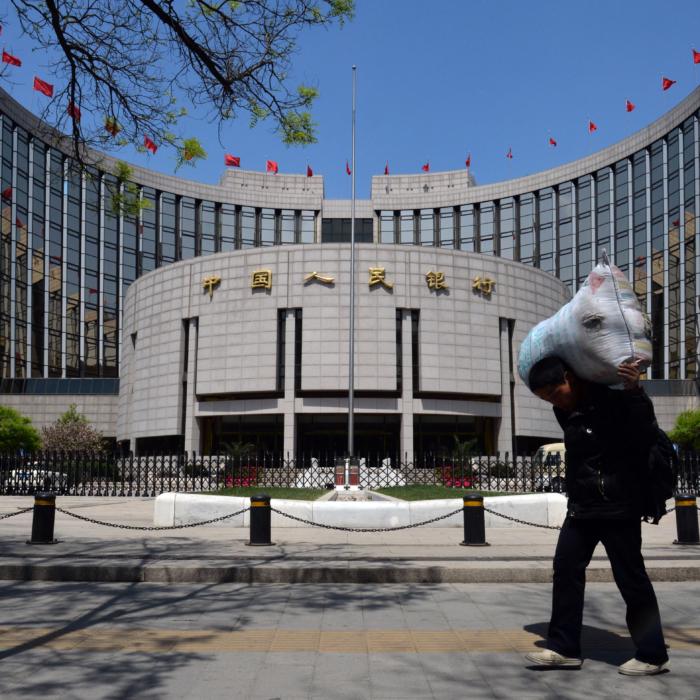
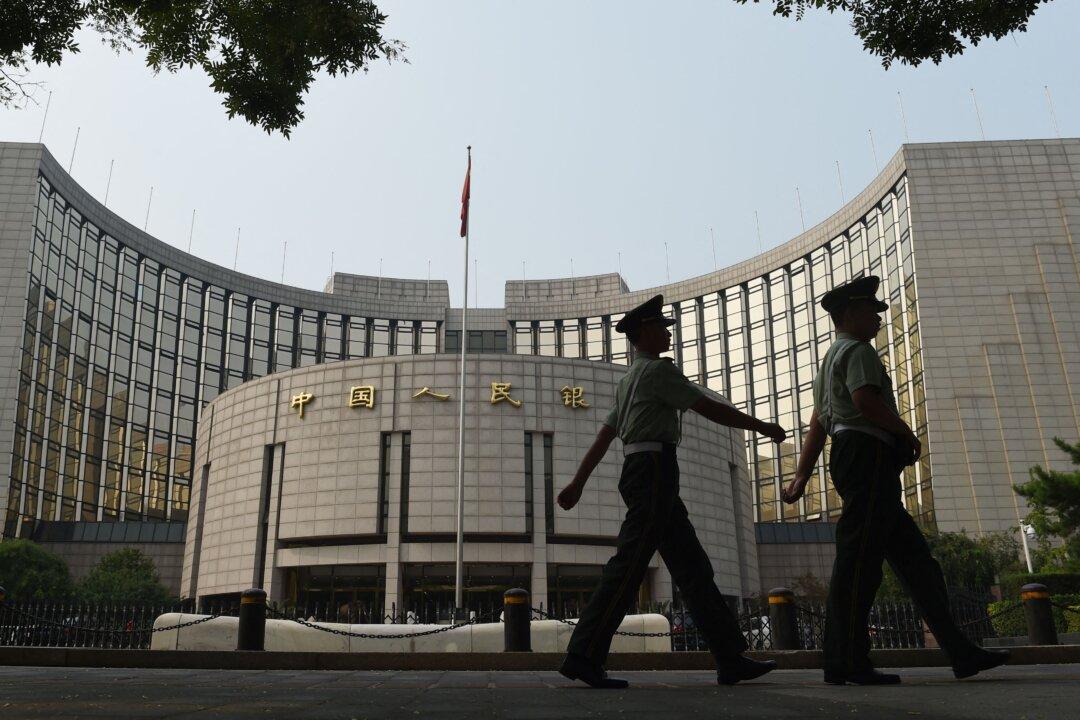
Every time Beijing announces policies to help the country’s faltering economy, it includes mention of lower interest rates and other forms of monetary ease. Of course, the economy needs more than simply monetary help, but even on this front, the People’s Bank of China (PBOC) falls short of a substantive contribution to the stimulus effort. The bank is simply failing in its obligation to the regime.
Earlier this May, the PBOC confirmed this pattern of failure. It abided by Beijing’s request for monetary easing but made such a small gesture that it might as well have done nothing. All this monetary authority could muster was a 0.1 percentage point cut in interest rates. This began in May with a tiny cut in the rate on seven-day repurchase agreements and was followed later in the month with reductions of the same size in its benchmark lending rate, the one-year loan prime rate, and on five-year maturities.
For an economy that even the Chinese Communist Party (CCP) admits needs urgent help to stimulate consumer spending and capital investment by businesses, these can only be described as piddling changes. They are, however, entirely consistent with what has been happening for years. Since December 2021, when the PBOC began to help with Beijing’s stimulus efforts, monetary policymakers have cut interest rates by a grand total of only 0.8 percentage points, from a prime lending rate of 3.8 percent to 3.0 percent after the last move. That amounts to 0.2 percentage points a year.
It is hard to see how that kind of a move could motivate any borrower or lender to change their attitude toward borrowing, lending, or spending. Contrast this behavior with the behavior of the Federal Reserve (Fed) in the United States, which, in response to only hints of economic weakening, much less the economic problems plaguing China, quickly cut American interest rates by a full percentage point between September 2024 and February 2025.
Action by the PBOC is even less explicable because over this time, the economy has developed a deflationary bias. Consider that when there is inflation in an economy, borrowers get to repay loans with money that is worth less in real terms than it was when they borrowed it.
Back in 2021, for instance, when the PBOC began its limp efforts at monetary stimulus, the national average producer price inflation was close to 10 percent a year, allowing a borrower to repay with money worth 10 percent less in real terms. With the prime lending rate at 3.8 percent a year, that borrower, even after paying the interest, was more than 6 percent ahead in real terms. That was a great inducement to borrow and spend or to invest.
But since that time, producer price inflation has turned into a deflation of nearly 3 percent a year. The borrower now has to repay the loan with funds that are worth some 3 percent more, not less, in buying power than the prior year. Even with the interest rate cuts in the interim, the real cost of borrowing has risen to almost 6 percent.
This reality certainly discourages borrowing, spending, and investing. The PBOC would need to drive interest rates down below zero, just to recapture some of the borrowing inducement that prevailed back in 2021. Its efforts look even less effective in this respect than they already appear in the raw figures.
Monetary policy, in other words, has actually become increasingly restrictive, not more accommodating. The PBOC has actually worked against the CCP’s efforts to stimulate China’s economy and overcome the ill effects of the property crisis and the decline in confidence that has accompanied that event. Because the Trump tariffs and threats of more tariffs have intensified the need for the Chinese authorities to provide more economic stimulus than ever, this continued failure by the PBOC is itself more disappointing and more dangerous than ever.
Views expressed in this article are opinions of the author and do not necessarily reflect the views of The Epoch Times.
Milton Ezrati is a contributing editor at The National Interest, an affiliate of the Center for the Study of Human Capital at the University at Buffalo (SUNY), and chief economist for Vested, a New York-based communications firm. Before joining Vested, he served as chief market strategist and economist for Lord, Abbett & Co. He also writes frequently for City Journal and blogs regularly for Forbes. His latest book is “Thirty Tomorrows: The Next Three Decades of Globalization, Demographics, and How We Will Live.”