This copy is for your personal, non-commercial use only. Distribution and use of this material are governed by our Subscriber Agreement and by copyright law. For non-personal use or to order multiple copies, please contact The Epoch Times Reprints.
Chinese Premier Li Qiang (C) speaks during a meeting with European Commission President Ursula von der Leyen during the European Union–China summit at the Great Hall of the People in Beijing on July 24, 2025. Mahesh Kumar A./Pool/Getty Images
As Beijing’s global ambitions falter, low expectations for the European Union–China meeting and Chinese leader Xi Jinping’s absence from the BRICS summit highlight growing doubts about the ability of the Chinese Communist Party (CCP) to lead a new world order.
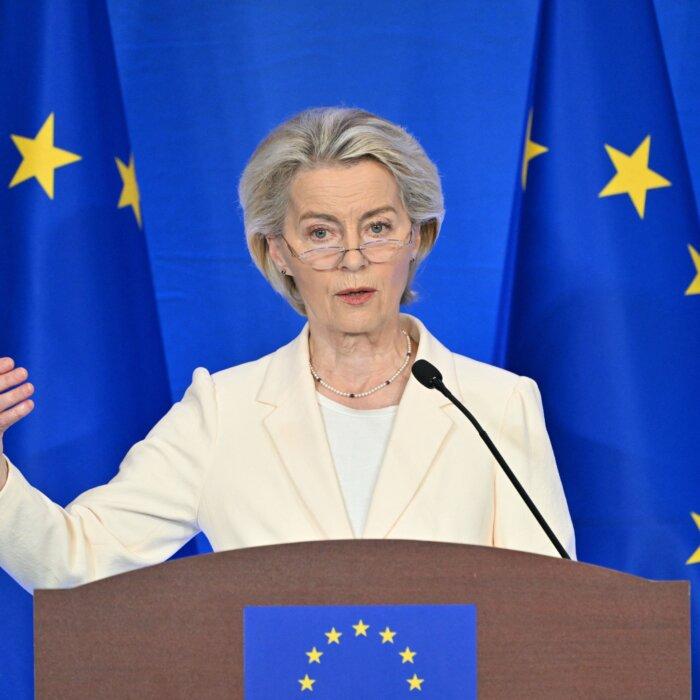
When the EU delegation arrived in China for a summit with Xi on July 24, they were met at Beijing Capital International Airport not with a welcoming ceremony, worthy of a state-level visit, but with a shuttle bus. The lackluster reception foreshadowed the underwhelming outcome of the summit.
Talks yielded little progress, with European Commission President Ursula von der Leyen urging China to open its market and address industrial overcapacity. Initially scheduled for two days, the summit was cut to one. The EU delegation left Beijing early, with some characterizing the summit as a failure.
Tensions between the EU and China have intensified in recent weeks. The EU restricted Chinese medical device companies from public tenders, prompting Beijing to retaliate with import controls and new tariffs on European brandy. Analysts point to deeper structural trade frictions, including China’s industrial overcapacity and the EU’s efforts to shield its domestic industries.
Geopolitical disagreements, especially over China’s support for Russia’s war in Ukraine, continue to frustrate European leaders. Von der Leyen recently accused Beijing of flooding global markets with cheap products and enabling Russia’s war economy.
Against this backdrop of deteriorating EU–China relations, Beijing’s diplomatic challenges are compounded by Xi’s declining visibility, both at home and abroad. Chinese state media have increasingly sidelined Xi’s image and ideology. A June 10 People’s Daily article on social welfare reforms made no mention of Xi Jinping Thought, and Chinese Premier Li Qiang recently spoke at a constitutional loyalty ceremony without referencing Xi.
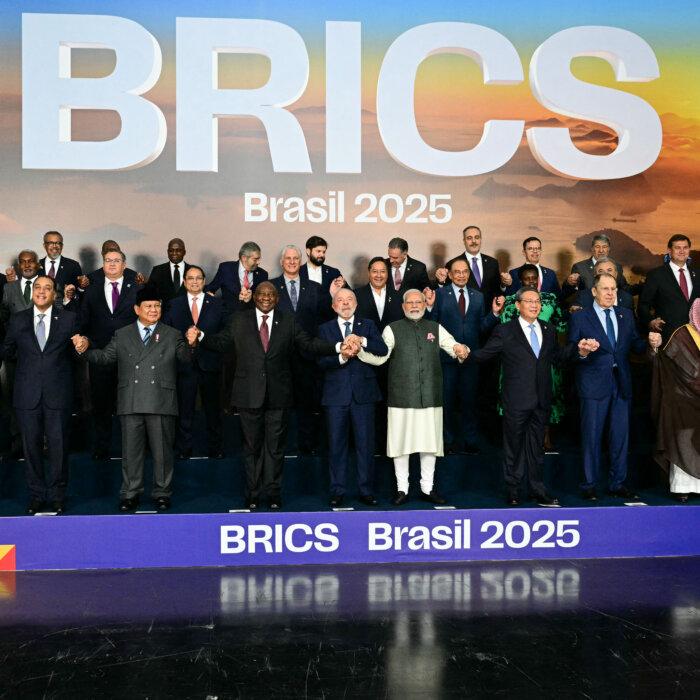
Diplomatically, some of Xi’s recent engagements have lacked formality and prominence. His meeting with Belarusian President Alexander Lukashenko in June occurred privately, without senior aides or media coverage. Most notably, Xi skipped the BRICS summit in Brazil earlier this month—the first time in more than a decade that he has missed the gathering of emerging economies, which has long been positioned as a counterweight to U.S. dominance.
The absence of both Xi and Russian President Vladimir Putin, who joined the BRICS summit only via video because of his arrest warrant by the International Criminal Court, cast serious doubt on the bloc’s relevance. With the bloc’s two most powerful members missing, Brazilian President Luiz Inácio Lula da Silva’s anti-American and de-dollarization rhetoric, delivered in response to U.S. tariff threats, rang increasingly hollow.
Recent developments underscore widening fractures within BRICS and growing resistance to Beijing’s regional ambitions. India, the largest BRICS member by population, is openly resisting China’s leadership within the Global South.
In recent months, China has recalled more than 300 engineers from Foxconn’s iPhone plant in India, prompting New Delhi to seek support from Taiwan, the United States, South Korea, and Japan. The move followed a brief conflict with Pakistan in May, during which India accused China of backing its rival.
In June, India suspended the Indus Waters Treaty, protested China’s dam construction in Pakistan, and refused to endorse the Shanghai Cooperation Organization’s joint statement because of issues regarding the Kashmir attack.
Beijing attributed Xi’s absence from the BRICS summit to a “scheduling conflict.” Still, analysts widely suspect that internal political turmoil and mounting economic pressures pulled his focus away from advancing the CCP’s global agenda, one that is falling short of his original vision. BRICS remains central to Xi’s strategy to counter U.S. influence, and the summit came amid renewed pressure from U.S. President Donald Trump’s tariffs. Yet Xi may have concluded that domestic challenges now take precedence over geopolitical ambitions.
Xi’s no-show casts doubt on Beijing’s ability to reshape global institutions such as the United Nations Security Council, International Monetary Fund, and World Bank in ways that would weaken U.S. dominance and empower authoritarian regimes such as the CCP, Moscow, and Tehran. At the summit, leaders continued pushing “de-dollarization,” with Lula endorsing trade in local currencies to reduce dependence on the U.S. dollar. While they stopped short of announcing a common currency, the bloc emphasized expanding use of national currencies and strengthening the China-led New Development Bank as an alternative to Western financial institutions.
Despite the rhetoric, the dollar remains firmly entrenched. The New Development Bank remains approximately 70 percent dollar-denominated, with many BRICS currencies either pegged to or reliant on the U.S. dollar, or constrained by sanctions, capital controls, or economic instability. The ruble is nonconvertible, and China’s yuan remains only partially convertible, limiting its viability as a true reserve currency.
BRICS was established in 2009 and initially included Brazil, Russia, India, and China. South Africa joined the following year, and in 2024, the group expanded further to include Egypt, Ethiopia, Indonesia, Iran, Saudi Arabia, and the United Arab Emirates. Despite the expansion, the year 2025 has exposed diplomatic fatigue. Only Indonesia and Vietnam joined this year, signaling a slowdown.
While framed as a platform for “multipolarity” and “Global South cooperation,” BRICS increasingly reflects the Chinese regime’s ambitions to construct a CCP-led world order. But its continued reliance on the U.S. dollar and visible internal fractures suggest that the CCP’s vision for a unified anti-Western bloc may be reaching its limits.
The Shanghai Cooperation Organization is also showing signs of stagnation. Since adding India and Pakistan in 2017, only Iran (2023) and Belarus (2024) have joined, bringing the total membership to 10. Nearly half of the member states have nonconvertible currencies, and three—Russia, Iran, and Belarus—are under heavy international sanctions. Undermining the appeal of a China-led economic bloc, Trump has warned BRICS members that hostility toward U.S. interests could trigger additional tariffs.
Against this backdrop, Xi’s absence from the BRICS summit raises doubts about whether he still believes that the CCP’s vision of reshaping the world order is achievable on its current path. With a faltering BRICS, a sidelined Xi, a stagnating Shanghai Cooperation Organization, and strained ties with the EU, the CCP’s ambition to lead a new global order looks increasingly uncertain.
Views expressed in this article are opinions of the author and do not necessarily reflect the views of The Epoch Times.
Antonio Graceffo, Ph.D., is a China economy analyst who has spent more than 20 years in Asia. Graceffo is a graduate of the Shanghai University of Sport, holds an MBA from Shanghai Jiaotong University, and studied national security at American Military University.