General Principles and Mixed Government
Before getting into the details of writing a constitution, Americans had to consider their goals. This entailed identifying the basic principles that the Constitution would reflect. John Adams was serving as a diplomat in Europe during most of the constitutional debates. While there, he wrote an encyclopedia of republican governments: “A Defence of the Constitutions of the United States.” (The “Constitutions” referred to were those then in force in the states.) The first volume was issued in early 1787 and was cited frequently during the constitutional debates.- Law is built on justice; where there is no justice, there is no law.
- A nation is not just a mass of individuals but an association based on consent.
- The best constitution mixes elements of monarchy, aristocracy, and democracy.
- Unmixed governments degenerate into corrupt forms, particularly into tyranny. A tyranny is not a true republic because a republic is the property of the people, while in a tyranny, everything belongs to the ruler.
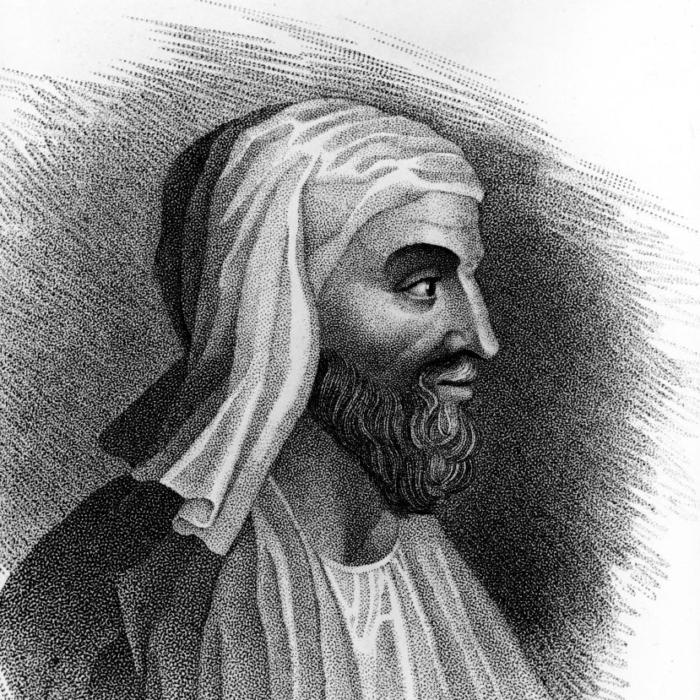
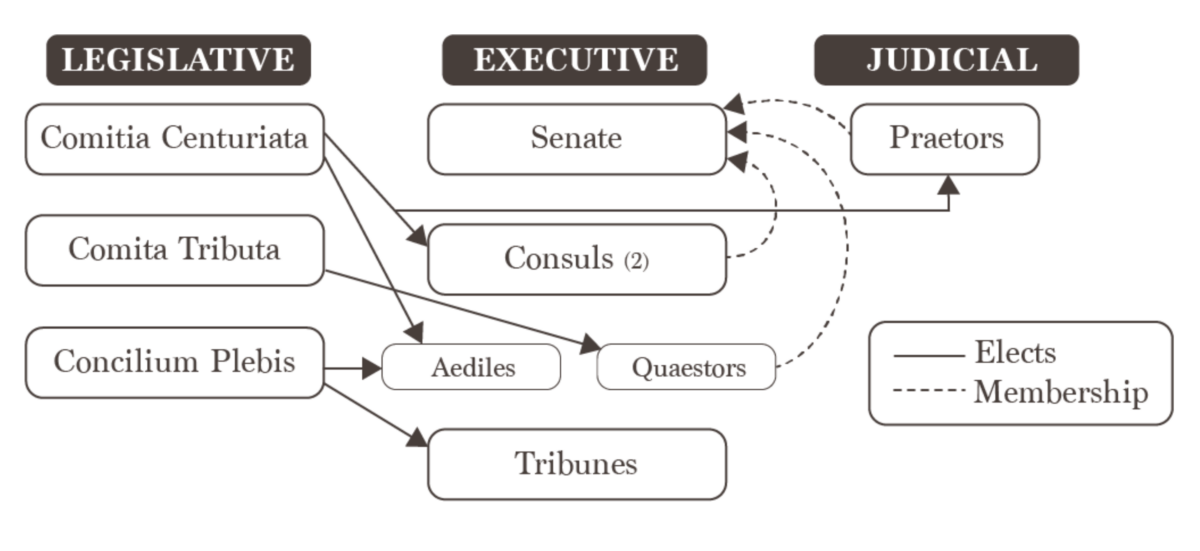
When explaining the Roman Republic’s success to his fellow Greeks, Polybius emphasized Rome’s unwritten constitution as a major contributor to that success. He pointed out that its government was not a monarchy, an aristocracy, or a democracy but a mixture of all three: The republic’s popular assemblies were (somewhat, but not entirely) democratic, the Senate was (somewhat, but not entirely) aristocratic, and the consuls shared the power formerly exercised by kings. Each element checked the other, preventing degeneration into corrupt forms.
The following chart depicts a simplified version of the government of the Roman Republic. It shows three of the four popular assemblies, omitting one that served purely religious purposes. The chart suggests how the different branches checked each other.

Federalism
The Constitution’s greatest contribution to political theory may have been its system of federalism, under which the people divided sovereignty, granting some to the central government and the rest to the states. While developing this concept, the Founders consulted a number of federal models, including confederacies of city-states in ancient Greece and more recent confederacies in Switzerland and the Netherlands. The Founders also took into account the British Empire’s working arrangement before 1763, in which the central government in London controlled foreign affairs, the post office, and commerce with foreign nations and among units of the empire, while the colonies otherwise governed themselves.Among these models, the pre-1763 colonial arrangement was probably the most influential among the Founders. However, they also seriously considered the Greek confederacies. Their information on those confederacies derived primarily from Polybius and Plutarch.
Polybius and Plutarch were the sources of John Adams’s discussion of Greek confederacies in his treatise on republican governments. They likewise were sources for James Madison’s famous pre-convention research notes, “Of Ancient and Modern Confederacies.” Madison deployed his knowledge of the subject in Federalist No. 18, where he compared the Greek Amphictyonic Council to the United States under the Articles of Confederation:
“The powers [of the Council], like those of the present Congress, were administered by deputies appointed wholly by the cities in their political capacities; and exercised over them in the same capacities. Hence the weakness, the disorders, and finally the destruction of the confederacy. The more powerful members, instead of being kept in awe and subordination, tyrannized successively over all the rest.”
Madison concluded that the new federal government should act primarily on individuals, not on the states. By contrast, Madison’s then-rival James Monroe—the future president, but at the time an Antifederalist—relied on Polybius’ account of the Greek Achaean League to argue that the Articles of Confederation, if amended somewhat, would be adequate for American needs.
In Federalist No. 34, Alexander Hamilton drew on his knowledge of the Roman constitution to answer opponents’ claims that sovereignty could not be divided:
Other Constitutional Lessons
During the course of the constitutional debates, participants looked to Roman sources for other lessons as well. Thus, a Virginia Federalist cited Cicero in support of the Constitution’s grant of the pardon power to the president and its bans on state and federal ex post facto laws (retroactive criminal laws).In Federalist No. 63, Madison used the Roman example to underscore the need for a federal Senate.
“History informs us,” he wrote, “of no long-lived republic which had not a senate.”
And Hamilton, writing in Federalist No. 70, emphasized the need for a single president rather than an executive council or other plural executive:
“Every man the least conversant in Roman history, knows how often that republic was obliged to take refuge in the absolute power of a single man, under the formidable title of Dictator. ... A feeble Executive implies a feeble execution of the government. A feeble execution is but another phrase for a bad execution; and a government ill executed, whatever it may be in theory, must be, in practice, a bad government.”
On the other hand, an opponent, writing under the name of “Caveto” (Latin for “Be ye warned!”), cited Tacitus’s “Histories” on the Risks of a Unitary Executive:
“They who would put their country under such a form of government, and think thereby to render its condition more safe and easy, must suppose that none but good Princes shall be upon the throne, which did not happen to the Romans, when they had the choosing of their own masters—They were often mistaken in their choice; some had good inclinations, but were corrupted by those about them. In others, the seeds of vice and cruelty lay undiscovered as in Tiberius [the emperor immediately succeeding Augustus]; others’ nature had formed well enough, but so much power turned their heads, and made them worse—Solusque Vespasianus Omnium ante se Principum in melius mutatus est.” (“Compared with all the emperors before him, only Vespasian turned out for the better.”)