



NEW YORK—“Billy Miller died because I wanted to go see a dead foreign fighter,” said war photographer Ashley Gilbertson. After a pregnant pause, he continued: “Everyone who goes off into conflict comes back with a sense of responsibility.”
Gilbertson shared a powerful and very personal account of his time documenting the Iraq war Monday night as part of the forum series “Ground View,” hosted by The Epoch Times in collaboration with NYU Arthur L. Carter Journalism Institute and moderated by Getty staff photographer Chris Hondros. “Ground View” aims to bring a remarkable photojournalist to show and speak about his or her work every few months.
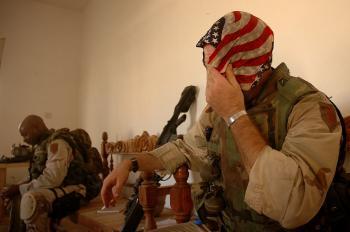
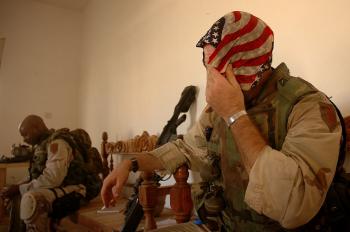
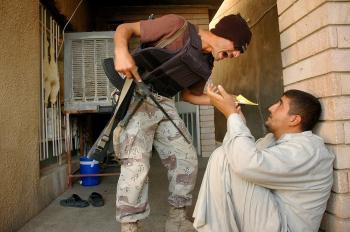
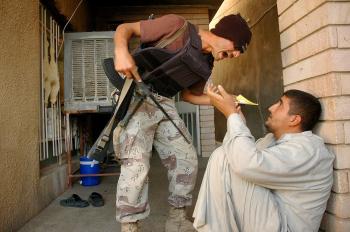
“This is who does our bidding,” said Gilbertson as he displayed the humanity and suffering of American soldiers. He strives to remind Americans that we are at war, to bring the reality of warfare to his fellow New Yorkers.
“I can go through my entire day and not think about the fact that we’re at war right now,” mused Gilbertson.
This renowned photographer tells a tale of suffering—the horrid scenes experienced on the field, the guilt, and sense of responsibility after a term served in Iraq or Afghanistan, and the epidemic of PTSD plaguing this nation. Gilbertson does not, however, chronicle this woeful tale without hope that if Americans better understand all of these experiences, soldiers and war-torn families may heal quicker and suffer less loss.
Gilbertson makes it clear he does not have a political message, which would have a polarizing effect, contrary to his goal of promoting understanding and community.
“I can’t politicize this work. This is about human beings,” declared Gilbertson. “If I politicize it, I am dividing human beings,” he added.
Though born and raised in Melbourne, Australia, Gilbertson now calls New York home. Gilbertson is a freelance photographer who captured scenes in Iraq from 2002 to 2008 for The New York Times among other publications. His photos are not limited, however, to the battle scenes one typically associates with war photography. Gilbertson has extended his coverage to American soil.
Gilbertson shared a powerful and very personal account of his time documenting the Iraq war Monday night as part of the forum series “Ground View,” hosted by The Epoch Times in collaboration with NYU Arthur L. Carter Journalism Institute and moderated by Getty staff photographer Chris Hondros. “Ground View” aims to bring a remarkable photojournalist to show and speak about his or her work every few months.
“This is who does our bidding,” said Gilbertson as he displayed the humanity and suffering of American soldiers. He strives to remind Americans that we are at war, to bring the reality of warfare to his fellow New Yorkers.
“I can go through my entire day and not think about the fact that we’re at war right now,” mused Gilbertson.
This renowned photographer tells a tale of suffering—the horrid scenes experienced on the field, the guilt, and sense of responsibility after a term served in Iraq or Afghanistan, and the epidemic of PTSD plaguing this nation. Gilbertson does not, however, chronicle this woeful tale without hope that if Americans better understand all of these experiences, soldiers and war-torn families may heal quicker and suffer less loss.
Gilbertson makes it clear he does not have a political message, which would have a polarizing effect, contrary to his goal of promoting understanding and community.
“I can’t politicize this work. This is about human beings,” declared Gilbertson. “If I politicize it, I am dividing human beings,” he added.
Though born and raised in Melbourne, Australia, Gilbertson now calls New York home. Gilbertson is a freelance photographer who captured scenes in Iraq from 2002 to 2008 for The New York Times among other publications. His photos are not limited, however, to the battle scenes one typically associates with war photography. Gilbertson has extended his coverage to American soil.
For his “Bedrooms of the Fallen,” a series that was in large part commissioned by The New York Times Magazine, Gilbertson visited the homes of fallen soldiers to photograph the bedrooms that tell so much about the men and women behind the uniforms. These intimate settings, nestled in the homes of the loved ones they left behind, also capture the loss, the vacant gaping holes that punctuate the nation where these individuals once had their place.
He also put together a series of photos and sound bites from a national suicide hotline for veterans based in mid-state New York.
“When I was planning the event the one thing I kept coming back to was that every day 18 veterans commit suicide,” said Genevieve Long, Nation editor for The Epoch Times, in her introduction to the presentation.
A personal connection
“I went out to war to find out why. … I saw what I sought and now I’m that affected guy who wishes he could turn back the clock,” said Gilbertson. Photojournalists are not required to go to counseling, even if they have spent two solid years in Iraq as Gilbertson did.
Veterans are required to go through 30-day, 60-day, and 90-day counseling programs, explained Gilbertson. Soldiers are aware, however, that whatever they say will go on their public record so they often lie their way through it. If they admit to feeling unstable, they may be denied security jobs, gun licenses, and so on.
Continued on the next page...
He also put together a series of photos and sound bites from a national suicide hotline for veterans based in mid-state New York.
“When I was planning the event the one thing I kept coming back to was that every day 18 veterans commit suicide,” said Genevieve Long, Nation editor for The Epoch Times, in her introduction to the presentation.
A personal connection
“I went out to war to find out why. … I saw what I sought and now I’m that affected guy who wishes he could turn back the clock,” said Gilbertson. Photojournalists are not required to go to counseling, even if they have spent two solid years in Iraq as Gilbertson did.
Veterans are required to go through 30-day, 60-day, and 90-day counseling programs, explained Gilbertson. Soldiers are aware, however, that whatever they say will go on their public record so they often lie their way through it. If they admit to feeling unstable, they may be denied security jobs, gun licenses, and so on.
Continued on the next page...
Much like the marines and soldiers he photographs, Gilbertson returned from Iraq with a sense of responsibility that weighed heavily on his heart.
A soldier had reported that the dead body of an armed insurgent lay in a nearby mosque. Gilbertson felt if he could capture this image, he could show that fighters in Falluja were using mosques as centers of military activity. The mosques would no longer be considered holy ground, according to the Geneva Convention. It could help prove the American military was not indiscriminately attacking places of worship.
He was accompanied to the mosque by a group of marines. A photo Gilbertson took of his escort of about half a dozen marines laying down in rays of sun shining through a window captured the calm before the storm. One of the men, Billy Miller, did not make it back.
Ground View
In 2003, at the age of 25, Gilbertson made a name for himself with photos taken during the American invasion of Iraq. Gilbertson was not embedded, meaning he had not signed an agreement with the military to withhold information that may pose a security threat. He was therefore not allowed to speak with soldiers.
Instead, he watched and snapped. One photo captures a soldier sliding down a banister in Saddam Hussein’s old palace, which he called a “happy snap.” They were not all “happy snaps” says Gilbertson. He sent these pictures home as kind of postcards to friends and family, as well as to his agency. He was surprised when these candid photos ended up as a two-page spread in Time Magazine.
Gilbertson experienced firsthand the danger faced daily by men at war. Clouds of dense white smoke billow through a scene Gilbertson can now recall with a bit of humor, but which was terrifying at the time.
White phosphorus is a waxy substance that combusts upon contact with oxygen, sending forth thick white smoke. As bits of the corrosive material that “don’t stop burning until they reach the bone,” rained down, most were dodging here and there looking upward, while famed Pulitzer-prize winning journalist Dexter Filkins was not as quick with his backside up and head down, described Gilbertson. Filkins slept in a sleeping bag full of holes that night after some of the phosphorus landed on his backpack, Gilbertson recalled with a laugh.
The attack was friendly fire. Fellow Americans showered them with white phosphorus after mistaking them as Iraqi insurgents, though Gilbertson says the tanks that were part of their convoy should have been a dead giveaway.
Though he captured many poignant scenes and helped bring the experiences of soldiers home, he maintains “my war photography failed.” He says people are not interested. He began to reframe the conflict from a perspective with greater proximity to his audience.
On home turf
A “Lord of the Rings” poster hangs above Richard Langenbrunner’s bed. Science fiction movies and television show posters cover the other walls and a telescope stands by the window. It could be the bedroom of any 19-year-old American.
Langenbrunner committed suicide in Iraq in 2007 at the age of 19. This young man from Indiana was described as being perturbed and holding his head in his hands after carrying out orders to shoot a pickup truck as it crossed a kill line, explained Gilbertson. He killed one person and wounded two others. He took his own life soon afterwards.
In “Bedrooms of the Fallen,” Gilbertson brings the viewer into the lives of those left behind. Brandon Craig’s father still leaves a present in his son’s room at Christmas every year. Three wrapped bundles sit in the corner unopened.
“The soldiers are no longer just ranks, ages, and names,” explained Gilbertson. Traditional war photography often does not do much to capture the personality of the human being in the uniform in a way the viewer can relate to.
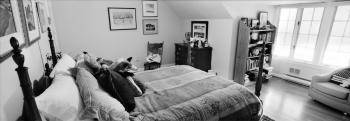
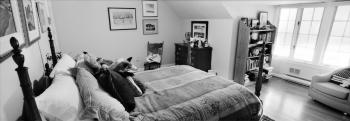
Gilbertson first photographed sniper Kirk Bosselmann in Falluja, Iraq. The 23-year-old was killed by small arms fire in 2004. His bedroom in Maryland conveys much more about this young man than the photo of the uniformed soldier in Iraq ever could. He loved to go see Shakespeare plays in D.C.; he enjoyed fine art prints.
“[Bossleman is shown to be] so not the marine type with this big, beautiful bedroom with a stuffed toy fox on the bed,” commented Gilbertson.
A soldier had reported that the dead body of an armed insurgent lay in a nearby mosque. Gilbertson felt if he could capture this image, he could show that fighters in Falluja were using mosques as centers of military activity. The mosques would no longer be considered holy ground, according to the Geneva Convention. It could help prove the American military was not indiscriminately attacking places of worship.
He was accompanied to the mosque by a group of marines. A photo Gilbertson took of his escort of about half a dozen marines laying down in rays of sun shining through a window captured the calm before the storm. One of the men, Billy Miller, did not make it back.
Ground View
In 2003, at the age of 25, Gilbertson made a name for himself with photos taken during the American invasion of Iraq. Gilbertson was not embedded, meaning he had not signed an agreement with the military to withhold information that may pose a security threat. He was therefore not allowed to speak with soldiers.
Instead, he watched and snapped. One photo captures a soldier sliding down a banister in Saddam Hussein’s old palace, which he called a “happy snap.” They were not all “happy snaps” says Gilbertson. He sent these pictures home as kind of postcards to friends and family, as well as to his agency. He was surprised when these candid photos ended up as a two-page spread in Time Magazine.
Gilbertson experienced firsthand the danger faced daily by men at war. Clouds of dense white smoke billow through a scene Gilbertson can now recall with a bit of humor, but which was terrifying at the time.
White phosphorus is a waxy substance that combusts upon contact with oxygen, sending forth thick white smoke. As bits of the corrosive material that “don’t stop burning until they reach the bone,” rained down, most were dodging here and there looking upward, while famed Pulitzer-prize winning journalist Dexter Filkins was not as quick with his backside up and head down, described Gilbertson. Filkins slept in a sleeping bag full of holes that night after some of the phosphorus landed on his backpack, Gilbertson recalled with a laugh.
The attack was friendly fire. Fellow Americans showered them with white phosphorus after mistaking them as Iraqi insurgents, though Gilbertson says the tanks that were part of their convoy should have been a dead giveaway.
Though he captured many poignant scenes and helped bring the experiences of soldiers home, he maintains “my war photography failed.” He says people are not interested. He began to reframe the conflict from a perspective with greater proximity to his audience.
On home turf
A “Lord of the Rings” poster hangs above Richard Langenbrunner’s bed. Science fiction movies and television show posters cover the other walls and a telescope stands by the window. It could be the bedroom of any 19-year-old American.
Langenbrunner committed suicide in Iraq in 2007 at the age of 19. This young man from Indiana was described as being perturbed and holding his head in his hands after carrying out orders to shoot a pickup truck as it crossed a kill line, explained Gilbertson. He killed one person and wounded two others. He took his own life soon afterwards.
In “Bedrooms of the Fallen,” Gilbertson brings the viewer into the lives of those left behind. Brandon Craig’s father still leaves a present in his son’s room at Christmas every year. Three wrapped bundles sit in the corner unopened.
“The soldiers are no longer just ranks, ages, and names,” explained Gilbertson. Traditional war photography often does not do much to capture the personality of the human being in the uniform in a way the viewer can relate to.
Gilbertson first photographed sniper Kirk Bosselmann in Falluja, Iraq. The 23-year-old was killed by small arms fire in 2004. His bedroom in Maryland conveys much more about this young man than the photo of the uniformed soldier in Iraq ever could. He loved to go see Shakespeare plays in D.C.; he enjoyed fine art prints.
“[Bossleman is shown to be] so not the marine type with this big, beautiful bedroom with a stuffed toy fox on the bed,” commented Gilbertson.


