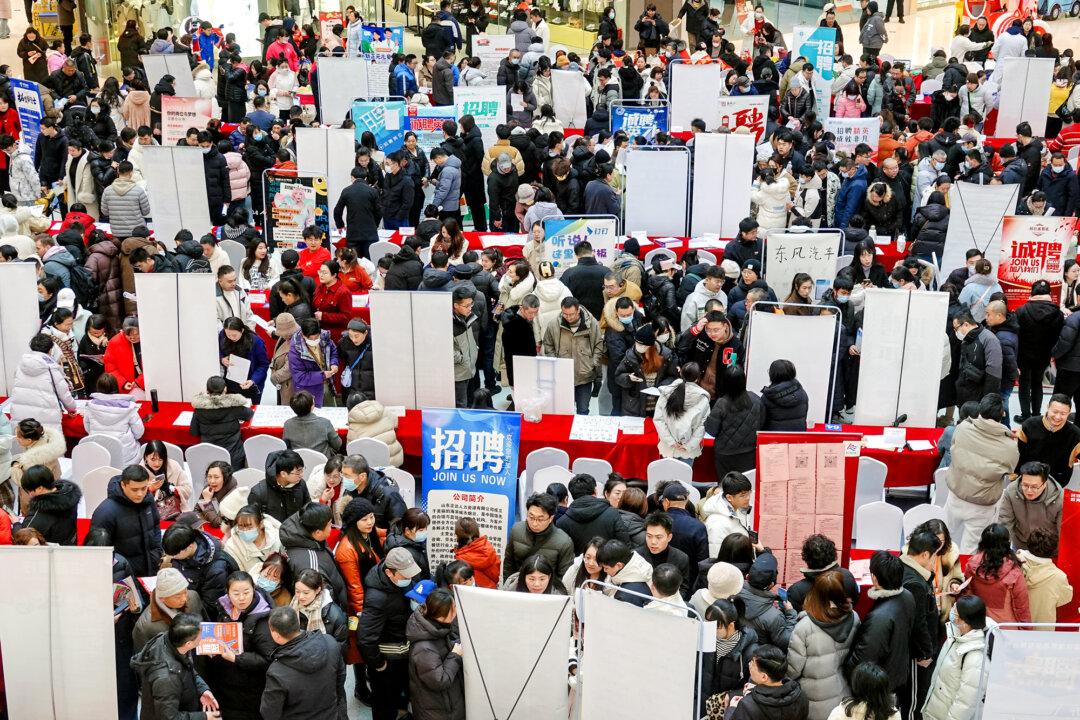
In the past week, widespread reports have emerged from cities across China that public employees, including civil servants, teachers, health care workers, and state-owned enterprise (SOE) workers, are not getting paid on time.
Reports of Wage Delays Ripple Nationwide
On June 27, a blogger in Shenyang went viral after posting a list of public departments allegedly unable to make payroll.“All departments in Yuhong District have not paid salaries in [the past] six months,” he wrote. “Even public kindergartens have stopped paying staff.”
The post drew significant attention on Chinese social media and prompted other netizens to list the government departments in their local regions that have not been paying their workers. Public sector workers in other Shenyang districts also reported widespread wage arrears. Social media has become one of the few outlets for Chinese citizens to voice grievances since traditional media are all controlled by the regime.
“My wife is about to give birth, and we can’t even afford the hospital stay,” one Shenyang social worker wrote.
Even retirees are worried. Li Renyi, a retired public servant from Shenyang, told The Epoch Times that long-assumed job security is now in question.

“It’s not just current employees,” he said. “Even those ‘iron rice bowl’ jobs aren’t so iron anymore. Local governments are collapsing. They can’t sell land, and tax revenue has plummeted. A friend of mine in the municipal water bureau [in China] said their department has stopped paying social security or housing provident funds, and wages haven’t been paid in a while, too.”
SOEs and other public institutions are also affected.
“Pensions are still being paid for now,” Li added. “But who knows how long that will last?”
Similar problems are surfacing in other provinces. On June 26, a civil servant in Zaozhuang, Shandong Province, wrote online: “No wages paid.”
In Qingdao, Shandong Province, a frontline health care worker wrote, “I haven’t been paid in two months. I show up to work, but my mind isn’t there.”
Zhao Na, a resident of Weifang, Shandong Province, said town-level public officials are not only facing delayed payments but also often partial ones.
“My relative told me their township leaders only received 80% of their salary last month. Some district-level staff haven’t been paid in several months.” Zhao said.
Zhao also noted that some private company employees are in similar straits but cannot afford to quit.
“One worker even took out a loan to help the company meet payroll, but they could only lend to them [under those circumstances]” once, Zhao said.
In Puyang, Henan Province, a volunteer teacher wrote online that their annual rural education subsidy had not been paid.
“We’re at our breaking point,” the teacher said. “After seven and a half months, we’ve received only 1,500 yuan (about $210). We cannot survive like this.”
In Lianyungang, Jiangsu Province, one of China’s wealthier regions, a group of construction workers recently blockaded a state-run solar power site operated by the China National Nuclear Corporation, and their demand was for the company to address the paid wages.
A Deepening Fiscal Crisis
Peng Jiazheng, a retired professor in economics from Zhongnan University of Economics and Law in China, told The Epoch Times that the root of the crisis lies in China’s overreliance on land sales for local government revenues. This model has imploded as the real estate market slumps.“Public-sector wage delays are just the tip of the iceberg,” Peng said. “Now, the crisis is hitting core services like education, health care, and sanitation. This is a systemic issue in China’s fiscal and policy environment.”
On June 28, Chinese financial magazine Caixin cited the Chinese Communist Party State Council’s 2024 audit report, revealing that 41 billion yuan (US$5.72 billion) in agricultural subsidies had been misappropriated across 16 provinces and 175 counties, with some being used to pay civil servant wages or repay debts. The report also found that more than 100 counties had allowed companies to fraudulently claim nearly 5 billion yuan (US$70 million) in farm equipment subsidies, while more than 3,200 regime officials were suspected of embezzling rural support funds.
As public coffers dry up, people are increasingly shouldering the burden. In Guangdong Province, a widely shared video shows an elderly man working 12-hour night shifts on a construction site for just 170 yuan (US$24) for that entire day.
“If the government can’t fix this soon,” Peng warned, “we’ll see not only a collapse of basic services and talent loss in public roles, but also deeper urban-rural inequality and mounting unrest. The fiscal crisis is spreading quietly, but its consequences could be profound.”