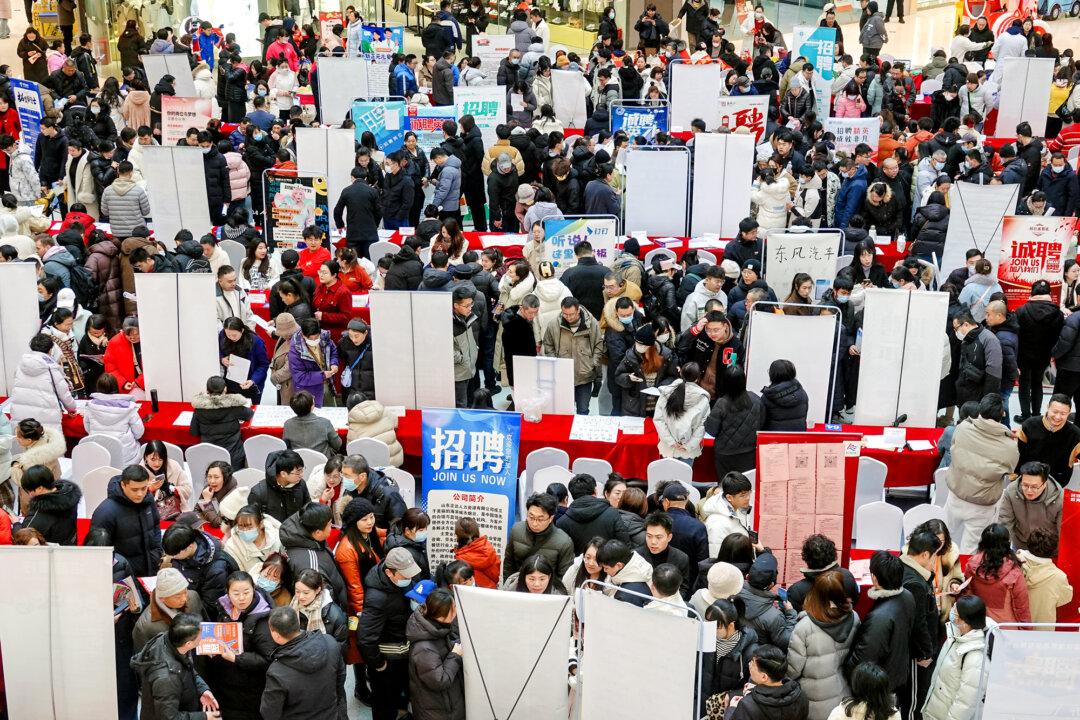
A public hospital in Chengdu has ordered all employees, including permanent staff, contracted workers, and temporary workers, to disclose their religious beliefs, while education officials in the southwestern Chinese city have also been collecting information on students’ religious backgrounds and those of their parents, according to leaked internal documents and individuals familiar with the practices.
The individuals spoke to The Epoch Times on condition of anonymity out of fear of reprisal.
The measures illustrate how scrutiny of religious affiliation has extended beyond religious institutions into workplaces and schools, with employees and students required to report whether they or their family members practice Christianity, Islam, or other religions.
An internal notice recently circulated on social media from a public hospital in Chengdu said the hospital was conducting a comprehensive survey of employees’ religious beliefs to implement requirements for the “regular investigation of ideological, ethnic, and religious work.”
The notice instructed the hospital to cover “every individual without leaving anyone out.”
All employees were required to provide information and were prohibited from concealing or omitting relevant details. The information would be collected by designated personnel and kept confidential, according to the notice.
Employees with no religious affiliation were also required to register and select “no religious belief.” The hospital was to require all employees to submit information regardless of whether they had a religion.
The notice also stated that members of the Chinese Communist Party (CCP) are not permitted to practice any religion. Those with religious affiliations were required to report the matter to their Party branch.
Religious proselytizing and religious activities were prohibited in the workplace. The notice also warned that “all information is strictly prohibited from being disseminated online.”
Scrutiny Extends to Parents
The practice is not limited to the medical system, according to an administrative employee at a university in Sichuan, surnamed Chen.
Chen told The Epoch Times that schools are also investigating the religious affiliations of students’ family members.
“They are now investigating religious beliefs, [and] the schools have to compile the statistics and report them upward,” she said.
Chen said she did not know exactly how the information would ultimately be used. However, the inclusion of students’ parents in such surveys suggests that the scrutiny extends beyond an individual’s own religious affiliation to the religious background of their immediate family.
An employee at Chengdu’s education authorities told The Epoch Times that the education system conducts background checks on students’ families every year before new students enter school.
Religious affiliation is among the information collected, she said.
The employee’s account indicates that religious-background checks in Chengdu’s education system are not necessarily a one-time campaign but part of a recurring process conducted before each academic year.
She also said the education system maintains contact with the regime’s religious authorities.
The accounts could not independently establish how widely the hospital or the schools’ practice is used elsewhere in China. However, it provides a glimpse into how religious information is being incorporated into workplace management within the public sector.
Religious Control Under the CCP
The language used in the hospital notice, including references to an “ideological” and “ethnic and religious” investigation, reflects the CCP’s broader approach of treating religion as an issue of political and ideological management.
In 2025, Chinese leader Xi Jinping again called on Party authorities at all levels to strengthen their leadership over religious affairs and incorporate religious work into the Party’s overall leadership system.
A Chinese scholar, surname Lu, told The Epoch Times the Chengdu hospital’s investigation showed the extent to which the regime seeks to monitor and restrict religious belief.
“This phenomenon is not limited to Chengdu. I have heard that Shandong and Zhejiang prohibit civil servants from believing in Christianity. If they are discovered, they are required to leave their jobs,” he said.
Lu cited the case of a civil servant in Wenzhou, Zhejiang Province, who he said was dismissed for being a Christian several years ago.
“If you participate in a house church gathering, the state security will harass you all day,” he said.
The Chengdu hospital notice does not indicate that employees would face disciplinary action based solely on their religious affiliation. However, the requirement that every worker disclose their religious status, coupled with the prohibition on Party members practicing religion, shows that religious belief is being treated as information subject to institutional monitoring rather than solely as a private matter.