A House committee investigating the Chinese Communist Party (CCP) has demanded records from five major U.S. drugmakers about clinical trials in China that they participated in, citing studies the committee says involved hospitals in Xinjiang and medical sites tied to the Chinese military.
Xinjiang has been a focus of U.S. government actions targeting Beijing on human rights and forced labor issues.
Rep. John Moolenaar (R-Mich.), chairman of the House Select Committee on the CCP, sent letters dated June 29 to Merck, Pfizer, AbbVie, Eli Lilly, and Bristol Myers Squibb, according to documents obtained by The Epoch Times.
The letters set a July 17 deadline for the companies to provide records on trial locations, informed consent, site inspections, data security, and licensing or joint-venture deals with Chinese biotechnology firms.
Each letter states that there is no evidence the company addressed engaged in illegal activity or wrongdoing. The letters instead argue that conducting trials in Xinjiang and at Chinese military hospitals exposes U.S. companies to ethical and national security risks tied to informed consent, data protection, and intellectual property.
Drawing on public records from ClinicalTrials.gov and ChinaDrugTrials.org.cn, the committee identified at least 73 trials across the five companies that it said included hospitals in Xinjiang, and at least 132 trials that it said included Chinese military medical centers or hospitals. The letters describe the lists as non-exhaustive.
In the letter to Pfizer, Moolenaar wrote that his office understands the company “will no longer sponsor trials in Xinjiang and at PRC military hospitals in the future,” referring to the acronym for China’s official name, the People’s Republic of China.
Pfizer did not respond to The Epoch Times’ request for comment by publication time.
Documents, Data, and China Deals
The letters place the companies’ China trial activity inside a broader congressional review of U.S. biotechnology exposure to China.Moolenaar wrote that China has become “the cheapest and fastest place in the world to run early-stage human drug trials,” citing regulatory changes, subsidies, large patient pools, and ethical concerns raised by biotechnology executives and researchers.
Patient enrollment at Chinese clinical trial sites is two to five times faster than in the United States, the letters say, citing a McKinsey report.
The letters say, however, that speed may also be accelerated by weaker safeguards around informed consent and voluntary participation, citing research on clinical-trial consent in China.
The Food and Drug Administration lists informed consent rules among its regulations governing good clinical practice and clinical trials. Federal rules require legally effective informed consent and say consent must be sought only under circumstances that minimize coercion or undue influence.
The letters ask the companies to provide due diligence procedures for ensuring good clinical practice standards at trial sites in China, including in Xinjiang and at Chinese military hospitals.
Trial Counts
The letters cite the following company-level trial counts: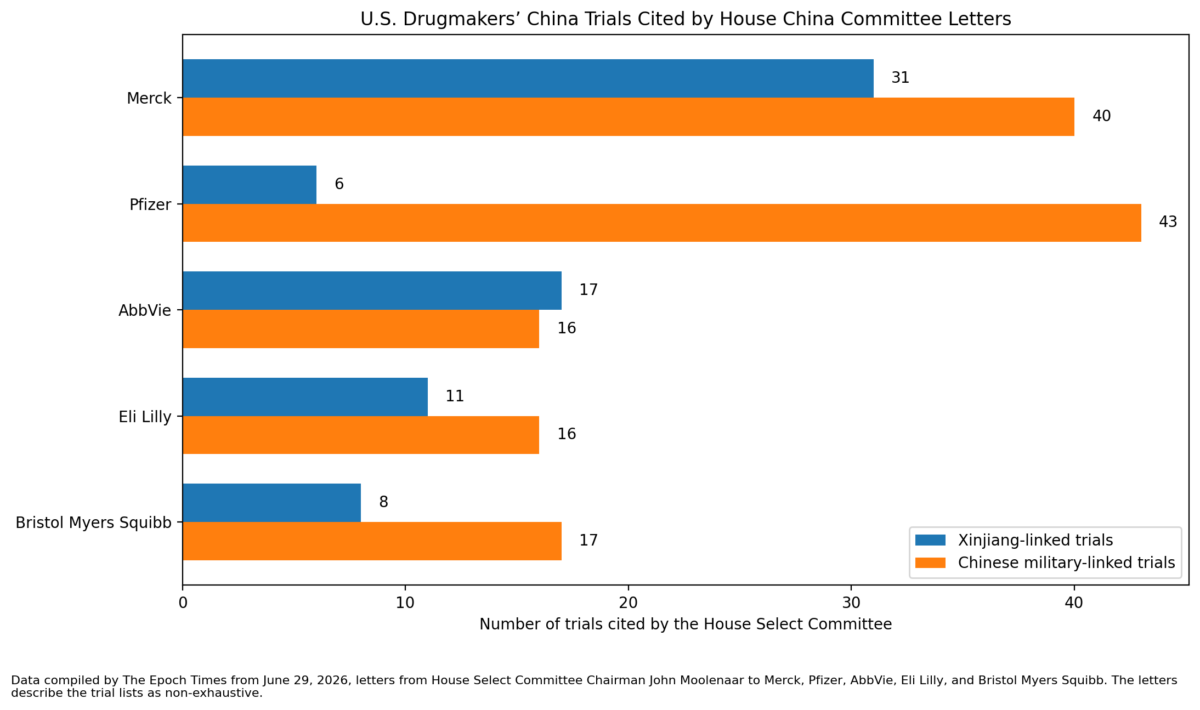
The Merck letter says the company appeared to have sponsored or collaborated on 224 clinical studies in China since 2005, including at least 31 trials involving hospitals in Xinjiang and at least 40 trials involving Chinese military medical centers or hospitals.
The Pfizer letter says the committee identified at least six trials involving Xinjiang hospitals and at least 43 trials involving Chinese military medical centers and hospitals.
The AbbVie letter says the committee identified at least 17 trials involving Xinjiang hospitals and at least 16 trials involving Chinese military medical centers and hospitals.
The Eli Lilly letter says the company appeared to have sponsored or collaborated on more than 220 clinical studies in China since 2003, including at least 11 trials involving hospitals in Xinjiang and at least 16 trials involving Chinese military medical centers or hospitals between 2016 and 2024.
The Bristol Myers Squibb letter says the company appeared to have sponsored or collaborated on about 180 clinical studies in China since 2004, including at least eight trials involving hospitals in Xinjiang and at least 17 trials involving Chinese military medical centers or hospitals between 2015 and 2024.
Xinjiang and Military Sites
The State Department determined in 2021 that Chinese authorities had committed genocide and crimes against humanity against Uyghurs and other mostly Muslim minority groups in Xinjiang, citing mass detention, forced labor, forced sterilization, and other abuses.Congress later enacted the Uyghur Forced Labor Prevention Act, which bars imports of goods made wholly or in part in Xinjiang unless importers can rebut a forced-labor presumption. U.S. Customs and Border Protection says the law directs enforcement of a rebuttable presumption for goods mined, produced, or manufactured wholly or in part in Xinjiang.
The letters say the forced-labor law does not specifically address clinical trials. They invoke the law as an analogy for the level of due diligence U.S. companies should apply in Xinjiang, arguing that clinical trials are part of the drug-development pipeline even though they are not part of physical-goods supply chains.
The letters also raise concerns that trials conducted at Chinese military hospitals could expose sensitive data or intellectual property to military-linked institutions.
“Clinical trials involve collaborative research activities with doctors, nurses, and other officials at the trial sites and produce sensitive and proprietary data,” one of the letters says.
The same passage says conducting such research at Chinese military hospitals puts American biotechnology intellectual property “at potential risk of being transferred to the Chinese military.”
July 17 Deadline
The letters ask each company to provide a briefing and documents by July 17.The requested materials include policies governing clinical trials, inspection records for China trial sites, internal analyses or risk assessments, records on trials in China since 2015, and information on how each company protects intellectual property and sensitive data at trial and manufacturing sites in China.
The letters also ask each company to provide all licensing, equity, or joint-venture agreements with Chinese companies since Jan. 1, 2020.
The committee’s rules for the 119th Congress incorporate the House resolution that established the panel, and the rules page says the chairman has subpoena authority.
The letters do not state what steps the committee may take if the companies do not provide the requested information by July 17.