Hong Kong International Airport started conducting secondary screenings recently for some passengers arriving from mainland China and traveling to the United States before the Chinese regime’s new exit regulations take effect, according to a popular online video.
A traveler flying from Shanghai to Los Angeles via Hong Kong posted a video on Aug. 5 on YouTube with the account name “Mei Dashi flying across China and U.S.” It recounts his experience at the Hong Kong airport, which garnered more than 111,000 views in five days.
After completing transfer procedures and arriving at the boarding gate, his family of four saw passengers for the Los Angeles flight lining up for checks outside the boarding gate. Staff had cordoned off the waiting area with metal barriers, and passengers were required to undergo questioning before being allowed to enter, the traveler said, showing the area in the video.
The traveler stated that Hong Kong airport inspection personnel examined their passports and boarding passes, asking where in mainland China they had arrived from and how long they had stayed on the mainland. He noted that questions regarding the duration of a traveler’s stay are typically posed by U.S. immigration officers upon entry, yet in this instance, the questioning took place prior to boarding in Hong Kong.
In addition, inspectors asked whether his iPad had undergone repairs before, which the passenger found strange.
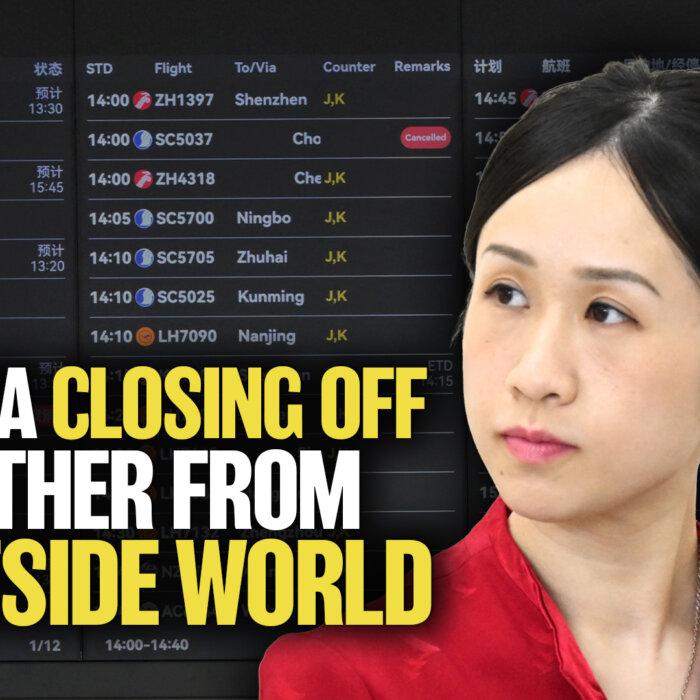
The passenger also stated that he had not encountered such procedures in the past when traveling to the United States via Hong Kong, and other passengers on-site were also discussing why checks had suddenly been increased.
Leung, a Hong Kong resident who requested to use only her surname, told The Epoch Times: “I didn’t run into this situation at the boarding gate when I flew to Los Angeles in late July. It seems like a new measure targeting people from mainland China. I don’t understand why they are screening mainlanders this way.”
The passenger in the video said he asked the inspecting officer on the spot, “Does traveling from Hong Kong to the United States now require this kind of special questioning? I’ve never encountered this before.”
He said the officer replied, “Yes, it does—ask him. You ask him; I can’t say who he is.”
The passenger said, “Then, I understand immediately who he is,” implying ruling Chinese Communist Party (CCP) leader Xi Jinping.
Zhang Le, an immigration agent based in Australia who used a pseudonym out of fear of reprisal from the Chinese regime, told The Epoch Times that Hong Kong inspection staff did not call the new inspection procedures airline regulations, nor did they attribute responsibility to the U.S. side.
Zhang said the Hong Kong airport staff’s apparent reference to Xi “indicates that the personnel on site at the Hong Kong airport knew the source of the relevant notice or directive but were unwilling to name [the CCP leader] openly.”
Hong Kong: No Longer a Free Port
Liao Chenkai, a Japan-based political commentator who also used a pseudonym out of fear of reprisal, told The Epoch Times that although the CCP’s new entry-exit regulations have not yet been officially implemented, controls on the cross-border movement of people have already extended to Hong Kong.
Hong Kong is being transformed by Beijing into a part of the mainland’s outbound travel control system; the institutional advantages it once held as an international free port, a global transshipment hub, and a gateway to the outside world are being gradually erased by the CCP’s national security apparatus, he said.
The Hong Kong island was a collection of several small fishing, farming, and salt-producing hamlets with a total population of about 7,000 people when it was ceded to the British in 1842 under the Treaty of Nanjing after Qing Dynasty China was defeated in the First Opium War by the British. Kowloon was added permanently in 1860 after Qing lost the Second Opium War. The New Territories was leased by Britain in 1898 for 99 years. These three areas made up the Hong Kong colony of the UK.
Hong Kong had developed into a major free port in the Asia-Pacific, an international financial hub, and a bustling metropolis with more than 7 million residents in more than a century under British rule.
However, the UK government under Margaret Thatcher in 1984 signed a declaration with Beijing, to return in 1997 the entire Hong Kong colony to the Chinese communist regime that has occupied mainland China since 1949.
Beijing promised to maintain the “one country, two systems” in Hong Kong for 50 years, allowing Hong Kong to continue to have a capitalist system and its own judicial independence and Hong Kong citizens to continue to have various civil rights under the British rule similar to those enjoyed by citizens in Western democratic countries, but denied to people living in mainland China directly under the CCP’s rule.
“Hong Kong’s established judicial independence, freedom of movement for people, and status as an international financial center have been gradually dismantled,” he said.
Hong Kong grew from a small fishing village into an international metropolis under British rule by relying on the rule of law, freedom, and integration with the global community, Liao said.
“The CCP is now destroying these advantages one by one, effectively reverting the city to its former state. Hong Kong is no longer the city it once was; instead, it is transforming into a frontline gateway through which the CCP controls the flow of people, information, and capital,” he said.