Foreign Correspondents’ Club of China (FCCC) released a report on July 13 showing that foreign journalists in China continue to operate amidst surveillance, administrative pressure, obstacles to reporting, and an environment where sources are increasingly cautious.
The FCCC is a professional organization for foreign correspondents based in Beijing, China, according to public information.
A total of 89 FCCC members participated in this survey, representing media outlets from Asia, Europe, Latin America, and North America. Fearing retaliation, the majority of the journalists surveyed preferred to remain anonymous, according to the FCCC.
The report, titled “The New Abnormal,” shows that 94 percent of the journalists surveyed believe that current reporting conditions in China do “not usually” or “almost never” meet international standards.
Specifically, 38 percent of the journalists stated that the reporting environment in China “almost never” meets international standards, while 56 percent said it “usually” does not.
Notably, not a single surveyed respondent believed that the news-gathering environment in China “usually” or “almost always” meets international standards.
The report notes that politically sensitive topics, including Taiwan, Tibet, Xinjiang, and criticism of the ruling Chinese Communist Party’s (CCP) top leadership, continue to be subject to major constraints on foreign journalists’ reporting.
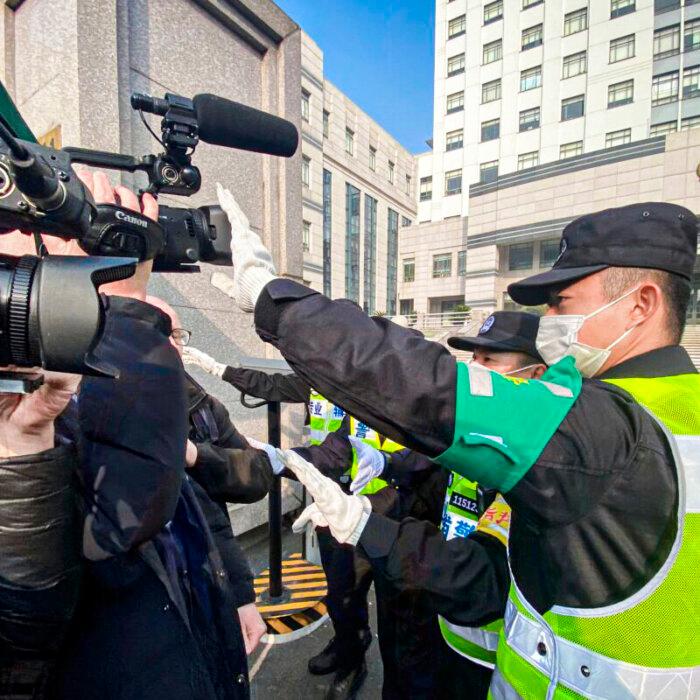
Reporting on the ground in China is no easy task, the report summarized. Sixty-four percent of respondents stated that they had encountered obstruction by the Chinese regime’s police or other officials at least once in 2025.
The FCCC stated that such interference is no longer limited to traditionally sensitive regions such as Xinjiang and Tibet. Journalists report encountering obstacles when covering routine social issues—such as local development, business operations, or matters affecting people’s livelihoods.
Furthermore, respondents have noted that the scope of sensitive topics in China is expanding. “Long-standing political red lines remain firmly in place, while economic, technological, and social issues are also becoming more sensitive,” the report reads.
The survey shows that 47 percent of the journalists interviewed believe new sensitive issues have emerged over the past year, including China’s demographic issues, the overall Chinese economic situation, youth unemployment, the real estate crisis, U.S.–China trade conflicts, as well as rare earth elements and emerging technologies.
The report notes that as China’s economic growth is slowing down, reporting on issues involving market confidence, real estate, and employment has become more difficult.
A foreign journalist said in the survey, “I feel like everything is sensitive and/or people think that it might be sensitive and therefore block you.”
In addition, journalists surveyed also raised concerns over digital surveillance, visa delays, and legal threats linked to their reporting.
Pressure on Sources and Chinese Employees
Meanwhile, Chinese interviewees are facing increasing pressure, according to the survey.
Seventy-seven percent of the journalists surveyed stated that sources in China had refused or canceled interviews, citing reasons such as “can’t talk to foreign journalists.” Thirty-two percent of the journalists reported that their sources had faced questioning, threats, or other negative consequences for giving interviews to foreign media.
“It’s very hard to get interviews with state and local officials or business leaders. Many times the answer is that ‘we don’t/can’t talk to foreign journalists.’. Endless ping-ponging from one official to another to have permissions to interview or visit a site,” the survey quoted one Beijing-based foreign correspondent as saying.
“Business owners declined interviews about the economy out of fear to speak to foreign media. Academics were asked by conference organizers not to give interviews, economists and agricultural experts declined interviews because they are apparently not permitted to speak to foreign media. Pressure on sources—both overt and covert—is intensifying,” a correspondent said in the survey.
In the report, the FCCC specifically notes that foreign correspondents working in China rely heavily on Chinese researchers, producers, and assistants, yet these staff members often face greater pressure from the Chinese regime.
Surveys show that 89 percent of the journalists surveyed work for institutions that employ Chinese nationals. Among them, 40 percent reported that their Chinese colleagues had faced pressure, harassment, or intimidation from Chinese authorities.
Some Chinese employees have been summoned for “tea”—a euphemism for questioning—by the police or state security agencies, and were required to disclose details regarding interviews conducted by foreign journalists and their work schedules.
A European news journalist stated in the survey, “My news assistant regularly gets invited for tea and faces questions about my reporting.”
The FCCC said that “restrictions were described not as isolated incidents, but as part of a broader reporting environment shaped by surveillance, administrative pressure, and increasing caution among sources and institutions.”
The report said that in China “formal reporting rights often exist on paper but are increasingly difficult to exercise in practice.”
The FCCC summarized: “The survey responses suggest that restrictions on reporting are no longer experienced as isolated incidents, but as a routine feature of the reporting landscape. For many correspondents, this has become the new abnormal.”