China recently put senior military officers through a 10-week training program, the first of its kind.
Training Details Suggest Loyalty Screening
On June 24, the PLA Daily published details of the inaugural training program, which took place from April 8 to June 16 at the National Defense University in central China’s Hunan Province. Participants watched anti-corruption films intended as a stern warning to all CCP officials, sang revolutionary military songs emphasizing rules and discipline, and even spent morning exercise sessions relearning basic marching and drill movements.Senior generals normally do not have to undergo basic military training, and requiring the military’s privileged leadership to relearn basic marching formations has been widely interpreted as a deliberate act of political humiliation.
Chen Poking, a U.S.-based China analyst and author, told The Epoch Times that forcing senior officers to repeat basic drills was Xi Jinping’s way of belittling these high-ranking military officers. “On the surface, the program is about fighting corruption. In reality, it’s about reinforcing Xi Jinping’s personal authority,” Chen said.
PLA Daily also said the program used case studies and analyses of real corruption investigations to examine the causes and lessons behind major cases. According to the report, the participants unanimously pledged to uphold the “Two Safeguards,” the PLA’s doctrine affirming loyalty to Xi’s leadership and the Party’s authority. They also pledged to fully implement the CMC chairman responsibility system, another key mechanism reinforcing Xi’s control over the military.
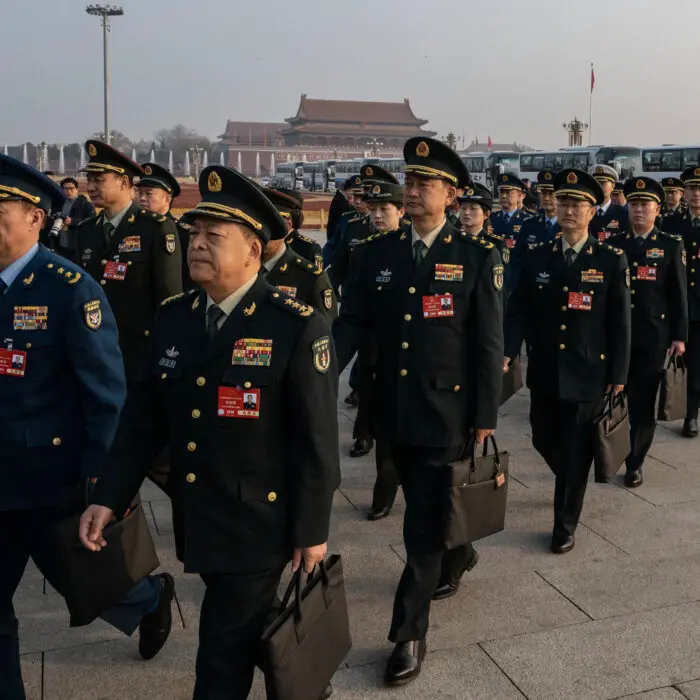
Since 2023, the PLA has experienced an unprecedented wave of purges targeting senior commanders. Those investigated or removed include former CMC Vice Chairman He Weidong; CMC member Miao Hua; and, more recently, Vice Chairman Zhang Youxia and CMC member Liu Zhenli. State military media outlets have accused Zhang and Liu of “seriously undermining the CMC chairman responsibility system,” among other political offenses.
Shen Ming-shih, a research fellow at Taiwan’s Institute for National Defense and Security Research, told The Epoch Times that the more than two-month closed-door program effectively isolated senior officers from outside contacts, giving authorities an opportunity to closely monitor their behavior. He said the process resembled the CCP’s historical “Rectification Movement”—a series of internal political campaigns in which officials underwent ideological study, self-criticism, and mutual criticism to identify dissent and enforce loyalty.
He said the group discussions during the program were likely designed to test whether participants would openly repudiate Zhang Youxia and Liu Zhenli and reaffirm their loyalty to Xi Jinping. The discussions may also have been intended to pave the way for future public denunciations of the two men by China’s central authorities.
Xi’s Speech Seen as Warning to the Military
After authorities announced investigations into Zhang Youxia and Liu Zhenli on Jan. 24, the CMC introduced a series of new regulations widely seen as responses to the ongoing military purge. Those directives became key study materials during the training program.
Chen said Xi may have removed perceived rivals by purging Zhang and Liu, but he also created widespread resentment within the military.
“That is why he keeps issuing new directives and organizing political study sessions—to warn everyone else,” he said.
At the April 8 opening ceremony, Xi urged senior officers to “set an example by speaking the truth” and to “dare to struggle” against what he described as “wrong thinking” and “wrong work styles.”
Chen believes that Xi’s remarks were aimed at Zhang and Liu, portraying any disagreement with him as “incorrect thinking” in order to justify their removal.
“When he brings someone down, he keeps portraying them as politically wrong because he fears others will not accept the purge,” Chen said.
Shen, meanwhile, highlighted the irony of Xi’s remarks, saying that his call for senior officers to “speak the truth” suggested the military leadership has long been dominated by flattery, scripted rhetoric, and a tendency to report only good news.
Zhang Shengmin’s Loyalty Display Seen as Political Theater
The training program concluded on June 16. CMC Vice Chairman Zhang Shengmin attended the graduation ceremony and again stressed loyalty to Xi’s military doctrine and the CMC chairman responsibility system.After a series of high-level military purges, the seven-member Central Military Commission has effectively been reduced to just two authoritative figures: Xi Jinping, its chairman, and Vice Chairman Zhang Shengmin. Although Zhang Shengming was elevated to the position last year, he was not promoted to the CCP Politburo, fueling continued speculation about his political future.
Feng Chongyi, an associate professor at the University of Technology Sydney, said Zhang Shengming’s remarks were standard official rhetoric. “Xi has to guard against everyone to stay in power, while everyone else lives in constant fear that they could be the next person to be purged. They are all putting on a performance for each other,” he said.
Chen believes that Xi does not truly trust Zhang Shengmin, and Zhang Shengming is not necessarily loyal to Xi. “It is more accurate to say he fears Xi,” Chen said.
Chen also noted Zhang Shengming’s body language during a recent public appearance when he greeted retired officers alongside Xi, following the downfall of Zhang Youxia and Liu Zhenli. Television footage showed Zhang Shengming deliberately keeping his distance from Xi. When the retired officers tried to shake his hand, Zhang declined with a wave, apparently indicating that he is much inferior to Xi. According to Chen, this episode suggests that Zhang himself feels politically insecure.
PLA Facing Its Most Unstable Period in Years
Next year marks the 100th anniversary of the PLA as well as the CCP’s 21st Party Congress, where major leadership changes are expected. A possible reshuffle of the CMC has therefore become a focus of attention.A source within China’s political system familiar with military affairs who requested anonymity out of fear of reprisal told The Epoch Times that although public announcements of senior military purges have slowed, loyalty assessments remain the biggest obstacle to restructuring the CMC.
“The biggest challenge in personnel appointments later this year is determining who Xi can truly trust,” the source said. “You can’t judge new candidates based solely on their current performance. If you investigate their past conduct, however, you may uncover another set of problems.”
Shen said Xi is now trying to rebuild the military leadership after removing Zhang Youxia and Liu Zhenli by promoting a new generation of full generals. The effort, he said, is intended both to consolidate Xi’s political position and to restore command continuity, while preparing the PLA to achieve the capabilities Beijing has set for a potential invasion of Taiwan by the military’s centenary.
However, Shen believes the PLA is experiencing one of the most fragile periods in its recent history. Many officers who outwardly display enthusiasm and loyalty may be doing so merely to ensure their political survival rather than because they genuinely support Xi.
“If more and more officers are only pretending to obey, they could still turn against Xi if the right opportunity arises,” Shen said.
According to Chen, Xi’s repeated purges have created deep resentment within the armed forces. If a major crisis were to arise, such as ordering military action against Taiwan, Xi could face serious uncertainty regarding the military’s response.
“The PLA’s morale may be more fragmented now than in years past. For the CCP as a whole, it could also signal the beginning of a period of heightened political risk,” he added.