Some factories in eastern China’s Jiangsu and Zhejiang provinces have recently increased testing and deployment of humanoid robots to replace human workers amid the country’s persisting high unemployment, according to Chinese media reports and local industry professionals who spoke with The Epoch Times.
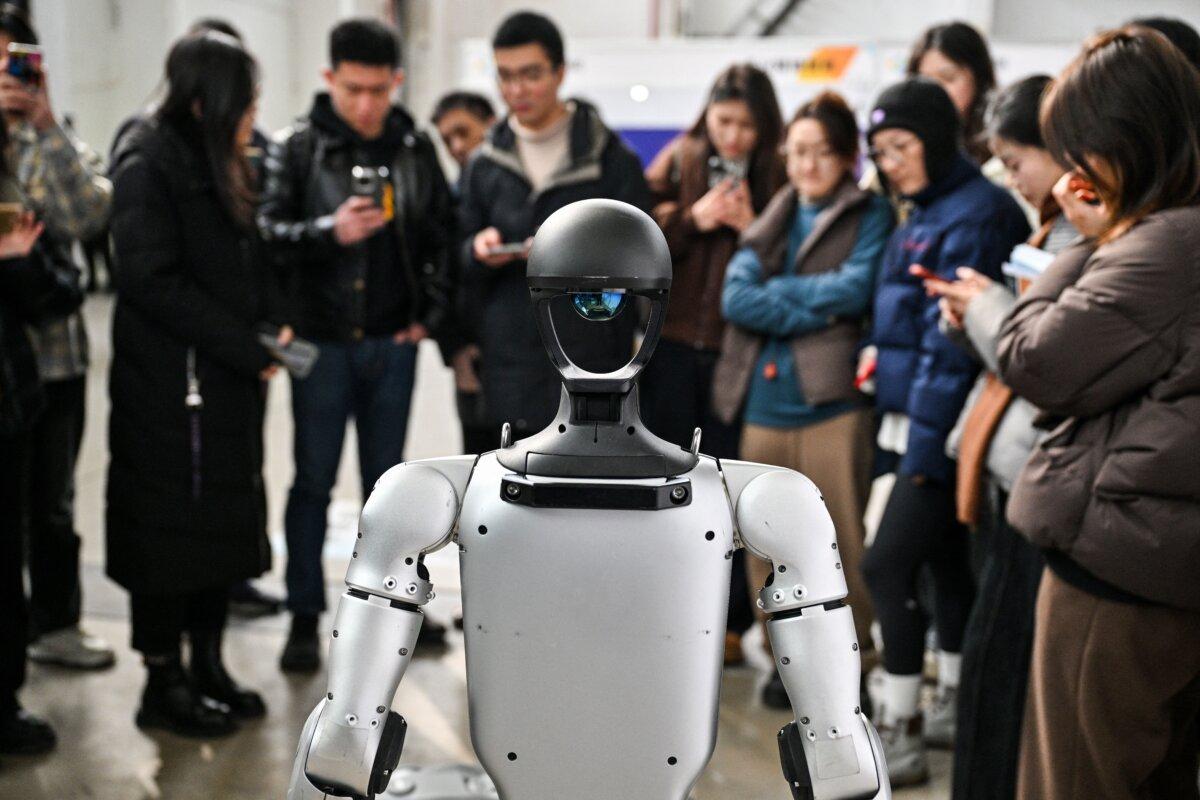
Humanoid robots from Beijing Xingdong Jiyuan Technology were flipping packages on a conveyor belt to ensure the shipping labels face upward before sorting them into the corresponding slots in Guangzhou city on June 9, according to Chinese media reports.
In the “Guiding Opinions on the Innovative Development of Humanoid Robots” issued in 2023 by the Chinese regime’s Ministry of Industry and Information Technology, it set a goal for the humanoid robot industry to achieve accelerated, large-scale development by 2027, with related products deeply integrated into the real economy. Regions such as Zhejiang, Jiangsu, Shanghai, and Guangdong have also successively introduced policies to support the robotics industry.
In the first half of this year, posts of robots working on factory floors in various regions such as Jiangsu and Zhejiang have emerged on social media.
Wu, a garment processing factory owner in Jiaxing, Zhejiang Province, who gave only his surname out of fear of reprisal, told The Epoch Times that labor costs are too high and many companies are switching to robots.


Workers’ Livelihood at Stake
Wang, the head of a machinery parts factory in Wenzhou, Zhejiang Province, who gave only his surname out of fear of reprisal, told The Epoch Times that the introduction of robots into factories is driven by a calculated push for “de-humanization” shared by enterprises and local governments, disguised as a form of industrial upgrading.“Many business owners today are adopting robots not because they can’t find workers, but because they find labor too expensive. On top of wages, there are costs for pension, medical, unemployment, and work-injury insurances. No matter how slow a robot might be, it doesn’t demand social security benefits, take time off, or assert labor rights,” he explained.
Wang said he was also considering using robots. “I plan to upgrade our factory’s equipment and switch to robotic operations,” he said. It’s because “China’s ruling Communist Party (CCP) uses policies, subsidies, and pilot projects to encourage replacing human workers with robots despite knowing full well that the job market is already struggling,” he said.
“Over in Hangzhou, robots are being promoted everywhere, and robotics manufacturers and factories using robots are receiving government support. Yet, this is at the expense of the livelihoods of low-level workers for industrial upgrading,” he acknowledged.
Many Chinese enterprises are struggling and have to alter their production models, Liao, a veteran of the Chinese manufacturing industry with 30 years of experience who gave only his surname out of fear of reprisal, told The Epoch Times.
“Many factories are relocating to Southeast Asia partly because production costs in China have become too high and profit margins are shrinking,” he said. “The combined annual cost of a worker, including wages, social security, room and board, and management overhead is substantial, yet orders have dropped by 40 percent. The government is pushing hard for the adoption of robots to replace human workers and touting ‘technological self-reliance,’ but in reality, they are driving businesses and workers to the brink of ruin.”
While the CCP markets robotics as “new quality productive forces,” Liao said, “ordinary people see only job losses, and entrepreneurs face the rapid relocation of supply chains out of China. The CCP is simultaneously calling for stable employment and pushing for the replacement of human workers with robots. These two objectives are clearly in conflict.”
Observers say the CCP is manipulating rhetoric to cover up the persisting high unemployment, and many of these individuals who are in “flexible employment” would be classified as engaged in nonstandard, informal, employment or underemployment under Western labor statistics standards and social policy.