A journalist’s review of Committee of 100 (C100) records has renewed scrutiny of sponsor-paid trips that brought senior figures from major U.S. news organizations to China and recorded changes in their views and professional plans.
In response to questions from The Epoch Times, C100 confirmed that it covered travel costs, selected the participants, set their itineraries, and chose whom they met.
The organization rejected journalist and media host Natalie Winters’s description of the trips as “pay-for-play,” saying no coverage was exchanged for the travel and participants retained editorial independence.
Winters published her review on Substack on July 28, characterizing the multiyear journalist delegation program as a “propaganda pipeline.” Her report drew attention to documents posted on C100’s website.
A 2012 trip report on the website marked “Internal Use” placed the cost of a nine-day delegation for five journalists at approximately $60,000.
The report said the program sought to improve perceptions of China and encourage participants to share their experiences with professional peers.
The five journalists represented The New York Times, The Atlantic, the Financial Times, Foreign Affairs, and WNYC. A page about the delegation on the C100 website says they traveled through Beijing, Shanghai, and Hangzhou from Nov. 25 through Dec. 3, 2012.
The trip report described lodging, meals, transportation, sightseeing, corporate and cultural visits, and about 20 arranged meetings with Chinese officials, academics, media representatives, students, and business executives.
C100 Recorded Changes in Views
Winnie O’Kelley, then-deputy business editor at The New York Times, said she would return from the trip with several story ideas and “shape my staff across Asia in some different ways,” according to the report.
Gary Silverman, then-U.S. news editor and deputy managing editor at the Financial Times, said he would not again “think or write about China” without reflecting on what he had learned.
WNYC host Brian Lehrer was described as saying his perception of China had changed “in 100 ways.”
Jonathan Tepperman, then-managing editor of Foreign Affairs, said the trip had given him a “much deeper, more subtle and more nuanced” sense of China and elite opinion in the country.
He said he had made contacts he intended to continue consulting and called it the best press trip he had attended.
Clive Crook, then-senior editor at The Atlantic, said the visit reinforced his view of China as a “huge and fascinating story” and told organizers to “keep it up.”
C100’s report highlighted two articles Crook published after the trip: “Why China and the U.S. Can Be Capitalist Comrades” and “China’s Ghost Towns Won’t Have a Hard Landing.”
C100’s delegation page links to those articles, another Crook article, three Lehrer broadcasts, and a Silverman column. The page says the visit gave participants information and perspectives for their later reporting.
Shen Dingli, a professor at Fudan University in Shanghai who met the delegation, responded to the participants’ assessments with a remark recorded in the trip report.
“You made the change!” Shen said.
Participants From Major Newsrooms
C100 began its journalist-delegation program in 2007 and told The Epoch Times that it continued through 2014.
Over that period, C100 records identify participants from The New York Times, The Washington Post, NPR, PBS, Politico, Time, Newsweek, The Atlantic, the Financial Times, Foreign Affairs, WNYC, The New Yorker, USA Today, and other outlets.
A C100 account of a gathering of 2011 and 2012 delegates described the program as an opportunity for American thought leaders to witness China’s development and challenges and meet officials, experts, journalists, businesspeople, artists, and students.
The 2012 trip report said the program sought to improve perceptions of China and expected participants to share their experiences with professional peers.
In a December 2012 message, then-C100 Executive Director Angie Tang wrote that the journalist and civic-leader delegations were “shaping the U.S.-China dialogue on the frontlines.”
The 2012 delegation met Cui Tiankai, then-Chinese vice foreign minister; CCTV executive producer Cheng Yue; Sinopec Chairman Fu Chengyu; Shanghai financial official Fang Xinghai; and academics, corporate leaders, students, and local journalists.
C100 also held discussions with Chinese officials during the same period.
Its account of those meetings says C100 leaders met Chinese Culture Minister Cai Wu, Hong Kong Chief Executive-Elect Leung Chun-ying, and C.H. Tung, chairman of the China–U.S. Exchange Foundation, a Hong Kong organization established in 2008.
C100 leaders also discussed possible collaboration on the organization’s teacher and journalist delegations to China with He Yafei, then-deputy director of the State Council’s Overseas Chinese Affairs Office.
C100 Defends the Program
“Committee of 100’s journalist delegation program was an open professional exchange that last ran in 2014, during a period when the two economies were rapidly integrating [and] expanded U.S.-China engagement was the stated policy of both American political parties,” C100 said in a statement to The Epoch Times.
The organization said the program was intended to give American editors direct exposure to a country often covered from a distance.
“The program’s purpose, described openly for years, was understanding through direct experience,” the statement said. “Participants disclosed their trips and retained full editorial independence. Nothing in the record shows anyone wrote or edited a story at anyone’s direction.”
C100 also confirmed that it independently selected the participants, set their itineraries, chose whom they met, and covered travel costs.
The organization did not respond to follow-up questions asking whether the claimed disclosures were made to employers, audiences, or both; requesting examples of those disclosures; and asking whether participants and their employers received advance materials describing the program’s aim of improving perceptions of China.
Newsrooms Asked About Approval, Disclosure
The New York Times, The Atlantic, the Financial Times, Foreign Affairs, and WNYC were asked by The Epoch Times whether they approved the 2012 travel, whether they paid or reimbursed any expenses, and what sponsored-travel and disclosure policies applied at the time.
They were also asked whether C100’s sponsorship was disclosed to readers or listeners in work connected to the trip.
O’Kelley, Silverman, Lehrer, Tepperman, and Crook were separately asked to verify the statements attributed to them and explain whether the trip affected any reporting, editing, staffing, sourcing, or broadcasting decision.
None of the participants or news organizations responded by publication time.
Arranged Access, Restricted Reporting
C100’s program emerged during an era when engagement with Beijing was mainstream U.S. policy. Chinese authorities, however, had long treated exchanges, hospitality, and managed access as tools for shaping foreign perceptions—a practice that continues even as U.S. policy toward Beijing has hardened.
On July 27, 19 media workers from Myanmar, Laos, Vietnam, and Bangladesh began a six-day visit to Baoshan in Yunnan Province under the guidance of the CCP’s Baoshan Municipal Propaganda Department, according to a Xinhua report.
The itinerary directed participants toward coffee production, historic towns, traditional crafts, cultural heritage, agriculture, tourism, and local-development projects.
Five days earlier, a Baoshan government account said authorities in Tengchong had trained more than 300 elementary school guides and university volunteers as local narrators tasked with carrying CCP theories and approved local accounts into communities and households.
The survey found that 94 percent of respondents said reporting conditions in China did not usually, or almost never, meet international standards. Some 64 percent reported interference, harassment, or obstruction while reporting, while 77 percent said sources had declined or canceled interviews or required permission before speaking to foreign media.
Most respondents to the FCCC survey declined to be identified because they feared retaliation against themselves or their news organizations.
One unnamed European journalist said a Chinese Embassy invited the reporter on a government-organized trip to Xinjiang. After returning, the journalist was summoned by the Chinese Foreign Ministry and warned that subsequent reporting would be monitored to ensure it was “unbiased.”
Another unnamed European journalist said police surrounded a reporting team investigating detention sites and prisons in Xinjiang, examined its cameras and phones, copied footage, and deleted material.
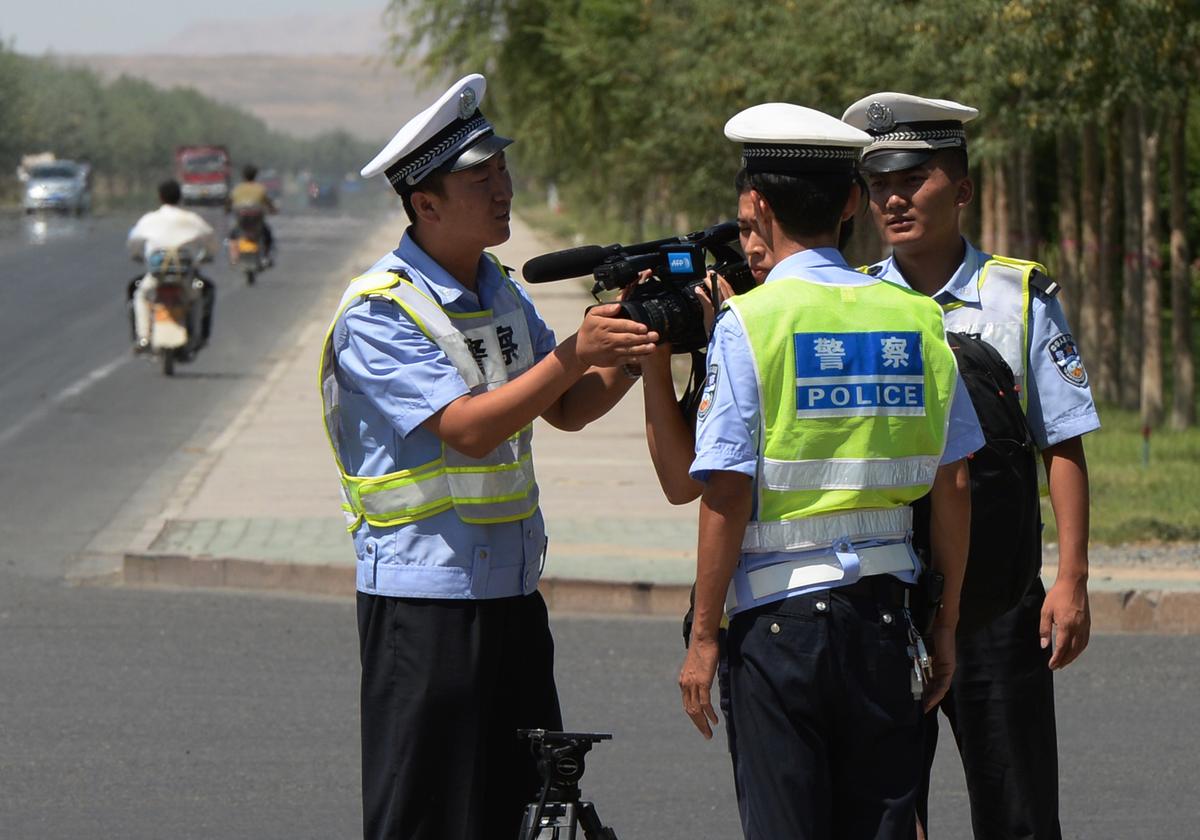
The FCCC said government-organized tours were occasionally offered in Tibet, but journalists who joined them reported having no opportunity to work independently. No surveyed correspondent received permission to enter the Tibet Autonomous Region independently in 2025.
The survey also found that 40 percent of respondents said their Chinese colleagues had faced pressure, harassment, or intimidation from officials or while assisting with field reporting.
C100 said the journalists on its delegations disclosed their trips, but it did not provide examples or specify whether readers and listeners were told who financed the travel.
The five news organizations represented on the 2012 delegation did not answer questions about their approval, reimbursement, or disclosure policies by publication time.