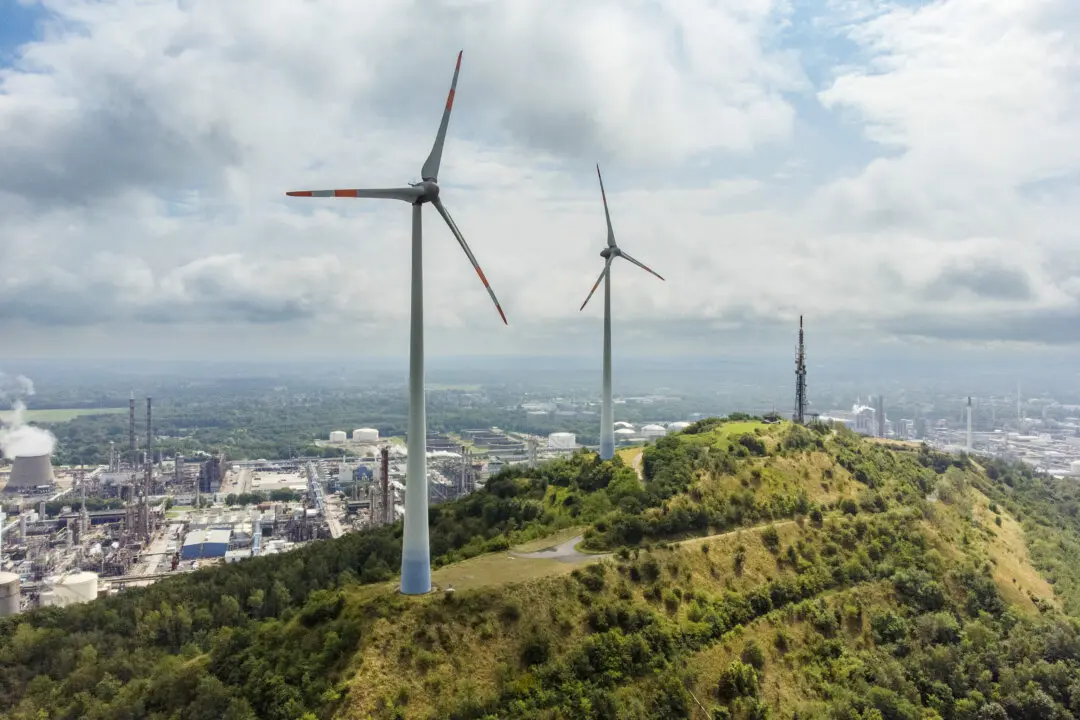
The national average price of regular gasoline was $4.24 per gallon on Thursday, down 18 cents since last week and registering the second consecutive weekly decline in prices.
“Pump prices are cooling off as the price of crude oil remains below $100 per barrel,” the American Automobile Association (AAA) said in a June 4 statement. “Drivers will take all the relief they can get as they embark on summer road trips. But uncertainty lingers over when the Strait of Hormuz will fully reopen and resume traffic. That unknown means oil prices will likely not decrease dramatically as summertime gasoline demand starts going up.”
Gasoline prices are down from $4.42 per gallon a week back and $4.57 a year back. Six states had average gas prices in excess of $5—California, Washington, Hawaii, Alaska, Oregon, and Nevada—with California having the highest price at $5.97 per gallon, according to AAA.
Brent crude oil futures were trading at $95.41 per barrel as of 9:50 p.m. ET, down from the May 15 peak of $109.75. However, current prices are still up by more than $20 per barrel compared to the roughly $72 closing price on Feb. 27, a day prior to when the U.S.–Iran war broke out.
While prices have cooled off in recent days, the unresolved conflict conditions surrounding Hormuz pose a risk that oil and gasoline prices could shoot up once more if the war intensifies.
Fresh attacks once again cast doubt regarding the resumption of energy flows through Hormuz, ING Bank said in a June 4 post.
“Every day that passes without a resumption of oil flows leaves the market increasingly vulnerable. This increases the pressure to strike a deal,” the bank said.
“Inventories have provided a cushion for the oil market. However, even if we see an imminent restart of oil flows through the Strait of Hormuz, the recovery will be slow and gradual. This suggests inventories are likely to continue to tighten into the third quarter, leaving upside risk to prices.”
In a May 12 report, the Energy Information Administration predicted Brent crude oil prices to average around $106 per barrel for May and June. Prices are projected to drop to $89 per barrel in the fourth quarter due to an expected increase in Middle East oil production.
Global Impacts, Resolving The Conflict
The Organization for Economic Cooperation and Development (OECD) warned in a June 3 statement that the global economic outlook had weakened amid energy shock and surging inflationary pressures, with the conflict in the Middle East shaping global economic prospects.Even if a lasting resolution to the conflict is reached soon, OECD expects global growth to slow from 3.4 percent last year to 2.8 percent in 2026, and rise next year to 3.1 percent. The United States’ GDP growth is projected to be 2 percent this year and 1.8 percent in 2027.
In the worst-case scenario, if the current disruptions in energy output and export in the Gulf economies persist into 2027, global GDP growth will only be 2.1 percent in 2026 and 1.8 percent in 2027, the report said.
“The global economy entered 2026 with robust momentum, but the outlook has weakened significantly since the start of the conflict in the Middle East, with effects likely to be felt for some time,” OECD Secretary-General Mathias Cormann said.
“The longer the disruptions last, the larger the economic and social costs become.”
Meanwhile, efforts are underway between the United States and Iran to strike a deal.
During a congressional hearing on June 2, Secretary of State Marco Rubio said Iran has “agreed to negotiate aspects of their nuclear program that just a month ago, just a year ago, they were refusing to even mention.” However, he cautioned there was no guarantee of reaching a “deal that’s acceptable.”