The housing market in 2025 was defined by low sales, steadily rising prices, and uneven inventory across regions. Still, most of America’s top-performing real estate agents are optimistic that declining interest rates could revive activity in 2026 and restore a better balance to the market.
Top Agent Insights
In its recent “Top Agent Insights: Housing Market Outlook and Predictions for 2026” survey, real estate technology company HomeLight noted that top-ranked agents believe that the housing market has passed its worst point.Based in San Francisco, the company surveyed nearly 1,000 of the country’s leading real estate agents between Dec. 2 and Dec. 9, 2025.
With supply shortages still posing a challenge for potential homebuyers, 68 percent of the agents surveyed predict that housing inventory will increase this year, although nearly half believe that home prices will continue to rise, according to the report.
Overall, 70 percent remain optimistic about the market in the year ahead, with 22 percent describing themselves as “extremely optimistic.”
“We have weathered a storm caused by high interest rates (relative to recent years) and economic uncertainty,” Brian Bellairs, a Beaverton, Oregon–based real estate agent with 33 years of experience, said in the report.
“Declining interest rates in 2026 should jump-start the market, and a balanced real estate market should return in 2026.”
Todd Rhodes, Homelight vice president of agent sales, told The Epoch Times that he was surprised by the level of optimism.
“We surveyed agents in six different regions and the Northeast actually had the highest level of optimism,” he said. “It’s still very much a seller’s market in many regions of the country and prices are continuing to rise.”
“2025 was another tough year for homebuyers, marked by record-high home prices and historically low home sales,” Lawrence Yun, NAR chief economist, said in a video speech.
“However, in the fourth quarter, conditions began improving, with lower mortgage rates and slower home price growth.”
‘A More Active Year’
Jonathan Miller, a New York City real estate analyst and director of markets at StreetMatrix.net, said he believes that 2026 will be a more active year for housing, but he said affordability for first-time buyers will continue to be a challenge.“While we anticipate one or two Fed rate cuts that will encourage more listings and sales, we also expect somewhat higher housing prices and continued economic uncertainty,” he told The Epoch Times.
“One thing we learned during the pandemic is that lower interest rates can actually make housing less affordable. Rates became so low that they overpowered inventory and wiped almost everything out. As a result, bidding wars kept driving the prices higher almost everywhere.”
Miller, also an adjunct professor at Columbia University, publishes regular housing reports and analyses for major markets throughout the United States.
“While there is no national housing market, the entire country experienced a nationwide housing boom following the pandemic,” he said. “The narrative was surging sales, collapsing inventory, and soaring prices.”
Over the past year, Miller noted, more new housing units began popping up in the South, drawing potential homeowners to more-affordable regions, often resulting in an oversupply and softer price trends. The Northeast, meanwhile, continues to suffer from limited inventory and higher prices.
The report shows that as of December 2025, inventory in the West and South remained above pre-COVID-19 pandemic levels, while the Midwest and Northeast continue to lag significantly.
Affordability Issue
With inventory remaining tight and prices on the rise, contributing to the affordability challenges highlighted last year, President Donald Trump has proposed a series of measures to ease the problem, including 50-year mortgages.HomeLight-surveyed agents cautioned that lengthening the typical 30-year mortgage could change the perception of affordability without actually improving it.
“In actuality, they’re not going to be saving that much, and they’d be adding 20 years of payments and even more interest,” Miller said.
Part of the solution, according to Miller, is to build more homes, although this approach also brings its own affordability challenges.
“Developers build what’s financially viable, and many of today’s newer homes favor upper income consumers,” he said.
“It’s often harder to build modest-priced housing due to the cost of land, materials, and labor. I think local municipalities need to do more to offer incentives for creating affordable housing.”
Additional building is the catalyst for increasing inventory and more affordable housing options, according to Selma Hepp, chief economist at Irvine, California-based Cotality, a property data, analytics, and technology company.
“New construction will play the most critical role in shaping affordability, particularly in markets where builders can deliver entry-level homes,” Hepp told The Epoch Times.
“However, labor shortages and high material costs remain as constraints.”
Cotality reported on Jan. 19 that during the 12 months ending in August 2025, a record 340,000 homes were transferred through inheritance, accounting for an all-time high of 7.4 percent of housing transactions during the period.
Hepp also noted a few positive changes, such as wage growth and more new construction in some regions. Recent changes to personal taxes and an increase in state and local tax deductions are also designed to make homeownership more appealing for middle-income buyers.“However, even with slight rate relief, monthly payments are still high relative to income, compounded by rising non-mortgage costs like insurance and property taxes,” she said.
Coming Off the Fence
Concerning potential sellers who have been “on the fence,” 74 percent of Homelight agents surveyed said they believe that this will be the year that they finally decide to list their properties.Nearly 25 percent of top agents noted that half of their clients plan to use all cash to buy their next property. Among those selling their current property, 44 percent indicated that they would be relocating to another state, while 35 percent said they would be retiring and looking for a smaller local property to conserve finances.
For those homeowners with mortgage rates below 4 percent who are not downsizing, 81 percent of agents say these people plan to “stay put” to preserve those low interest rates.
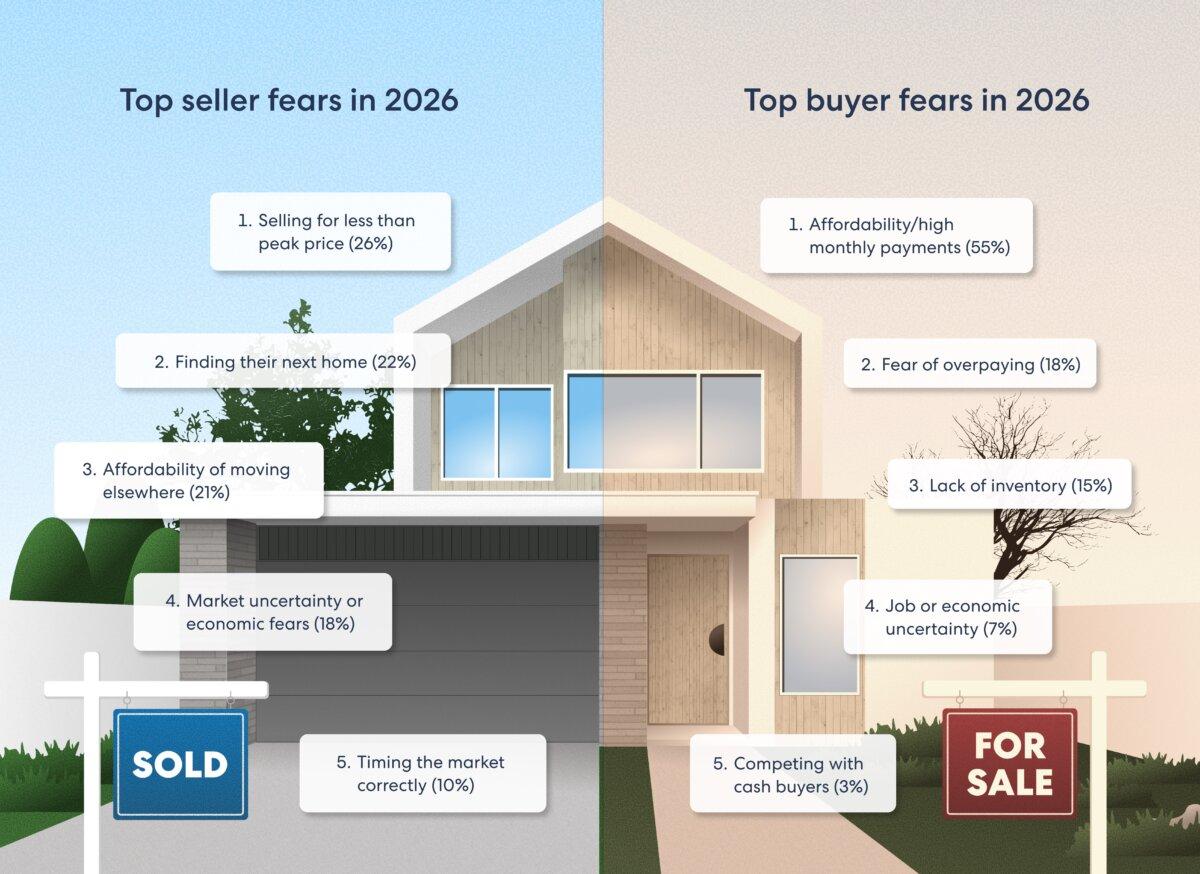
Many sellers who bought their homes within the past five years are worried about not selling for more than they paid.
“Today’s baby boomer generation is not necessarily moving to the typical retirement locations like Florida or Arizona,” Miller said. “They’re trending to stay in the same location so they can be closer to children and grandchildren.”
According to the Homelight survey, 26 percent of potential sellers told agents that they worry about receiving less than their peak home prices. Other seller fears include finding their next home, affordability, market uncertainty, and correctly timing the market.
“Unfortunately, no one can perfectly time the market,” Rhodes said. “Some sellers are looking at assumed value, based on what other homes in their area sold for in the last year or two. They may wonder if they missed out on getting the top dollar for their homes, but again, that’s just an assumed value.”
Occasionally, he said, people may engage in a “panic sell.”
“In this case, they think the value of their home is somehow going to dwindle, so they feel like they must act right away,” Rhodes said. “The truth is that the real estate market is just like the stock market, or anything else—there’s no way to predict the perfect ‘right time’ to sell.”
Hepp noted that others who may want to sell worry about the effect of an antiquated capital gains tax system.
“Many existing homeowners who may be interested in moving will be constrained by potential capital gains on their accumulated home equity,” she said.
Across the nation, surveyed agents said it now takes an average of 14 showings to sell a house. However, agents are divided as to the necessity of holding “open houses” for sellers this year. Only 30 percent indicate that open houses should be part of their listing strategy.
“While we typically see significantly more showings than during the pandemic years, 14 showings is not over the top,” Rhodes said. “It actually represents more of a normal market.”
Nearly 60 percent of those agents agree that the list price should be slightly below the market value to drive offers, and 35 percent believe that homeowners should price their properties at market value.
Just 5 percent suggested pricing slightly above market value to allow room for negotiation. A majority of agents—62 percent—believe that accurate pricing will be the biggest influence on how quickly a home sells.