The Federal Reserve left interest rates unchanged for the fifth straight meeting on July 29.
Nine members of the Federal Open Market Committee—also known as the FOMC—agreed to leave the chief policy rate in the current target range of between 3.5 percent and 3.75 percent.
Cleveland Fed President Beth Hammack, Minneapolis Fed President Neel Kashkari, and Dallas Fed President Lorie Logan dissented and preferred to raise the federal funds rate by a quarter point.
“Economic activity is expanding at a solid pace despite elevated uncertainty that owes, in part, to the conflict in the Middle East. Productivity growth and capital investment are strong. Job gains have kept pace with the workforce, and the unemployment rate has changed little,” the post-meeting statement reads.
Inflation continues to be above the central bank’s 2 percent target, “reflecting supply shocks that have driven price increases in certain sectors, including energy.”
“The Committee will deliver price stability,” it reads.
It was once again a short statement, coming in below 200 words for the second consecutive meeting.
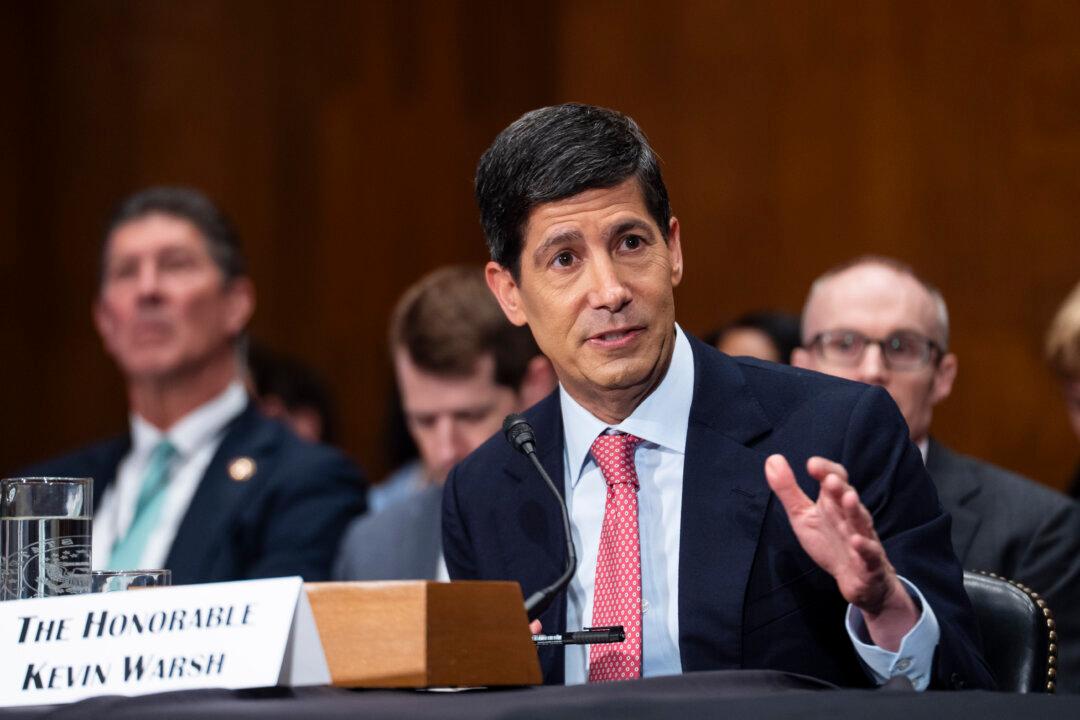
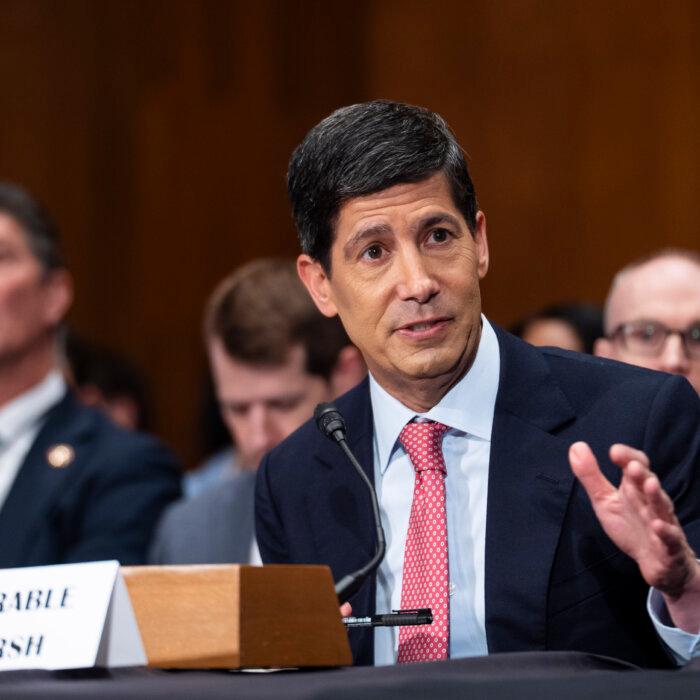
But although the Fed refrained from taking policy action, Fed Chair Kevin Warsh insisted that the Fed is ready to take action to combat inflation.
“I understand the desire for rolling forecasts and commentary from this committee, but for our part, we need to observe market reaction to developments direct and unfiltered,” Warsh said. “I want to stress, of course, that decisions by this committee matter a great deal, and where necessary and appropriate, we will not hesitate to act.”
He also said he would describe it not as a “pause” but rather as the Fed’s doing its “own homework” to review the big questions facing the central bank.
June’s inflation data came in better than expected amid stabilizing global energy markets. With the reacceleration in oil and gas prices, the July and possibly August numbers may not fuel optimism that inflation is decelerating and returning to pre-war levels.
The Fed’s playbook suggests that monetary policymakers look through oil supply shocks and concentrate on underlying inflation trends.
“Many other participants, however, assessed that the appropriate level of the federal funds rate would be above the current target range at the end of this year,” the meeting summary reads. “Participants noted that their future policy actions would depend on incoming information.”
A fresh batch of June’s inflation figures will be released on July 30: The Fed’s preferred personal consumption expenditures (PCE) price index for June and trimmed-mean PCE.
Fed officials place more weight on PCE than the consumer price index because the former is more detailed and is updated more frequently. The new central bank leader has recommended trimmed inflation as a possible yardstick since it removes outliers, whether a spike in crude oil prices or a collapse in egg prices.
In the end, Warsh pledged to “deliver price stability.”
“We have begun a new chapter, and we understand that the five-plus years of inflation above target cannot be cured in nine weeks, or by a single month of modest price decreases,” he said. “This Fed will not waver. Our credibility rests on performing our duties and delivering on our responsibilities.”
“If you take Fed Chair Kevin Warsh’s recent comments at face value, they could arguably be interpreted as consistent with a hike,” Christian Hoffmann, head of fixed income and portfolio manager at Thornburg Investment Management, said in a note emailed to The Epoch Times.
“There appears to be a growing debate around how much weight to put on one good inflation report versus longer-term inflation risks.”
Futures markets widely anticipate a quarter-point rate hike in September, according to the latest CME FedWatch data.
Yields on U.S. Treasury securities have sharply risen as well.
The two-year yield, which tracks Fed policy expectations, is above 4.3 percent. This suggests that traders are bracing for at least two rate hikes over the coming months.
In addition to the policy rate, the results of the Fed’s new five monetary task forces will also lurk in the background.
“There are risks around strong policy directives before the task forces have had a chance to do their work,” Hoffmann said.
Monetary Task Forces
What the five monetary task forces report will be key for financial markets moving forward.
The outside experts’ recommendations could describe a Fed that might do considerably less than it does today “and do its core job better as a result,” said Jai Kedia, a research fellow at the Cato Institute’s Center for Monetary and Financial Alternatives.
“No one should expect the Fed to ever deliver perfect macroeconomic outcomes—that requires a privatized monetary system and is not possible under our centralized fiat currency regime,” Kedia wrote in a July 28 paper.
Reforms that feature greater transparency, a smaller balance sheet, and better data would facilitate a more predictable and accountable institution, he said.
“Each reform stands on its own, yet each advances the same principle: A central bank that interferes least with private decisions, and operates by clear and stable rules rather than by discretion, serves the public best,” Kedia said.
The final reports are expected to be published by December.