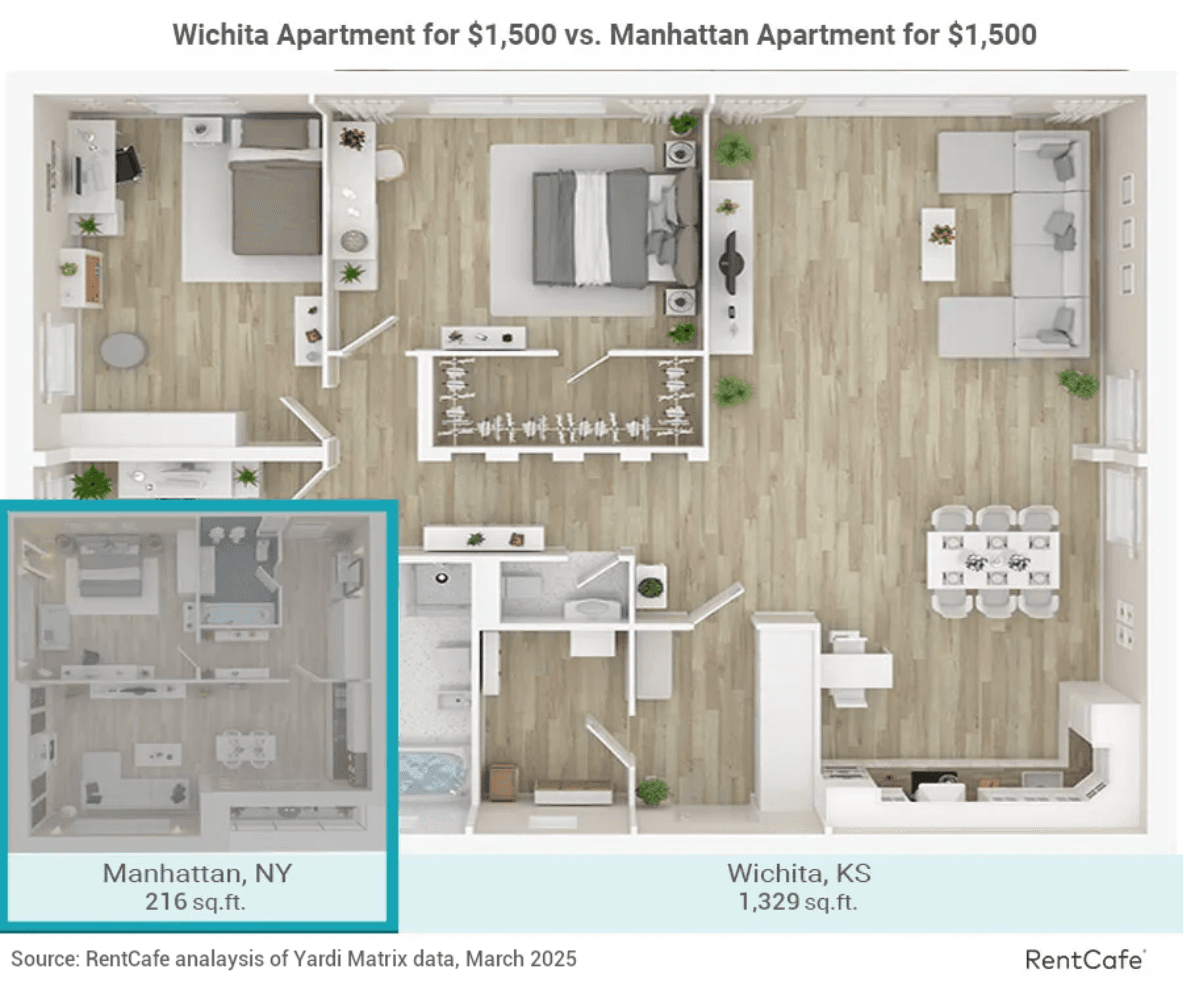
In Wichita, Kansas, for example, $1,500 per month offers a 1,329-square-foot apartment, which is typically enough space for three or four bedrooms. In contrast, renters in Manhattan paying the same amount will have to settle for just 216 square feet, smaller than the average studio apartment.
The national rental platform also found that, on average, $1,500 per month rent translates to about 715 square feet.
RentCafe listed the average monthly U.S. rental rate at $1,479 per month for an average 907-square-foot apartment.
The company analyzed 200 of the nation’s largest cities, defining “large” as those with populations of more than 225,000 and “small” as those with fewer than 225,000 residents.
Doug Ressler, a RentCafe analyst, told The Epoch Times that they’re seeing a new trend: Apartments are getting smaller.
“I think the ratio is changing, and there seems to be less two- and three-bedroom apartments being built and more studios and one-bedrooms,” he said. “People are starting families later now, and a lot of younger singles and couples don’t want to be tied down to a house.”
Ranking the nation’s largest cities, RentCafe found that major metro areas on the East and West coasts, such as New York City, Boston, San Francisco, and Los Angeles, offer the least amount of space for $1,500 per month—all coming in at less than 400 square feet. Five California cities ranked among those offering the smallest space, with $1,500 approximately covering the monthly rent for a studio apartment.
The report found that both the South and the Midwest offered the most square footage for that monthly budget. Following Wichita, the top five cities for more affordable rentals are Toledo, Ohio; Oklahoma City and Tulsa, Oklahoma; and Lubbock, Texas. El Paso and Corpus Christi, Texas, were among the top 10 spots, as were Memphis, Tennessee; Baton Rouge, Louisiana; and Fort Wayne, Indiana.
Smaller cities in the southern and midwestern regions also ranked higher in affordability. McAllen, Texas, along with Columbus and Macon, Georgia, each provided almost 1,400 square feet for $1,500 per month. Amarillo and Brownsville, Texas, were also listed among the top 10 most affordable smaller cities.
Some of the other major cities offering less than 500 square feet for $1,500 were Chicago; Arlington, Virginia; Seattle; and Washington.
Four California cities offer less than 500-square-foot apartments for $1,500 per month, with the smallest space reported in Sunnyvale at an average of 385 square feet. Pasadena, Huntington Beach, and Glendale also made the list, as did Bellevue, Washington, and Yonkers, New York.
Ressler said the high cost of tiny urban apartments is leading to more suburban “built-to-rent” (BTR) housing that offers much more square footage and lower costs.
“We believe a lot of city renters are transitioning to these BTR properties so they can have more space and a backyard,” he said.
The bigger problem, Ressler said, is the continuing demand for housing and the fact that wages have not kept up with the rising costs of owning a home.
“With today’s high home sale prices, plus a down payment, interest rates over 6 percent, insurance and maintenance costs, we’re talking about a lot of money—especially for first-time buyers,” he said.
As of June, the National Association of Realtors reported that the U.S. median sales price was $435,300, an all-time high.
Nathan Miller, a real estate investor and the founder of Rentec Direct property management software, works with nearly 20,000 landlords and property managers nationwide. He told The Epoch Times that renters on a tight budget always have the opportunity to share larger units.
“Co-living is a rising trend that pairs up compatible renters in one residence, often at anywhere from 30 percent to 70 percent of the cost of a traditional rental,” he said. “Moving outside the metro area may help save on rent costs, but renters should consider additional commuting expenses.”
Miller said that although relocating to a more affordable area can also reduce costs, it’s important for renters to also consider their career prospects and lifestyle preferences.
“They need to research average salaries there and access to amenities or activities in the new location,” he said.
Alisha Melvin, a Texas-based real estate and probate attorney, agrees.
“For example, my tech founder clients who are making strong salaries often choose to share larger, high-end apartments in expensive metro areas—it’s about convenience and location for them,” she told The Epoch Times.
“Then you have working-class renters, who tend to move farther out where rents are cheaper, but they often end up having to relocate every couple of years just to stay within budget.”
Despite the attractive rents and spaciousness of Midwest apartments, Ressler is not predicting a mass exodus to the middle of the country.
“I think a lot of people are concerned about the cost of moving, and most may want to stay within commuting distance of where they’re working,” he said.
“Of course, remote workers can have their choice of where to live, but many choose to stay closer to family and friends in their region.”