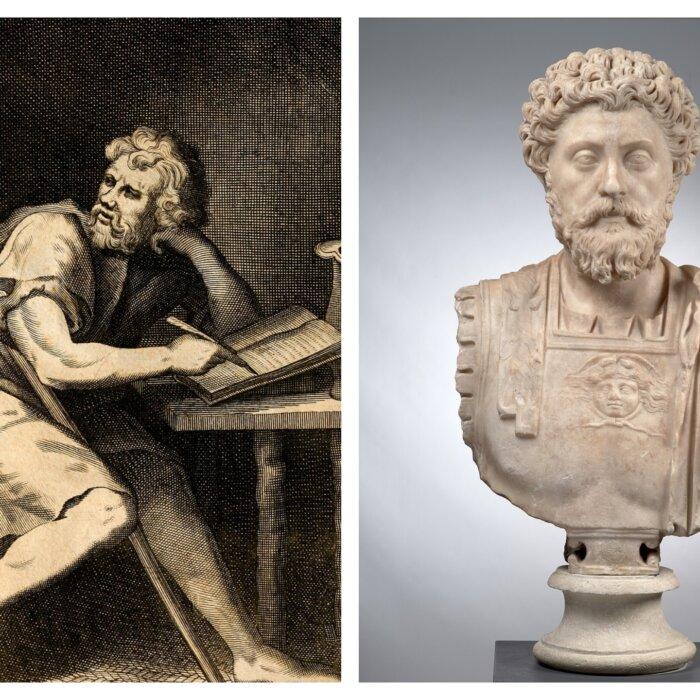
Epictetus, a Greek Stoic philosopher who flourished during the early second century, said the chief task in life is to separate what is within one’s control from what is not.
The philosophy of Stoicism promotes the reliance on reason and logic to determine what is good or virtuous and calls on its adherents not only to make such a determination but to act on it.
Stoic ideas have had a profound effect on Western culture, including in the fields of philosophy, literature, ethics, and even mathematics, and many of the teachings remain popular today.
Born into a merchant family during the reign of Alexander the Great, Zeno initially took up his father’s trade. However, after surviving a shipwreck, he went to Athens, where he discovered teachings by Socrates and decided to devote himself to philosophy.

After studying under several prominent Athenian philosophers, Zeno opened up his own school. He taught regularly in the public marketplace for almost 40 years, until his death around 262 B.C., and his ideas became the foundation of what became known as Stoicism.
Although most of the writings of Zeno and the other early Stoic philosophers did not survive, their ideas had a profound influence on the philosophical discourse of the time, in Athens and beyond.
They became especially popular in the early period of the Roman Empire, where Stoic ideas were often part of the educational curriculum and espoused by prominent statesmen such as Cicero and Seneca, and even by the emperor Marcus Aurelius.

Zeno and other early Stoics were undoubtedly influenced by Socrates, and the philosophy of Stoicism shares certain basic ideas with other philosophers in the Socratic tradition.
Prudence
“It’s not the accident that distresses this person,” said Epictetus, according to a short manual of practical Stoic ideas compiled by Arrian known as “Enchiridion.” “[It] is the judgement which he makes about it.”Prudence comes from the Latin word “prudentia,” meaning foresight or sagacity. It is described by Stoics as the ability to discipline one’s thoughts and actions through the use of reason.
Stoics taught that each individual has the potential to think and act in accordance with the divine reason of the universe by employing the portion of reason that resides in his or her own mind. By applying the intellect to the impressions created by the universe, one can make logical judgments concerning what is good or virtuous and what is not.
Fortitude
Roman statesman Seneca, who faced his death at the order of Roman emperor Nero with Stoic calmness, had written in one of his letters: “He who has learned to die has unlearned slavery; he is above any external power, or, at any rate, he is beyond it. What terrors have prisons and bonds and bars for him?”Fortitude refers not only to patience and endurance, but also to courage and bravery. Stoics pointed to the importance of forbearance, of calmly enduring those things in life that cause pain and suffering, and of accepting those things as part of the world in which we live.
Suffering is an inevitable part of human existence. Though we can’t stop or prevent it, we can control how we react to it. To consider it reasonably and bear it nobly is wisdom.
Yet it is not only suffering that must be faced with courage, but also fear. Whether the fear of battle, loss, poverty, or even death, Stoics believe that it should be overcome with reason and faced with bravery.

Temperance
Temperance means self-control or self-restraint, and it was often used by Stoics to refer to guarding against both the indulgence in pleasure and the avoidance of pain.The early Stoic philosopher Chrysippus described passion, or strong emotions, as a misleading force resulting from a failure to reason. In his treatise “On Passions,” Chrysippus identified the four primary passions to guard against: sorrow, pleasure, fear, and desire.
He referred to sorrow and pleasure as present emotions, while identifying fear and desire as emotions directed at the future. In all cases, he believed these emotions should be constrained by reason whenever they appear in one’s mind.
Justice
Cicero, who wrote extensively on Stoic ideas in “On Duties,” deemed justice as “the crowning glory of the virtues” and its primary duty to “keep one man from doing harm to another.”He said that justice constitutes the common bond of human society and of a virtuous community of life. The Stoic virtue of justice is based on acting in accordance with the highest good.

In other words, justice compels each person to conscientiously perform whatever duties fall to them, and it requires doing what is best for the community in which one lives. Thinking and acting with justice means fulfilling your duties to your fellow man, whatever they may be.
Justice, then, to the Stoic, is not some external system of punishment and reward, but rather a way of thinking and acting.
Enduring Value of Stoic Virtues
These four cardinal virtues of Stoicism—prudence, fortitude, temperance, and justice—are interdependent.Courage without prudence or temperance, or for purely selfish means, is not true courage, and neither is wisdom of any value without the fortitude to act on it. And of course, temperance, prudence, and fortitude are all necessary components of acting in service of the highest good, which is justice.
The virtues of Stoicism still provide guidance to the people living in modern society. The fact that this ancient philosophy has endured throughout the centuries and continues to inspire people around the world is a testament to its inherent value.
“[Rest] satisfied with what we have, which is abundantly sufficient; for he that is so, wants nothing,” he continued. “The great blessings of mankind are within us, and within our reach.”