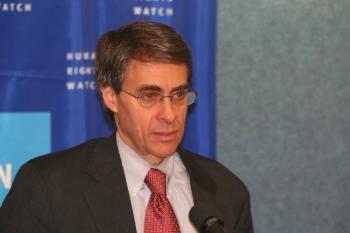
WASHINGTON—The human rights movement can look back on 2009 with some satisfaction in exposing abuses almost anywhere in the world. By shaming, diplomatic and economic pressures, the human rights movement is making it more costly for abusive governments to violate fundamental human rights, according to Kenneth Roth, Executive Director of New York-based Human Rights Watch (HRW).
However, in reaction to these successes, the most repressive governments are “counterattacking” and devising strategies that target human rights defenders themselves, and weaken the movement, said Roth at a news conference Jan. 19.
Roth announced the release of this year’s HRW 612-page annual World Report 2010,
which summarizes HRW’s work in over 90 countries and territories during 2009.
“In some cases, human rights activists—be they advocates, journalists, lawyers, petition-gathers, or others who document and publicize abuses or defend victims—have been harassed, detained, and sometimes killed,” says the introduction to the report.
Their methods have developed in 2009 to include murders of human rights defenders that the repressive government can deny involvement. Additionally, human rights activists are being prosecuted under the guise of common criminal charges. Laws regulating NGOs that appear neutral are used to harass and disband human rights organizations. Sometimes funding is blocked by disallowing foreign contributions, effectively putting a human rights organization out of commission.
“Russia stood out this year by the number of human rights activists murdered,” said Roth. Many of these victims were reporting on arbitrary detentions, torture and executions in Chechnya, such as Natalia Estemirova, who was abducted and murdered. These acts are “not done overtly by [Russian] government agents,” but “always unidentified assailants,” said Roth. And the government does not make an effort to find and prosecute those responsible.
In addition to Russia, the governments of Kenya, Burundi, Sri Lanka, Afghanistan, Malaysia, Uzbekistan, and even India were guilty of allowing or encouraging violent attacks on human rights defenders. In Afghanistan, for example, authorities have made “little or no effort” to find the murder(s) of Sitara Achakzai, a “prominent” human rights activist from Kandahar, who “complained for weeks about threats that she had been receiving,” a commonplace concern of many Afghan women in public life. Government officials did nothing to protect her, according to Roth.
Closed societies
There are some governments which are so tightly controlled that a domestic human rights organization cannot even exist and inspections from international human rights monitors are not allowed in. Eritrea, North Korea, and Turkmenistan fit this description. When lacking ‘civil society,’ it is “impossible for human rights activists to do their work openly,” Roth said at the news conference.
Other abusive governments are virtually closed, Roth said. “Embattled human rights movements” face off against hostile governments in Burma and Iran, but do just barely exist; both nations bar international monitors.
“Saudi Arabia does not acknowledge non-government human rights promotion,” says the report. Libyan leader Muammar Gaddafi rejects the concept of an independent civil society, effectively baring domestic human rights monitoring. Syria apparently rejects the concept as well, by not licensing any of its human rights groups.
“The Cuban government refuses to recognize the legitimacy of any independent human rights organization,” says the report. Virtually all forms of dissent are criminalized, and human rights defenders face beatings and imprisonment. Another communist country, Vietnam, similarly bans independent human rights organizations, which the Communist Party says are “subversive.” Last year, in June, police arrested Le Cong Dinh, a lawyer defending democracy and religious freedom activists, and charged him with “distorting Vietnam’s constitution and laws.”
Threats of violence in order to discourage or harm human rights defenders are cited in the report in the nations of Columbia, Democratic Republic of the Congo, Sri Lanka and Nicaragua.
Uzbekistan, Turkmenistan, Vietnam, Egypt, Eritrea, Ethiopia, Pakistan, Saudi Arabia, and Zimbabwe have prevented outside inspectors from investigating. Indonesia and Israel, in 2009, kept human rights activists and journalists out in troubled areas, where armed conflict had taken place.