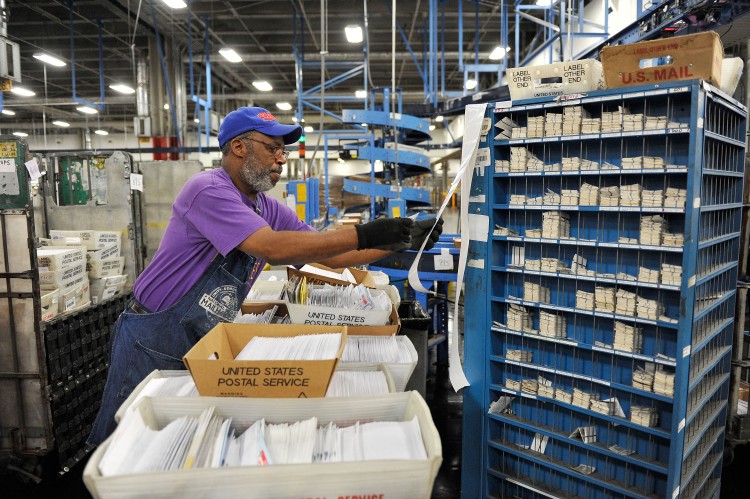
The U.S. Postal Service (USPS) faces more big bills it cannot pay—$5.5 billion due to the U.S. Treasury last month, and another $5.5 billion due by the end of September.
With over $12 billion in losses since 2007, it is clear that the system is not working. Yet despite big financial problems, the USPS assures customers that its dependable, six-day-a-week service will remain undisturbed.
Many agree that the nation’s mail carrier needs to change the way it does business, and legislators have presented a variety of remedies. However, some believe that the Postal Service would fare better if the government just backed off.
That approach has worked before. The U.S. Post Office is one of the nation’s first departments, and it is even mentioned in the Constitution. Its government-dependent status changed with the 1970 Postal Reorganization Act. The mandate made the Postal Service adopt more business-like operations, leaving behind the old subsidy-driven system that had nearly collapsed the mail service.
According to Richard Geddes, associate professor of the Department of Policy Analysis and Management at Cornell University and American Enterprise Institute postal reform expert, after the USPS began running solely on its own revenue, it stabilized and even saw several prosperous years.
But the world has changed again, and according to Geddes, if the USPS wants to keep up, it needs to respond in kind.
“The composition of the mail has just changed enormously over time,” he said. “It’s a new world.”
In this new world, few send personal letters, and the email and texting technology that now dominates American communication has hit hard at a business that once belonged exclusively to the USPS’s most profitable mail classes.
It is not just the declining revenues and mail volumes that urge major changes. Geddes says a growing difference in mail quality also warrants a revision.
“It’s just much more commercial advertising material these days,” he said. “In the old days it was more newspapers, which you could argue have social value, and there was also more personal letters. Now, even greeting cards are declining.”
It may be a new world, but Geddes says that the current USPS business model makes adapting to a changing business environment slow and difficult because, according to Geddes, “Congress tells the Postal Service what it can and can’t do.”
Whether it is setting fees, requiring universal six-day-a-week service, or approving the closure of underutilized offices, Congress ultimately decides the USPS’s major business moves.
One of the more controversial laws is the Postal Service’s most significant financial hurdle—a 2006 requirement which has the USPS prefund 75 years of retiree health benefits, resulting in an annual $5.5 billion bill but no money to pay it.
“I really sympathize with the management of the Postal Service because they’re really between a rock and a hard place,” said Geddes. “They just don’t have the resources to do what Congress is asking them to do.”
Geddes wants to see the USPS have more independence to make business decisions without the burden of congressional influence. He recommends subjecting the mail agency to private corporate law, with “a true Board of Directors” who have fiduciary duties to shareholders, instead of the current Board of Governors who answer directly to Congress.
“There would be real shares created. Even though those shares are not sold in an IPO, those shares would exist,” said Geddes. “It’s kind of how Amtrak operates at present.”
Although Geddes says talk of actual privatization is “a little premature,” he realizes that any move toward a more business-like mail agency is a politically volatile idea.
Postal unions have warned for years that privatization is the endgame in a congressional scheme to financially cripple the USPS and destroy collective bargaining, while some lawmakers fear that a private model threatens to cut service to rural constituents.
“People truly are attached to their rural post offices. I’m not going to minimize the importance of any of that,” said Geddes. “Rural senators and members of Congress who represent those rural areas, they hear a lot about how they don’t want the rural services reduced, and they’re afraid that privatization would result in reduced services. That may be true.”
Geddes says that in order for the Postal Service to operate in a true business-like fashion, managers need to have commercial freedom to make independent business decisions.
Given that the United States handles more mail per capita than any other developed country with a viable postal service, and that much of this mail is now composed of low-revenue advertising, Geddes says that it is time lawmakers re-evaluated the nation’s postal priorities.
“Congress really needs to sit down and figure out what the compelling public interest is in continuing to require six-day-a-week universal delivery for that [advertising] stuff,” he said. “If they decide that there’s still a compelling public interest that needs that form of delivery, then they need to figure out how they’re going to pay for it, instead of simply telling the postal managers that they have to do the impossible.”
The Epoch Times publishes in 35 countries and in 19 languages. Subscribe to our e-newsletter.