WASHINGTON—The Trump administration is now awaiting a final decision on whether the president’s proposal to build a 250-foot triumphal arch in the nation’s capital will advance, after a federal agency granted preliminary approval in July.
President Donald Trump proposed the monument to commemorate the 250th anniversary of American independence.
Earlier reports suggested that the administration might have to revise the design to comply with the height restrictions of a century-old federal law. However, a source familiar with the administration’s proposal who spoke to The Epoch Times on condition of anonymity said there are no such plans.
The 1910 Height of Buildings Act, which is central to the debate, was enacted to protect Washington’s skyline by limiting building heights in the capital.
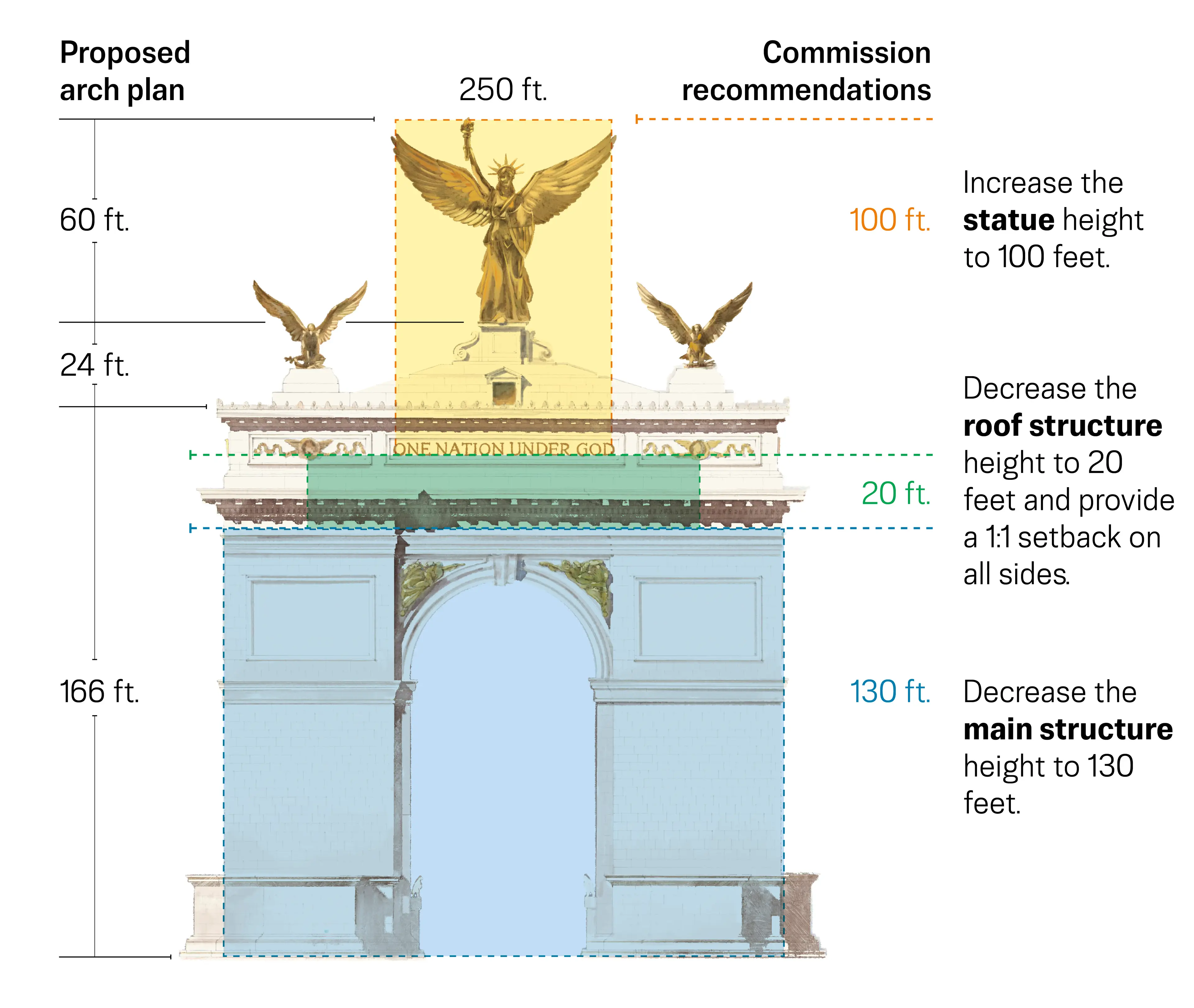
As an alternative, the commission recommended lowering the mezzanine to 130 feet and reducing the observation deck to 20 feet. It suggested adding the remaining 40 feet to the Lady Liberty statue instead. Under that revision, the statue would stand 100 feet tall while the monument’s total height would remain 250 feet.
The commissioners also asked the White House to justify the project’s height. They’re expected to make a final decision at their September meeting.
The source, however, said that the administration doesn’t plan to change the design and expects the commission to approve the project as proposed by the White House.
The source added that the commission’s chairman has already indicated he does not believe the 1910 law applies to the triumphal arch.
“That says a lot about the commission’s point of view,” the source said.
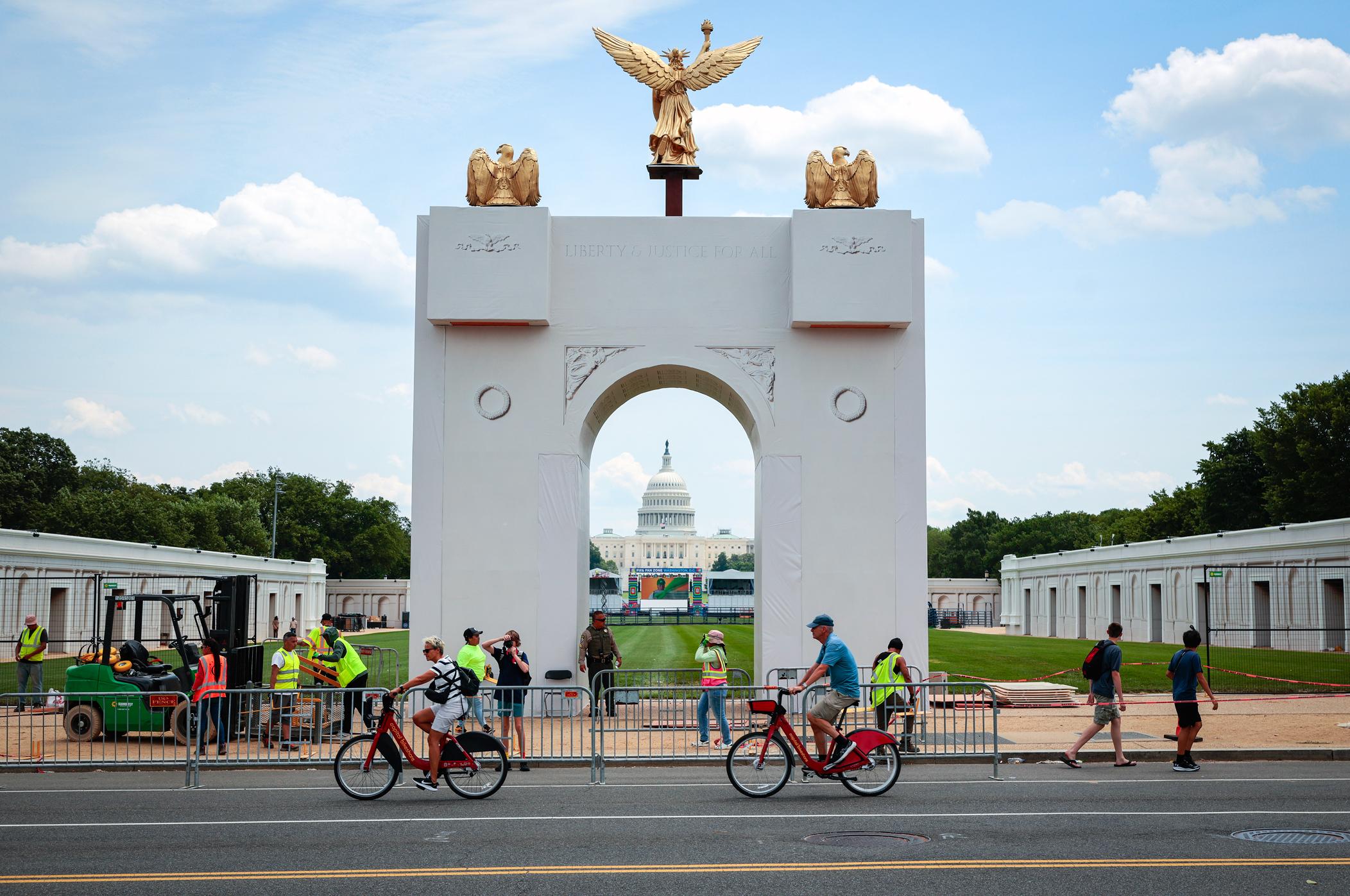
The design is modeled after Paris’s iconic Arc de Triomphe, which Napoleon commissioned to honor his armies. The proposed American version, however, would stand 100 feet taller than its French counterpart.
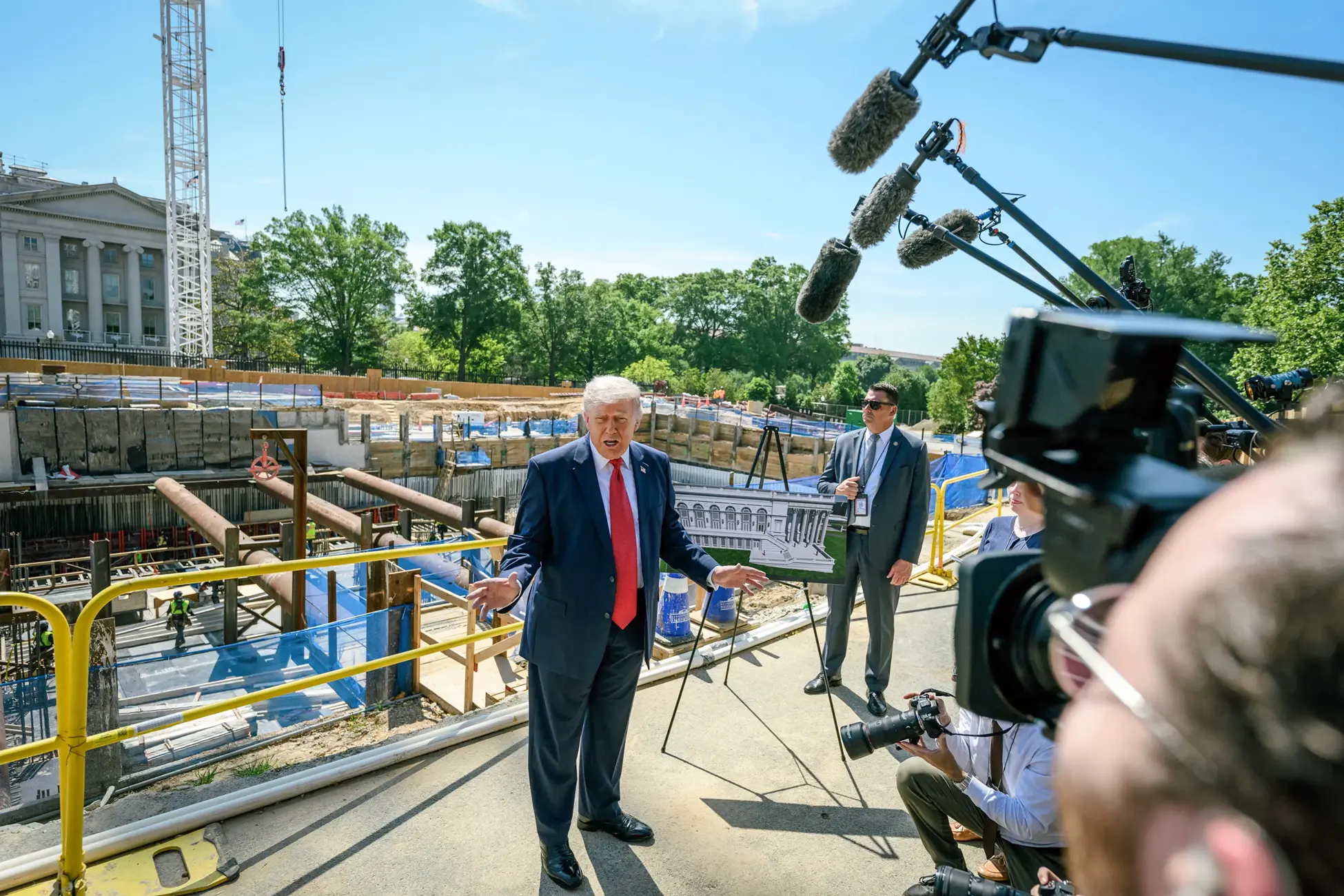
“We’re going to build one of the most beautiful arcs in the world,” Trump told reporters in May.
“We are going to have one that’s going to be, I think, superior to anybody else’s. It’s going to be a little bit larger, and I think a lot more beautiful.”
The Proposed Plan
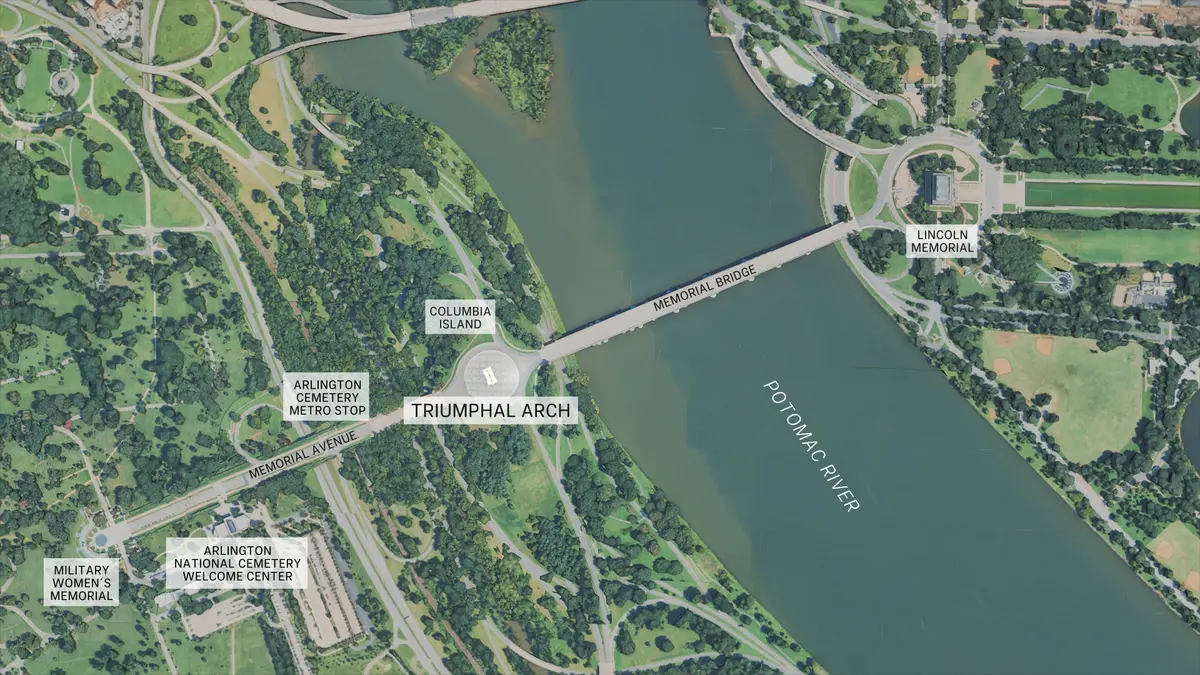
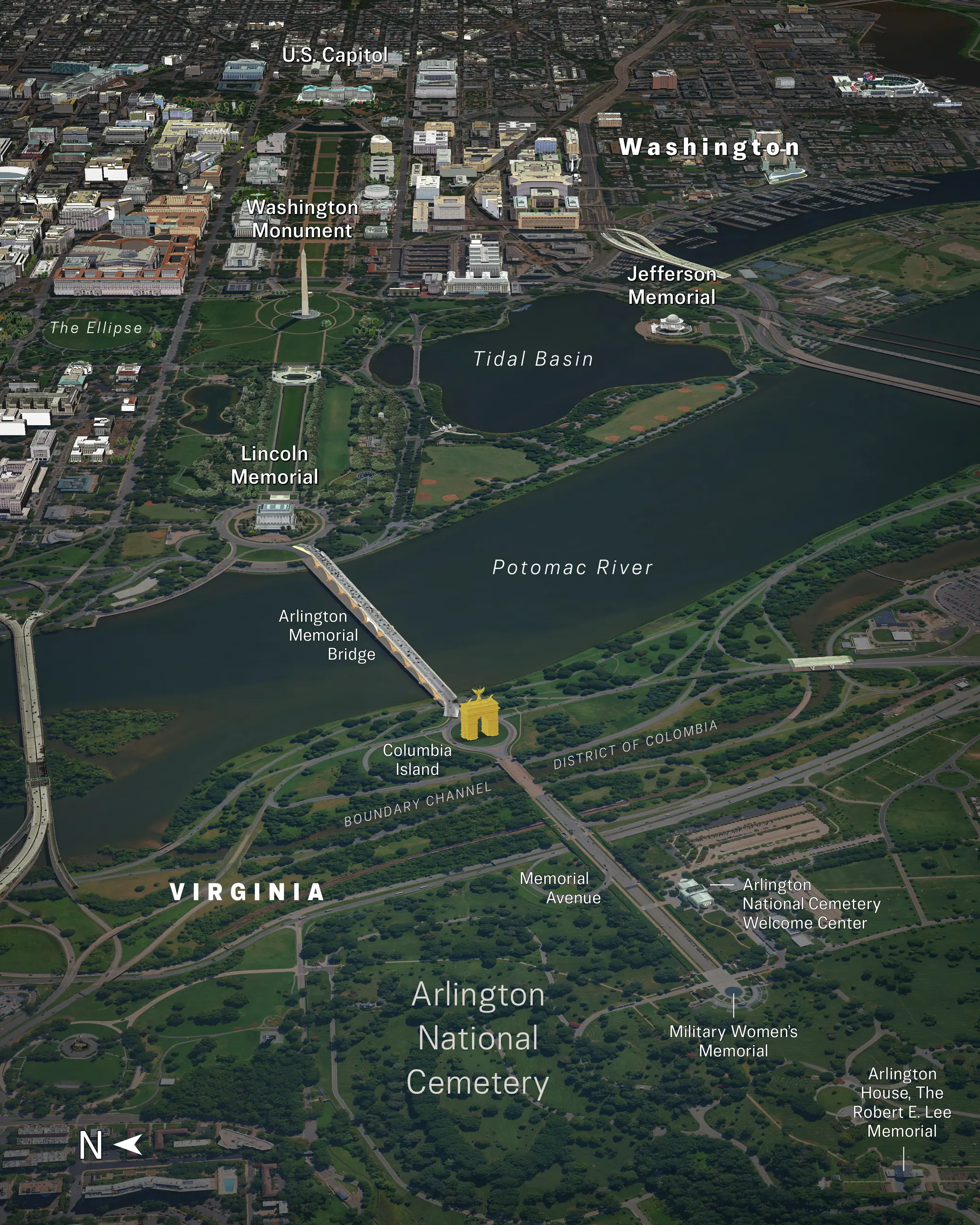
The administration selected Memorial Circle on Columbia Island as the site of the project. The traffic circle sits on the Potomac River and connects the Lincoln Memorial with Arlington National Cemetery.
The structure would have three levels, according to the current plan. The ground floor would house ticketing and security areas and back-of-house spaces, while the mezzanine level would feature two program spaces and stairs leading up to the observation deck.
At the top, the observation deck would include a stair hall and access to the viewing area, offering 360‑degree views of the surrounding landmarks.
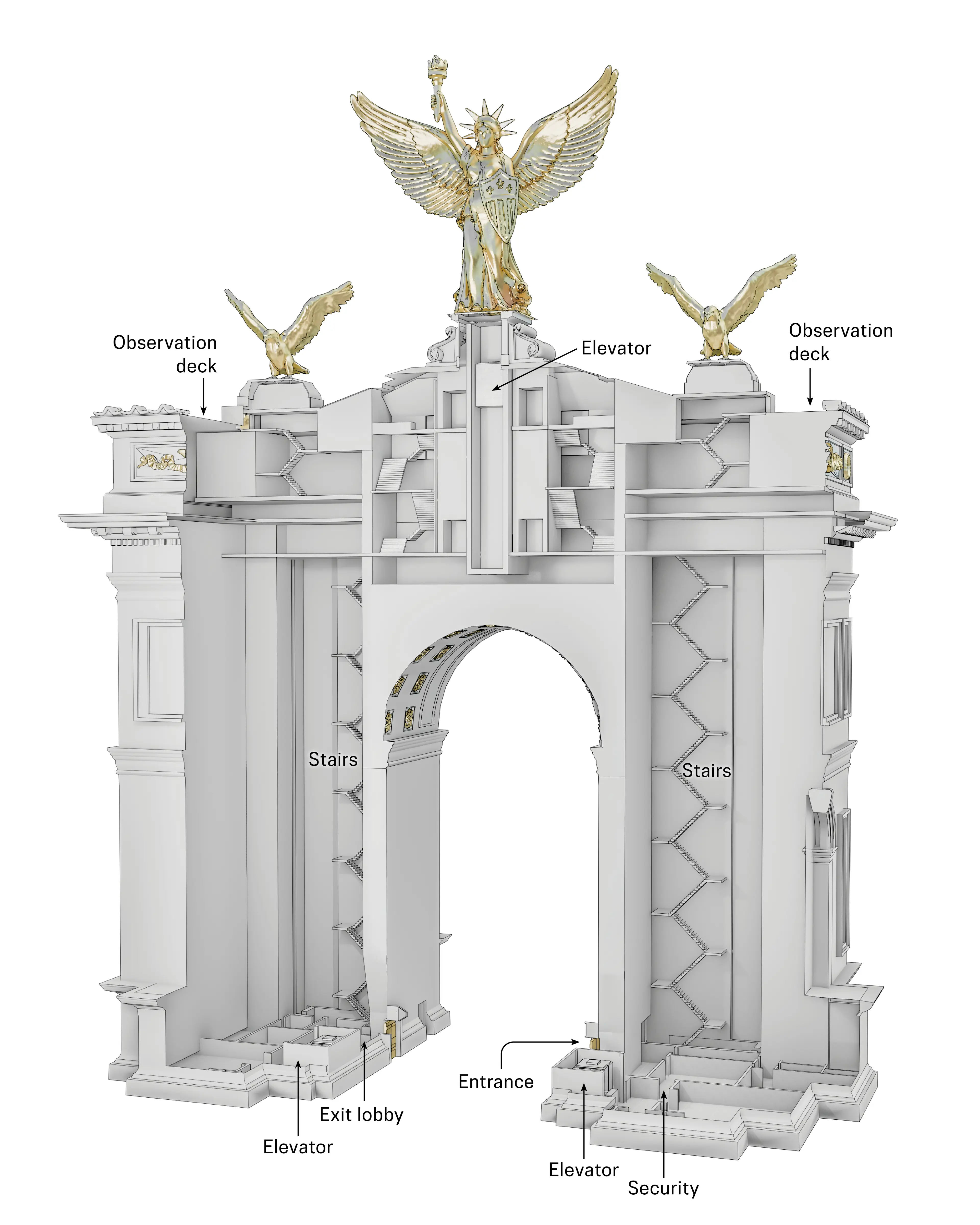
The phrases “One Nation Under God” and “Liberty and Justice for All” would be displayed in gold lettering on each side of the monument.
Initially, there was a plan to add four lions at the base of the arch, but that idea was later scrapped. The proposal also no longer includes an underground tunnel featured in earlier versions. Instead, the designer added several pedestrian crosswalks at both ends of the circle where it meets Memorial Avenue and the Arlington Memorial Bridge.
The arch would create a permanent landmark in a city already defined by monuments such as the Lincoln Memorial, Washington Monument, and Jefferson Memorial. At 250 feet, the structure would be significantly taller than the nearby 99-foot Lincoln Memorial, and nearly half the height of the 555-foot Washington Monument.
Return of Classical Architecture
Trump first revealed his plans to build a triumphal arch in October last year by showing reporters a model on his desk in the Oval Office.
In May, the U.S. Commission of Fine Arts approved the neoclassical triumphal arch design submitted by Atlanta-based Harrison Design.
The arch is one of several major projects Trump is pursuing, including a White House ballroom, to reshape the nation’s capital for the fifth semicentennial celebration.
Rick Gonzalez, an architect from West Palm Beach, Florida, has worked with Trump on construction projects for more than 30 years. Gonzalez believes that the president’s embrace of classical architecture and historic preservation will become a defining part of his legacy.
“What the president has been doing with the ballroom, the Triumphal Arch, and all the monuments is bringing back the beautiful, timeless architectural style we’ve used for centuries,” Gonzalez told The Epoch Times.
Gonzalez also serves on the Advisory Council on Historic Preservation, an independent federal agency that advises the president and Congress on national historic preservation policy.
“Classical architecture is timeless,” Gonzalez said. “It’s always beautiful in the eye of the beholder.”
Classical architecture, he added, follows established design principles instead of relying on an architect’s personal whims.
Eric Metaxas, conservative commentator and author of “Revolution: The Birth of the Greatest Nation in the History of the World,” said Americans have not given much thought to ambitious architectural projects in decades. He credited Trump with reviving a sense of grandeur through architecture, saying that many people had forgotten that presidents could undertake such projects.
“I’m simply excited to have a president creating beautiful things like the arch in particular,” Metaxas told The Epoch Times.
“Classical architecture is extremely important. Beauty is important. ... Beauty really points to God.”
In August last year, Trump reinstated a policy from his first term that makes classical and traditional architecture the preferred style for federal government buildings, rather than modernist designs.
Titled “Making Federal Architecture Beautiful Again,” the executive order states that government buildings “should uplift and beautify public spaces, inspire the human spirit, ennoble the United States, and command respect from the general public.”
Legal Challenges
The proposed arch has drawn criticism from preservationists and veterans’ groups over its location, scale, and design.
The National Trust for Historic Preservation is among several advocacy groups that have raised concerns about the project.
In February, Public Citizen, a government watchdog group, filed a federal lawsuit seeking to block construction on behalf of three Vietnam veterans and an architectural historian.
The group argues that the structure would “obstruct the view between Arlington National Cemetery and the Lincoln Memorial, a view carefully designed to symbolize the unification of the country after the Civil War and the strength of a united nation.”
The lawsuit also argues that the project violates the Commemorative Works Act of 1986, which requires congressional approval for monuments on federal land.
If Trump’s project overcomes legal challenges, construction could move forward quickly, as planned.
Gonzalez says the administration will probably speed up construction to finish the arch before the president’s term ends.
Drawing on decades of experience with the president, Gonzalez said he expects Trump to push hard to meet the timeline.
“[Even] if that means having two shifts or even three shifts working 24/7,” he said, Trump “will do everything that he can to break through the barriers and get it done.”