The world is at a turning point. After a decade of steady improvement, the quality of life worldwide has been stagnant since 2021, according to the Global Social Progress Index.
Health, safety, and environmental quality declined from 2021 to 2025. The quality of water and sanitation, housing, and access to information also declined during this period. The rule of law and civil liberties have been declining since 2011. All of this contributes to the slowdown in global quality of life, according to the Social Progress Imperative.
The United States ranked 32nd in the 2026 Social Progress Index, down from 18th in 2011—below Western and Northern European countries, Japan, Australia, and Canada.
To assess the quality of life within the United States, The Epoch Times turned to readers for personal accounts and viewpoints in a survey on June 24–25 by email and social media. Here’s a summary of opinion from our 1,665 respondents.
Overall Satisfaction
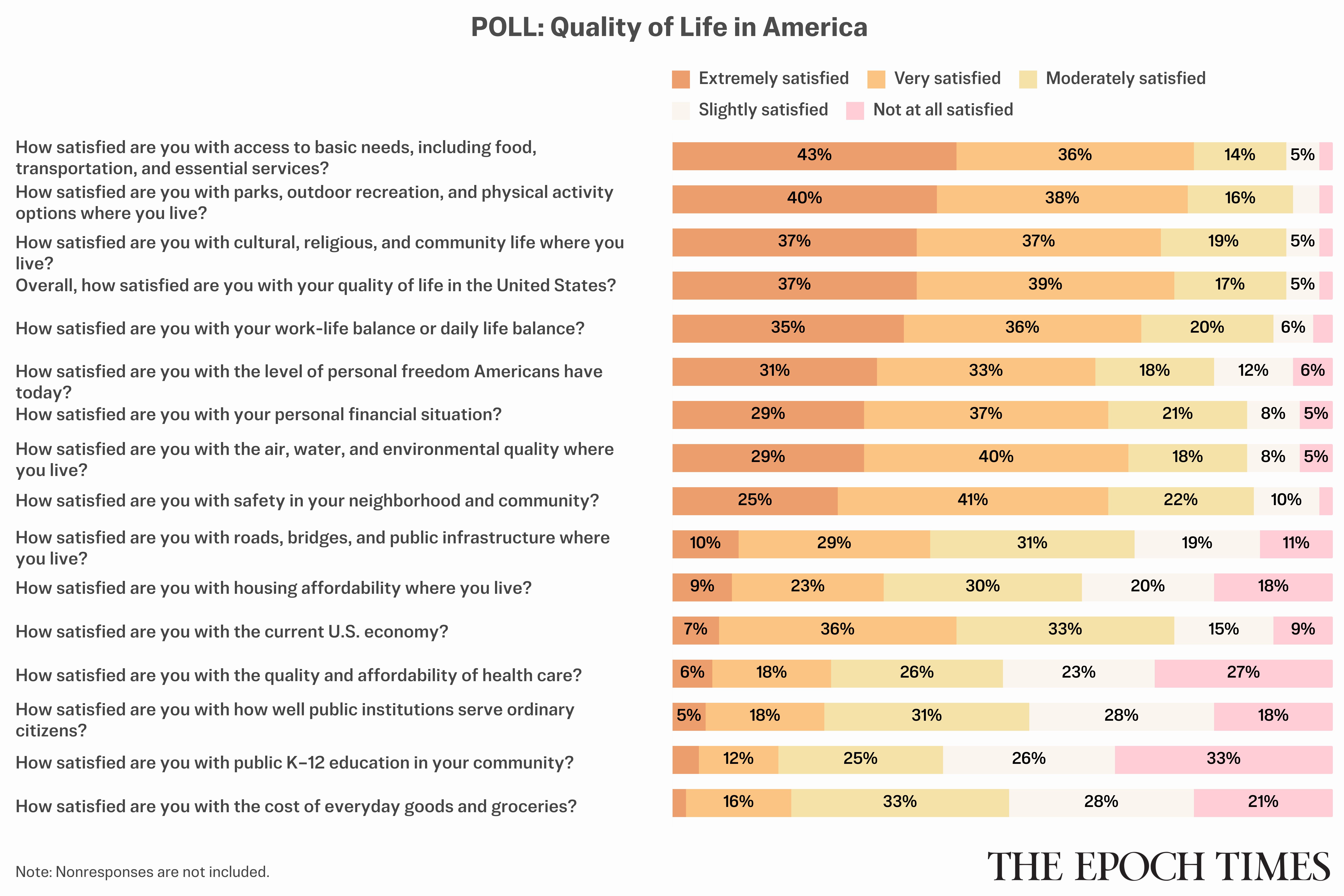
More than three-quarters of readers were at least very satisfied with their quality of life in the United States.
But 28 percent of those polled said quality of life at least somewhat declined compared with five years ago, and 35 percent said it stayed about the same. Thirty-seven percent said quality of life improved.
Notably, 65 percent of readers found it harder to achieve the American Dream compared with their parents’ generation. Only 14 percent said it was easier.
Affordability
The average American carried more than $105,000 in consumer debt, including mortgages, credit cards, student loans, and auto loans, according to Experian data as of September 2025.
Among survey respondents, less than half (43 percent) were at least very satisfied with the current U.S. economy.
Even fewer expressed contentment with the affordability of housing, health care, and groceries.
Roughly one-third of survey takers were at least very satisfied with housing affordability where they live. Eighteen percent were not satisfied at all.
More than one-quarter were not at all satisfied with the quality and affordability of health care.
Asked about the cost of everyday goods and groceries, 21 percent said they were not satisfied at all; just 18 percent of readers polled said they were at least very satisfied.
Daily Living Conditions
Readers expressed positive views on community life, including community essential services, activity options, and environmental quality. However, fewer felt content with public infrastructure, government services, and especially public education.
A majority of the sample group was at least very satisfied with access to basic needs (79 percent)—including food, transportation, and essential services—and activity hubs (78 percent)—such as parks, outdoor recreation, and physical activity options.
In terms of the air, water, and environmental quality, nearly 70 percent were at least very satisfied.
Nonetheless, fewer (39 percent) were at least very satisfied with roads, bridges, and public infrastructure where they live. But a majority (66 percent) felt at least very content with safety in their neighborhood and community.
Asked how well public institutions serve ordinary citizens, less than one-fourth said at least very satisfied; 18 percent said not satisfied at all.
One-third of readers polled said they were not at all satisfied with the public schools in their community.
“The more government involvement, the worse the average American life is. More family and Christian active involvement is essential for a robust country and economy,” a reader said.
Well-Being
Most of those polled reported that they were in a good state of well-being.
About two-thirds said they were at least very satisfied with their personal financial situation.
More than 70 percent of those surveyed said they were at least very satisfied with their work-life balance or daily life balance. Only 3 percent said they were not satisfied at all.
Asked about the greatest impact on happiness in life today, 40 percent of survey takers named faith, values, or a sense of purpose.
Nearly three-fourths of respondents were satisfied with cultural, religious, and community life where they live.
Another significant majority (64 percent) were at least very satisfied with the level of personal freedom Americans have today.
But when pressed on how optimistic they were about the future for America’s children, half of those surveyed felt pessimistic. Less than one quarter said optimistic.
The rise of socialism, the decline in individual rights, and the lack of demand for self-determination, coupled with the crippling debt, signaled “we’re in the twilight years of freedom,” a reader commented. “[That] diminishes my happiness.”