This copy is for your personal, non-commercial use only. Distribution and use of this material are governed by our Subscriber Agreement and by copyright law. For non-personal use or to order multiple copies, please contact The Epoch Times Reprints.
Two geese float on the Rideau Canal as buildings are obscured with haze from wildfires burning in Canada's prairie provinces, in Ottawa on June 6, 2025. The Canadian Press/Adrian Wyld
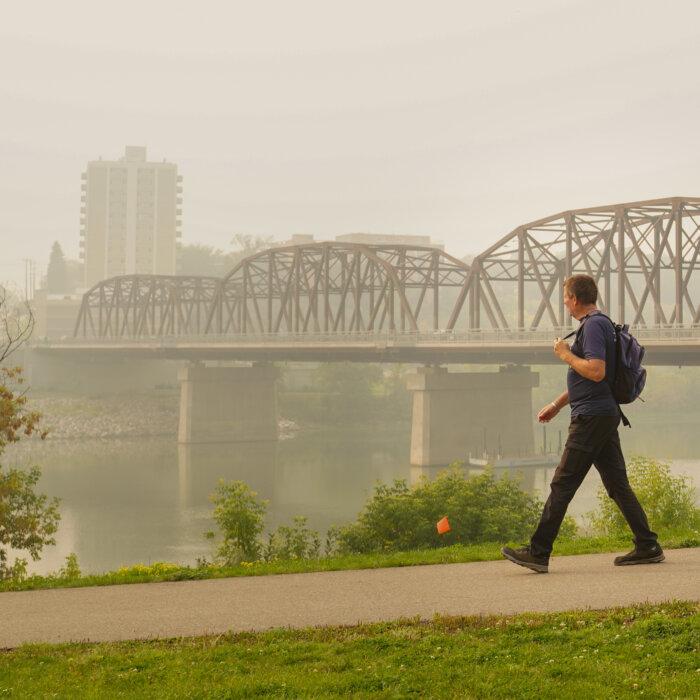
Several regions are experiencing “high risk” air quality levels due to smoke from the wildfires in the prairies.
Environment Canada issued an air quality statement for the Ottawa region on June 5, and expects the statement to last until the morning of June 8.
Downtown Ottawa’s Air Quality Health Index reached “high risk” at 8 p.m. on June 5 and remained there until 2 a.m. on June 7 before tapering off to “moderate risk” levels.
The agency on June 7 listed some cities including Toronto and Montreal as having a moderate to high risk.
While most of Ontario has been experiencing poor air quality due to wildfires in the prairie provinces, eastern Ontario experienced some of the worst air quality and visibility on June 6 with Kingston’s index at “high risk,” Cornwall’s at “high risk,” and Belleville’s at “very high risk.”
As of 4 p.m. on June 7, the index for Ottawa, Kingston, Cornwall, and Belleville had all decreased to “moderate risk” levels.
“As smoke levels increase, health risks increase,” Environment Canada said as of 11 a.m. in its special quality air statement. “Limit time outdoors. Consider reducing or rescheduling outdoor sports, activities and events.”
Eye, nose, and throat irritation, headaches, or a mild cough are among the mild and common symptoms Environment Canada said residents could experience. More serious symptoms include wheezing, chest pains, and severe cough, although these are less common.
“When the air quality is poor due to wildfire smoke, everyone is at risk as the fine particles in wildfire smoke affect individuals of all ages, regardless of their health,” the Eastern Ontario Health Unit said in a June 6 news release on the region’s poor air quality conditions.
However, both agencies say that health risks could be greater for those over the age of 65, pregnant women, infants, young children, people with existing illness or chronic health conditions, as well as those who work outdoors. These individuals are advised to reduce or reschedule outdoor activities.
Environment Canada suggests to keep windows and doors closed when possible and to use a ventilation system air filter or portable air cleaner that has the ability to filter fine particles.
“If you must spend time outdoors, a well-constructed, well-fitting and properly worn respirator type mask (such as a NIOSH-certified N95 or equivalent respirator) can reduce your exposure to the fine particles in the smoke,” the statement says.
Prairie Wildfires
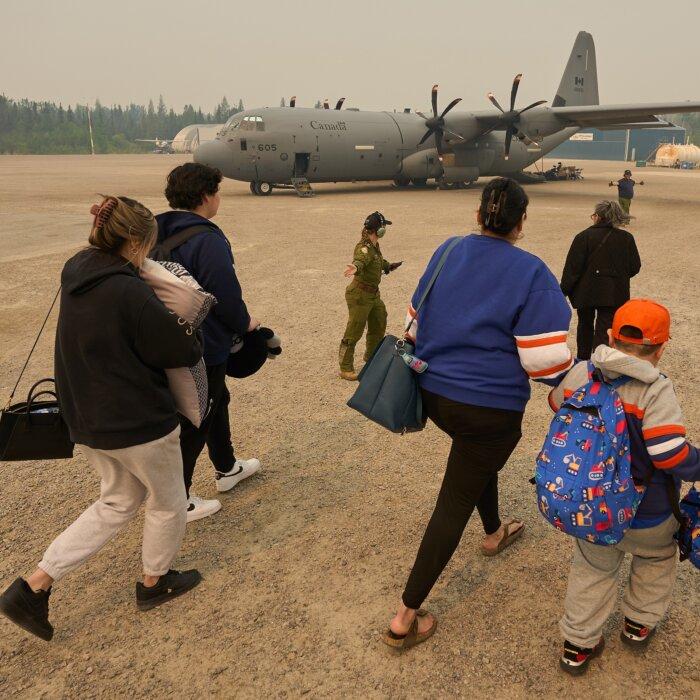
Manitoba and Saskatchewan each declared a province-wide state of emergency at the end of May due to wildfires. More than 30,000 residents have been evacuated as dozens of fires continue to blaze in the northern regions of both prairie provinces.
As of June 6, there were roughly 28 fires still burning in Manitoba, with 10 considered to be “out of control,” according to the province’s fire situation report. The province says there have been 114 fires to date this year, of which they say at least 102 were human caused.
The fires have covered over 789,000 acres of the province, and more than 17,000 Manitobans have been forced to leave their homes.
Meanwhile, in Saskatchewan there have been 254 wildfires to date with 24 active fires remaining as of June 7, according to the province’s public safety agency. Of the active fires, seven are classified as “not contained,” which indicates the fires are being suppressed but are expected to grow in size.
Evacuations in Saskatchewan have exceeded 15,000 as 19 evacuation orders have been issued, the agency says.
Jennifer Cowan and The Canadian Press contributed to this report.