There’s been a flurry of legislative activity in recent weeks with the Liberals tabling major bills that will impact how information is handled online.
Among the initiatives are the Liberals’ third attempt to pass online harms legislation and a bill to modernize Canada’s privacy regime. Both were introduced in recent days, with more substantive debate expected when Parliament returns in the fall.
Drawing particular attention this week, ahead of the House of Commons’ summer adjournment, is Bill C-22, known as the Lawful Access Act. The Liberal majority government is now moving quickly to expedite the legislation before Parliament breaks for the summer.


The Liberal government passed a motion this week to curtail committee review and debates on the bill, while accusing the Conservatives of delay tactics.
“We say, enough. It’s time for the House to pick a lane. Victims cannot wait any longer. Law enforcement needs these tools,” Public Safety Minister Gary Anandasangaree told reporters on June 16.
Tories have charged that more time needs to be spent on reviewing the consequential legislation amid significant pushback.
Part 1 of Bill C-22 would allow security agencies to obtain warrantless subscriber information from electronic service providers, a measure that has not been identified as a key concern from lawmakers and stakeholders. Tories support it and have called for this part of the bill to be split from Part 2.
Critics’ concerns are focused on Part 2 of the bill, which would require providers to retain user metadata for up to a year and potentially install systems enabling government access. Conservatives, tech firms, and civil liberties groups have all raised objections.
Anandasangaree said some of the concerns raised will be addressed through amendments in committee.
He said the bill will be amended to include protections for “encrypted communications” and a clear definition of “systemic vulnerability.” The current text of the bill says service providers will not be asked to introduce such a vulnerability when required by Ottawa to install systems giving access to security agencies.
Anandasangaree also said the metadata retention period would be changed, hinting it could be brought down to six months instead of a year.
Hate Crime Bill
While the focus this week is on Bill C-22, an older piece of legislation that went through a similar process was back in the Commons at the same time.The change added the “noose” to a list of prohibited symbols—alongside the Nazi swastika and others—when used to wilfully promote hatred against an identifiable group.
Bill C-9 is not specifically directed at the online space, but its adoption will impact what can be said or displayed on various platforms.
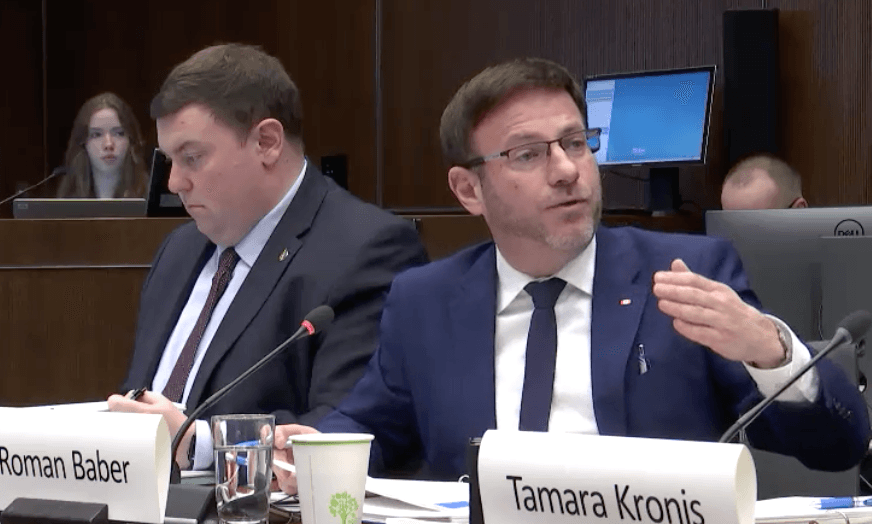
Tory MP Roman Baber spoke on C-9 during debates in the Commons on June 16 and called the simultaneous activity on different Liberal bills impacting the information space “one of the darkest weeks in the history of Canadian democracy.”
Online Harms and Privacy
Along with criticizing Bills C-9 and C-22, Baber noted the introduction last week of Bill C-34, the Safe Social Media Act, and of Bill C-36, the Protecting Privacy and Consumer Data Act.Bill C-34 proposes to ban youth under 16 from accessing social media, which critics say could require every social media user to provide identification to access these services.
Baber said that “of course” children need to be protected, but argued the ban will fail “unless we’re prepared to implement a Beijing-style authoritarian internet surveillance regime.”
Bill C-34 would also establish a Digital Safety Commission with wide-ranging powers over internet content and service providers.
“In the same week, which is the last week before the legislature rises, the Liberals are introducing so-called privacy legislation, which would eliminate the Privacy Commissioner in favour of their so-called digital safety czar, who would regulate, enforce and judge all at the same time,” Baber said.
“So much of our lives right now, especially our kids’ lives, have been shaped by platforms, apps, and digital services. We’re living in a different world, and our laws need to catch up,” he said.
Majority Government
The Liberals are expected to face few obstacles passing the bills after gaining a House majority through floor-crossing MPs.Previous attempts at passing online harms legislation failed in 2021 and 2025 due to the minority government calling a snap election or proroguing Parliament.
Other legislation impacting the online space was adopted under the Trudeau government, with consequences including Canadians not being able to see news on Meta platforms such as Facebook and Instagram, or broadcasting policies becoming irritants in trade negotiations with the United States.
The Online News Act, formerly Bill C-18, compels social media companies to share revenues with media organizations if they display news links. Meta stopped showing news links in response.
The Online Streaming Act, formerly Bill C-11, by way of regulations from the CRTC, compels online streamers to contribute to the production of Canadian and indigenous content. The broadcast regulator CRTC recently decided to triple the tax on streamers impacting U.S. giants like Netflix and Amazon.